DbcultAccessing Vault...
Cult Review
Senior Film Conservator
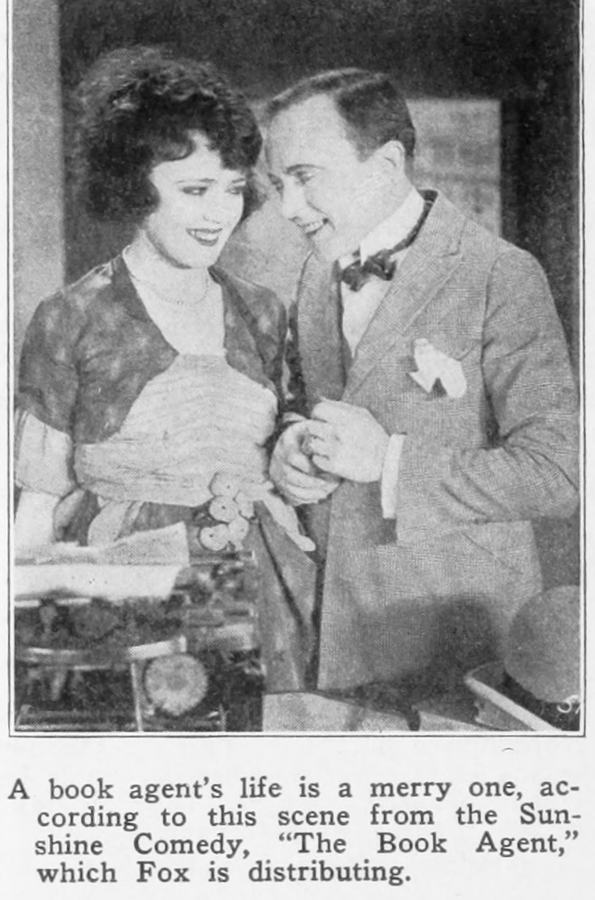
The Book Agent arrives like a confetti storm of contradictions: a comedy whose central prop is a book nobody wants, a romance whose stakes are measured in unsold pages, a 1921 one-reeler that feels eerily predictive of every future hustle culture meme. Director-writer Claire Sedgwick, moonlighting behind the camera while playing the coveted daughter, stages the entire fable inside a world where patriarchal pride is bound in morocco and stitched with hubris. Father—never named, only gestured at with the imperial gravity of a deus ex libris—has poured his retirement fund into printing a philosophical magnum opus that the universe greets with cosmic indifference. His counter-move: offload the albatross onto the shoulders of any aspirant son-in-law. The dowry is not land, not gold, but dead stock.
Enter Al St. John’s jittery suitor, equal parts Buster Keaton marble-face and Harold Lloyd gumption, saddled with a task that would make even a modern-day influencer blush. His mission: liquidate every last copy before the wedding bells toll. The film’s visual lexicon is built on the arithmetic of rejection—each slammed door a percussive punchline, each polite decline a miniature tragedy. St. John’s limbs elongate and retract like sprung window shades, a human accordion negotiating the tight corridors of American domesticity. In one brisk montage he peddles the opus to a barber who prefers pulp westerns, a flapper who wants fashion plates, and a blind bibliophile who can’t read Braille. The gag is ancient yet renewable: art foisted upon the unwilling becomes a Rorschach of cultural mismatch.
Meanwhile the father, played with whiskered pomposity by an uncredited veteran of the stage, stalks the parlor like a self-appointed Cotton Mather. His spectacles flash white when he tallies returned inventory, each unsold volume a dagger in the patriarchal heart. Sedgwick’s script grants him no redemption arc; his comeuppance is baked into the premise. Yet the performance teases out a strain of melancholy: the terror of irrelevance couched in bibliophilic leather. One almost pities the old tyrant when he hugs the remaining crate of books like a life raft, unaware the ship itself is made of paper and already taking water.
As daughter Mary, Sedgwick pirouettes between corseted obedience and modern flint. She is both prize and provocateur, slipping her beloved tipsy customers’ addresses and staging accidental run-ins that double as sales pitches. Watch her eyes in the ice-cream parlor sequence: they dart from the hero’s nervous brow to the clock, calculating love’s ledger in real time. The performance is silent yet loquacious, a masterclass in micro-gesture that rivals The Face in the Dark for nuanced femininity under duress.
What makes The Book Agent more than a quaint curio is its prescient diagnosis of cultural capitalism. The film intuits that in a society where everything is convertible to currency, even language becomes a commodity whose value is dictated by market appetite. Father’s text—rumored to be a muddled pastiche of Swedenborg and home-brewed Prohibition politics—never needed readers; it needed buyers. The gag lands harder a century later, when SEO algorithms, not literary merit, decide which volumes languish in the remainders abyss.
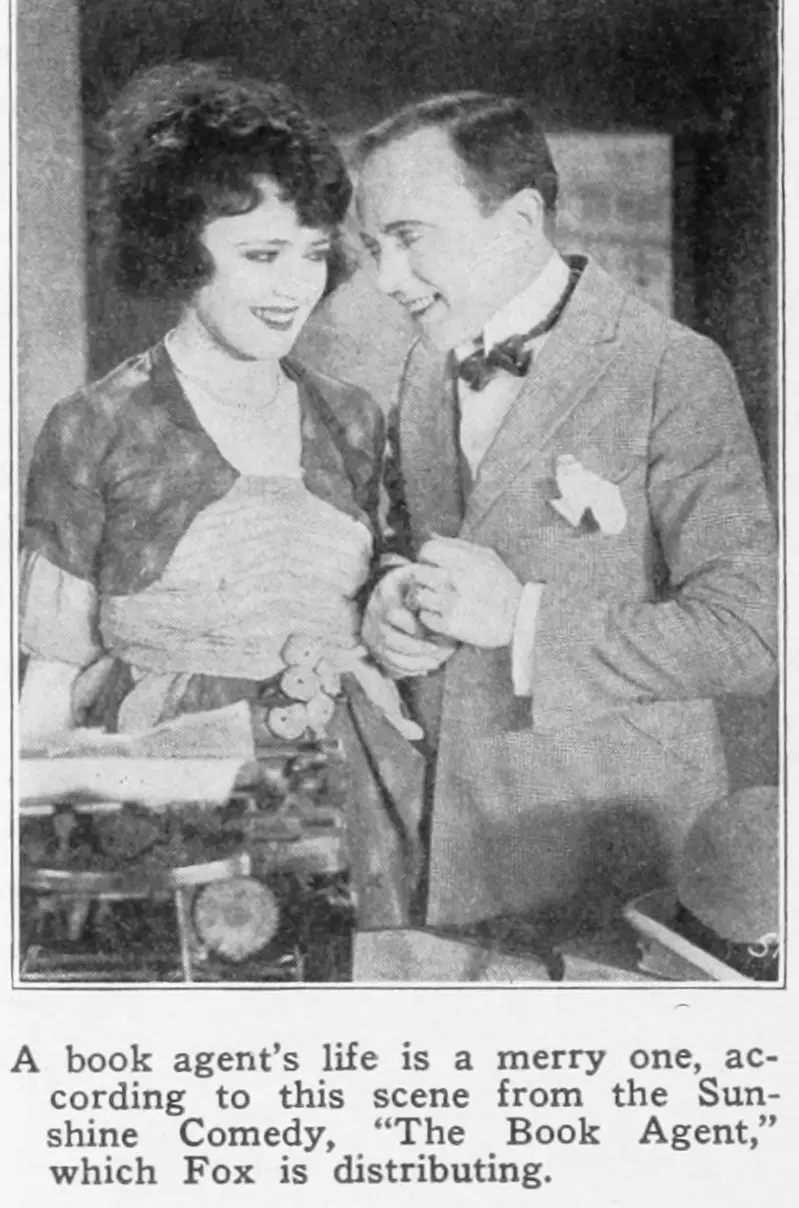
“To write is human, to sell divine,” the intertitle snarks, anticipating every LinkedIn hustle-guru who ever hawked a webinar on passive income.
The picture’s pacing mirrors the staccato of door-to-door desperation: brisk exterior gag, interior emotional beat, repeat. Yet within that formula Sedgwick finds pockets of lyrical respite. A moonlit sequence in a public library—shot on a set so spare it suggests a cathedral—lets the couple share a single volume of Shelley, pages fluttering like moths. For thirty velvet seconds art is untainted by transaction, until a night watchman ejects them for trespass. The moment is fleeting, but it stains the retina like an after-image of impossible purity.
Cinematographer John W. Brown, later famed for maritime documentaries, frames each rejection as a mini-portrait of American spaces: the claustrophobic hallway papered with Victorian cabbage roses, the grocery backroom cramped by towers of canned peas, the train depot where locomotive steam erases the hero’s pitch even as it leaves his mouth. The camera rarely moves; instead, the world shrinks around St. John’s angular silhouette, a visual metaphor for the contracting options of the penniless dreamer.
Though released during the twilight of the silent era, the picture is sonically aware. Intertitles mimic advertising jargon (“It’s Brain Food! Ask for it anywhere!”) and rhythmic alliteration that begs to be read aloud. Contemporary exhibitors reported audiences chanting the father’s absurd tagline back at the screen, turning the theater into call-and-response vaudeville. That communal babel feels closer to today’s meme culture than to the reverent hush of modern arthouses.
Set The Book Agent beside Roman Romeos and you gauge the era’s tonal spectrum: where the latter ladles operatic excess onto a tale of Italian swains, Sedgwick’s film opts for nickelodeon snap. Stack it against The Inspirations of Harry Larrabee and you see two converse approaches to authorship: Harry waxes rhapsodic over the creative act, while Book Agent lampoons what happens when the act meets the marketplace. The closest spiritual cousin may be You’ll Be S’prised, another compact farce where romantic eligibility hinges on an absurd task. Yet where S’prised leans on mistaken identities, Book Agent weaponizes the very texture of modern life: commerce, publicity, the death of the unread.
Sedgwick the writer refuses to let Mary be a mere McGuffin. Mid-film, she launches her own covert marketing scheme, convincing a women’s club that the father’s treatise reveals hidden matriarchal codes. The ensuing purchase order is the largest single sale in the narrative, and it comes from female solidarity—or perhaps from the pleasure of exploiting the exploiters. The sequence plays as breezy slapstick, yet it anticipates feminist economic agency in a way that makes Her Great Match feel retrograde by comparison.
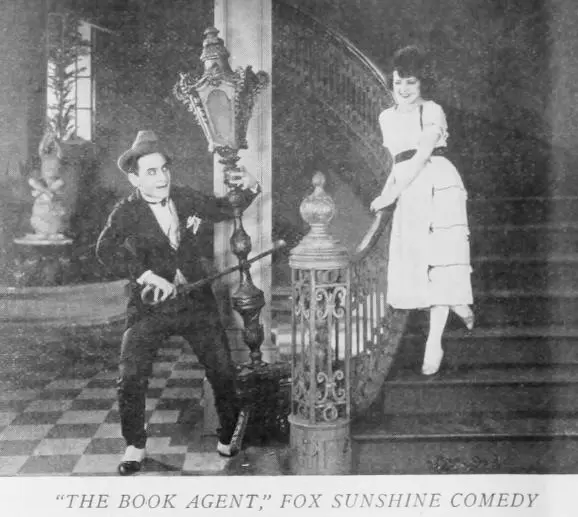
Inevitably, the last copy is bartered for a marriage license fee, and the father, confronted with an empty crate, collapses into an apoplectic heap. But Sedgwick withholds contempt; she closes on a tableau of the newlyweds boarding a streetcar, the worthless book repurposed as a seat booster for a toddler. Art is devoured, literally sat upon, by the next generation—an exquisite, unsentimental shrug that says everything about the lifespan of cultural capital.
For decades The Book Agent survived only in a 9.5 mm Pathé fragment stored in a Rouen basement. A 2018 4K restoration by EYE Filmmuseum salvaged 85% of the runtime, tinting matched to contemporary Dutch exhibition notes. The digital presentation reveals textures previously smothered in duped grain: the father’s pince-nez catching lamplight like a malevolent wink, the tiny price sticker on the book migrating from 50¢ to 10¢ to 3¢, a meta-graphic of depreciation. Festival audiences, weaned on post-modern cringe comedy, greet each humiliation with belly laughs that shake the velvet seats. In Rotterdam a sell-out crowd clapped the instant the hero slaps a remainder sticker on the father’s forehead—a beat that, according to preservation notes, originally prompted gasps in 1921. Morals evolve; humiliation comedy is timeless.
We dwell inside an attention economy where content glut dwarfs even the father’s print run. The Book Agent whispers that every hustle has a human face, every unloved artifact a dreamer who once mistook indulgence for legacy. To watch St. John sprint down a cobbled alley, armful of books no one ordered, is to recognize the ghost of your own unread emails, your own unliked posts, your own Kickstarter languishing at 12%. The picture is a 65-minute mirror aimed at anyone who ever conflated production with validation.
Pay attention to the match-cut bridging the second and third reels: a close-up of a rejected book slamming shut smash-cuts to a train compartment door flung open by the hero’s prospective buyer. The graphic continuity—rectangular form, central axis—compresses miles of geography into an ideological collision. It’s Eisenstein before Eisenstein, executed not for revolutionary fervor but for a cheap laugh. That is silent era ingenuity at its apex: ideology smuggled inside pratfall.
Does the film surpass the cosmic melancholy of Madame Butterfly or the epic sweep of Tabaré? No, and it never tries. Its triumph is microcosmic: it distills the entire tension between art and commerce into a brisk, gag-driven courtship. It is the rare artifact that satirizes authorship without ridiculing the written word itself, that lampoons patriarchal vanity while leaving space for generational grace. Watch it to recalibrate your metrics of success; watch it to witness Claire Sedgwick wink at you across a century, whispering that some books—and some loves—sell themselves in ways no ledger can capture.
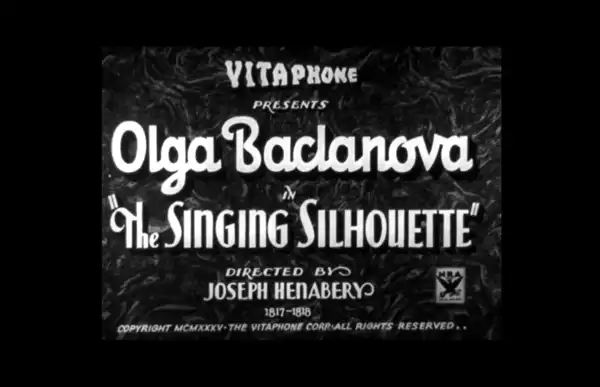
IMDb —
1935
Community
Log in to comment.