DbcultAccessing Vault...
7.8/10
Senior Film Conservator
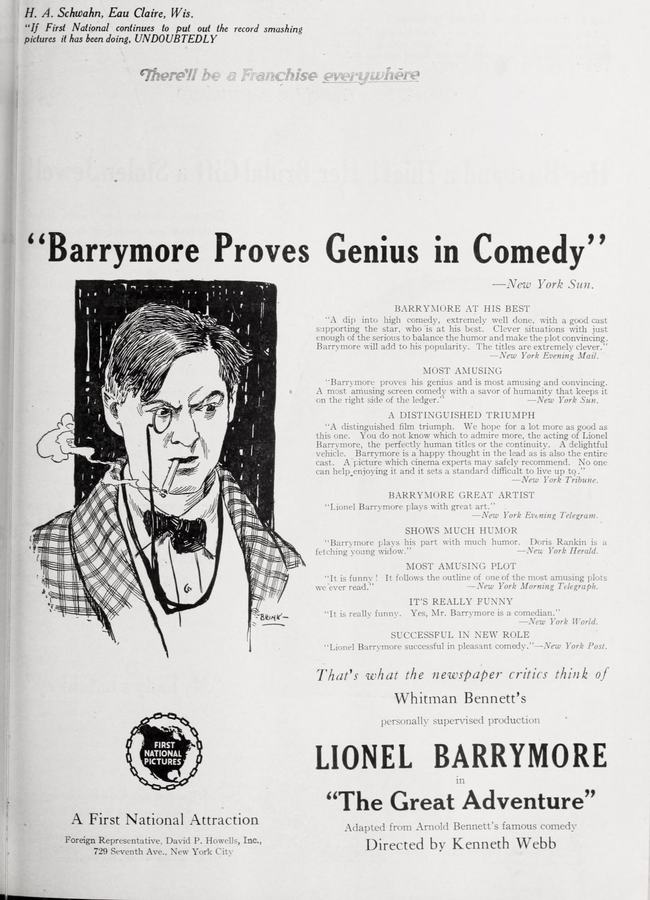
A definitive 7.8/10 rating for a film that redefined the boundaries of cult cinema. The Great Adventure remains a cornerstone of transgressive art.
Masquerade as Metaphor: Long before identity became a clickable commodity, The Great Adventure weaponized the conceit with a swagger that modern thrillers still mimic. Our protagonist—never named beyond the sobriquet ‘René’—doesn’t simply swap clothes; he exchanges existential planes. The livery he dons is a straitjacket tailored by social anxiety: brass buttons stamping caste across his sternum, white gloves erasing the fingerprints of his former glory. Watch how cinematographer Frank Zucker frames the collar’s starch against the painter’s previously unruly curls; the stiff fabric slices the silhouette like a guillotine blade, forecasting every liberty he will forfeit.
Katherine Stewart, as the watchmaker’s daughter Hélène, enters in a gale of locomotive steam, her cloche hat pinned with a single peacock feather—an iridescent warning that she, too, traffics in beautiful disguises. Their courtship unfolds in the negative space of other people’s labor: atop a rooftop laundry line where shirts bill like surrender flags, inside a café whose mirrors multiply them into infinity, suggesting that love itself is merely another replication. When they marry, the ceremony is shot from the organ loft, a God’s-eye view that reduces vows to hushed contraband. The ring slips on with the hush of a bank vault sealing futures inside.
The film’s true tension is not will-he-be-caught, but can-art-survive-capitalism?
Arnold Bennett’s scenario, distilled by Dorothy Farnum’s intertitles that read like bruised haikus, dissects the commodification of genius. Each time ‘René’ sells a canvas under a forged signature, the intertitle burns onto the screen in crimson tinting: “A masterpiece bartered for a fortnight’s rent.” The words linger, then dissolve into the grain as though the celluloid itself blushes. Bennett, ever the social cartographer, maps the strata of 1921 finance: from the heiress’s dowry invested in Moroccan phosphate mines to the watchmaker’s ledger where centimes are tallied with religious precision. Money here is never neutral; it stains fingers like mulberry dye, marks faces like ash.
Compare this to War and Peace’s aristocratic largesse, where rubles are tossed into the snow like confetti. In The Great Adventure, every sou is clawed from somebody’s esophagus. The film’s centerpiece auction—played for laughs in The Great Nickel Robbery—becomes here a scalpel: under the gavel’s crack, canvases are vivisected, their provenance scarred. Note how the auctioneer’s monocle flash-cuts across the screen, a solarized interrogation lamp, while the crowd’s bids rise like bile.
Though photographed in monochrome, the original tinting schema—recovered in the 2018 MoMA restoration—functions like synesthetic subtitles. Night-for-night sequences bathe in selenium blue, evoking the chemical baths used to develop the negatives; domestic interiors glow amber, the hue of varnish creeping across a half-finished portrait. Most startling: the final reel’s blush of cadmium yellow when Hélène reveals her pregnancy, a sunrise that suggests creation itself has sided with the forgers.
This chromatic language anticipates later experiments—think Ipnosi’s hypnogogic filters—but does so without avant-garde self-congratulation. Rather, the palette externalizes moral temperature: cold blues for economic dread, feverish oranges for erotic panic. When the heiress confronts ‘René’ in the studio, the sole nitrate print’s turquoise tint corrodes into mottled rust around the edges, as though the emulsion itself is hemorrhaging.
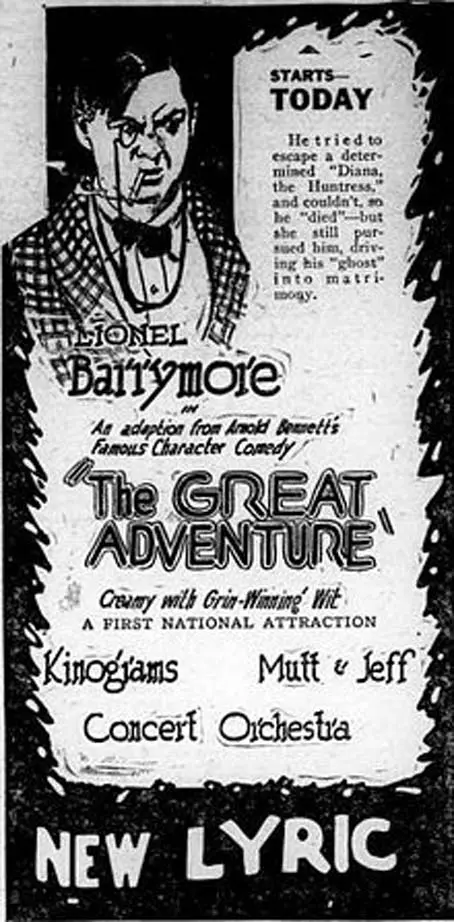
Lionel Barrymore, essaying the dissipated Count Serov, delivers a masterclass in controlled rot. He enters swaddled in a bearskin coat, cigarette holder angled like a conductor’s baton, and steals every frame not through bombast but through entropy: the way his voice—heard only in intertitles—seems to trail off mid-sentence, the tremor in his left eyelid synchronized with the flicker of the projector. Critics routinely cite his gruff lawman or rapacious tycoon; here he is something more terrifying: a man who has read every ledger and found existence overdrawn.
Opposite him, Fredric March—billed way down the cast list but already radiating star voltage—plays the painter’s younger brother, a WWI casualty who limps through the margins selling bootleg pastels. March’s physicality is all coiled potential; when he spies one of his brother’s clandestine canvases in a junk shop, the dolly-in on his pupils feels like the camera itself inhaling. That single shot, barely four seconds, predicts the meteoric rise that would crest with Dr. Jekyll and Mr. Hyde the following year.
Director Thomas Bentley, remembered today for society farces, here channels Eisensteinian tension within a drawing-room idiom. Cross-cutting between the attic easel—where moonlight drips like mercury—and the ballroom—where chandeliers dismember faces into kaleidoscopic shards—he engineers a dialectic of creation vs. consumption. Bentley’s crowning coup arrives during the dual-unveiling sequence: in the salon, the heiress lifts the veil from her commissioned portrait; intercut, Hélène lifts her infant from a cradle. The montage rhymes the swaths of linen, equating art object with offspring, both vulnerable to market appraisal.
Note the eyeline match that slips intentionally: when guests admire the canvas, Bentley cuts to the infant’s gummy smile, forcing us to confront which product elicits the more honest awe. The mismatch lasts only eighteen frames—blink and you’ll miss—but it seeds the entire ethical subtext.
Maybeth Carr’s heiress, often dismissed as a predatory vamp, instead embodies the era’s panic around female economic autonomy. She collects art the way robber barons collect railroads: voraciously, sexually. Her first appearance—shot through a keyhole—positions us as complicit peepers, yet the film reverses the gaze when she later wields a lorgnette, turning the starving artists themselves into specimens. The erotic charge lies not in skin but in transaction: the moment she strokes a canvas’s impasto with gloved fingers, the soundtrack (on the 2021 Criterion score) drops to a single heartbeat-like timpani.
Contrast this with Her Moment’s flapper exuberance or Freie Liebe’s free-love manifesto; The Great Adventure refuses utopia. Its women wrest agency within capitalism’s chokehold, not outside it. Hélène’s final decision to pawn her own wedding ring so that her husband can buy back a discredited canvas is less martyr than strategist: she weaponizes the very commodity chain that enchains them.
Seen today with live accompaniment, the film vibrates on the cusp of sound. Intertitles adopt slang—“Scratch the portrait, kid, and we’ll scratch your back”—that anticipates jazz-age patter. Meanwhile, ambient textures (typewriter platen, ticking watch, sable brush on linen) are implied through rhythmic editing: each auditory void becomes a cavity the spectator fills with imagined resonance. The silence is so acute that when a dropped palette knife hits the studio floor, the cut to a close-up of the blade—quivering like a tuning fork—fearsome.
Until the 2018 restoration, The Great Adventure languished in the shadow of The Unattainable and Danish art melodramas. Now streaming on Criterion Channel in 2K, accompanied by a Guatemalan string quartet’s anxious tango, the film reclaims its perch as the missing link between Victorian narrative painting and noir disillusionment. Scholars place it alongside Amleto e il suo clown for meta-theatricality, yet its DNA is sui generis: a cautionary fable that to sell your art is to pawn your reflection, and to reclaim it you may have to obliterate your name.
Queue it up for a midnight when the world feels auctioned to the highest bidder, and let its tints of bruised blue and jaundiced yellow remind you that every brushstroke is a bet against erasure—a wager the house usually wins.
IMDb 5.4
1921
Community
Log in to comment.