DbcultAccessing Vault...
Cult Review
Senior Film Conservator
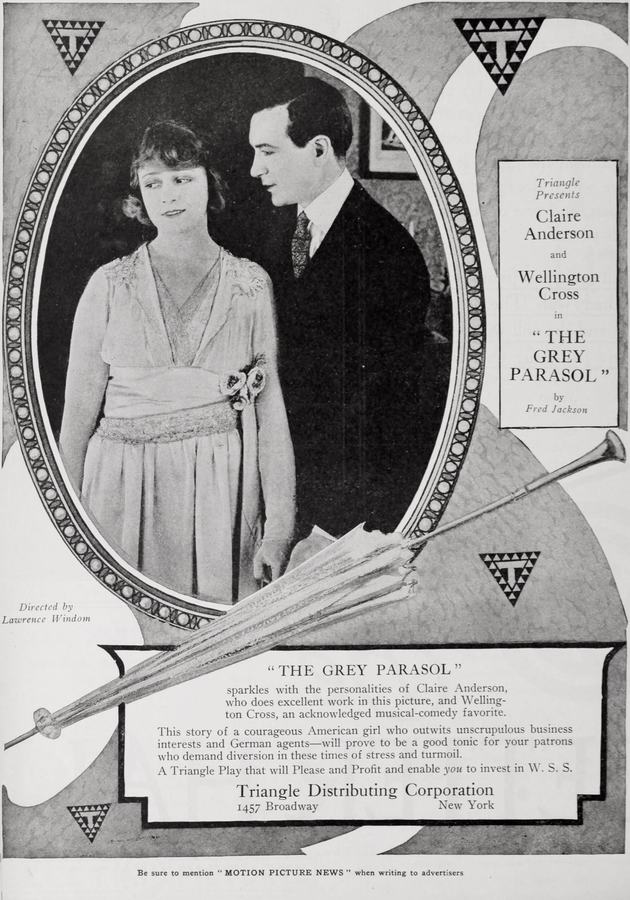
The Grey Parasol opens with a deceptively mundane setting: a rain-soaked umbrella shop where Hamilton Hill, a young man of bourgeois sensibilities, encounters Estelle Redding. Their meeting, initially a brief exchange, escalates when Estelle is accosted by Edward Burnham and an accomplice. The parasol, a grey, unassuming accessory, becomes the MacGuffin of this silent-era thriller. Estelle’s revelation that it contains the formula for Coalex—a coal alternative threatening to destabilize the monopolies of the day—elevates the stakes from personal protection to industrial warfare. The film’s tension hinges on the paradox of the parasol: a fragile object housing a weapon of economic disruption. As Hamilton becomes her reluctant ally, their dynamic shifts from chance to complicity, framed by the era’s anxieties about technological progress and foreign influence.
Frederick J. Jackson and Charles J. Wilson’s screenplay layers the personal with the political. The coal trust’s desperation to suppress Coalex mirrors the real-world anxieties of the 1920s, where energy monopolies were both literal and symbolic targets. The film’s portrayal of Estelle as a woman inventing in a male-dominated field is quietly radical, positioning her as a double agent in two senses: against the coal barons and against the gendered constraints of her time. Her brother Edward, a thug with a hidden agenda, embodies the moral ambiguity of the era. The German agents, posing as U.S. officials, evoke the post-WWI paranoia that lingered in American cinema, a theme later amplified in works like *My Four Years in Germany*. The parasol itself, a symbol of feminine grace, becomes a subversion of industrial masculinity—proving that innovation can emerge from the margins.
Claire Anderson’s Estelle Redding is a masterclass in silent film acting. Her eyes, framed by the parasol’s shadow, convey a spectrum of emotions: fear when confronted by Burnham, calculation during negotiations, and resolve when devising her final ploy. Frank Thorne’s Hamilton Hill is the antithesis—his expressions oscillate between infatuation and determination, his physicality shifting from awkward gallantry to decisive heroism. Ed Brady and William Quinn’s antagonists add texture: Brady’s Burnham is a brooding figure whose redemption arc is telegraphed through subtle shifts in posture, while Quinn’s Edward is a caricature of menace, his angular features exaggerating his villainy. The ensemble, including Joseph Bennett as a bureaucratic official and Wellington Cross as a beleaguered scientist, grounds the film in a world where every character is both a participant and a pawn.
The film’s visual grammar is as meticulous as its plot. The umbrella repair shop, with its cluttered shelves of broken canopies, is a metaphor for the industrial age—fragile, fractured, yet teeming with potential. Close-ups of the parasol’s handle, intermittently shown in tight shots, create a Hitchcockian suspense that predates the master of suspense himself. A key sequence—the parasol’s theft by Burnham—is staged with a claustrophobic intensity, the camera circling the pair as the formula is extracted in a single, unbroken take. The use of chiaroscuro lighting, particularly during the climax in the government office, contrasts the moral binaries of the story: light as transparency, shadow as corruption. These techniques echo the stylistic innovations of *The Scarlet Car* and *The Field of Honor*, though *The Grey Parasol* distinguishes itself with its focus on domestic objects as sites of conflict.
Though often overshadowed by its contemporaries in the adventure genre, *The Grey Parasol* laid groundwork for narratives that intertwine technology with personal stakes. Its premise—a portable, hidden formula—resonates in later works like *Temblor de 1911 en México*, where seismic events threaten to expose buried secrets. The romantic subplot, while conventional, avoids saccharine resolution, instead aligning Estelle and Hamilton’s union with the triumph of Coalex. This union of love and labor reflects the Progressive Era’s ideals, making the film a curious artifact of its time. Comparisons to *Under the Crescent* or *Children of the Stage* highlight its unique focus on engineering as a romantic pursuit, whereas *The Conspiracy* and *Den farlige Haand* lean more heavily into espionage tropes without the human element.
The film’s pacing, brisk yet deliberate, ensures that each revelation feels earned. The editing—particularly during the chase sequences where the parasol is passed between hands—is crisp, though some transitions between scenes (e.g., from the shop to Burnham’s lair) feel abrupt. The score, a mix of somber strings and percussive motifs, amplifies the tension without overpowering the visual storytelling. However, the film’s reliance on intertitles for exposition occasionally slows momentum, a flaw shared by many of its peers. Despite this, the dialogue-free performances maintain a gripping immediacy, especially in the final act where Estelle’s triumph is communicated through a series of triumphant glances and a raised parasol.
*The Grey Parasol* endures not merely as a relic of silent cinema but as a testament to the era’s inventive spirit. Its blend of technical curiosity, romantic idealism, and political commentary offers a microcosm of early 20th-century anxieties and aspirations. While modern audiences may find its moral binaries stark, the film’s ingenuity in repurposing everyday objects as tools of revolution remains striking. In an age where climate change and energy monopolies dominate discourse, the parasol’s dual role as both ornament and weapon feels oddly prescient. For lovers of cinema history, *The Grey Parasol* is a must-watch—a film where the smallest object can upend the world.
IMDb 6.4
1934
Community
Log in to comment.