DbcultAccessing Vault...
Cult Review
Senior Film Conservator
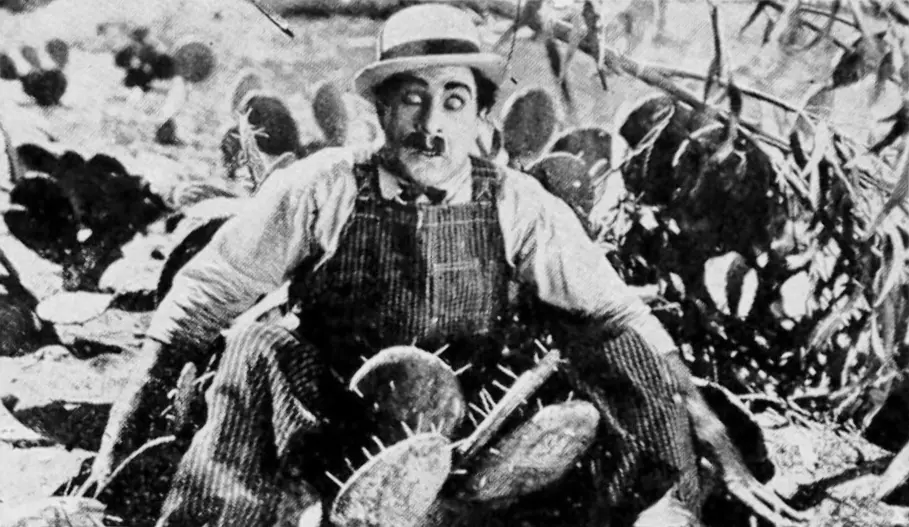
To watch The Hayseed (1923) in the modern era is to witness a fascinating specimen of primordial cinematic comedy. While the 1920s are often remembered for the refined pathos of Chaplin or the architectural precision of Keaton, Jimmy Aubrey represents a different, perhaps more visceral, lineage of the silent screen. This film, a frantic short that distills the essence of the 'rube' archetype, is a relentless engine of slapstick that prioritizes immediate physical impact over narrative complexity. Unlike the high-society dramas of the same year, such as The Way of the World, Aubrey’s work stays firmly rooted in the muck and toil of the proletariat, finding humor in the very struggle for survival and professional competence.
The premise is deceptively simple: a farmhand whose very presence is an affront to the laws of physics and the patience of his employer. However, the execution reveals a sophisticated understanding of spatial comedy. Aubrey, who cut his teeth in the Fred Karno troupe alongside the greats, possesses a body language that is both fluid and jarringly erratic. In The Hayseed, every bucket, pitchfork, and livestock animal becomes a potential weapon of mass irritation. The film’s pacing is breathlessly percussive; there is no room for the lingering melancholy one might find in The House of Mirth. Instead, the narrative is structured as a series of escalating vignettes, each one testing the structural integrity of the farm and the sanity of the owner.
Consider the way Aubrey interacts with the environment. He does not merely fail at his tasks; he fails with a specific, rhythmic cadence that suggests a man out of sync with the industrializing world. While other 1923 releases like The Great Air Robbery looked toward the skies and the future of technology, The Hayseed is content to find its universe within the boundaries of a fence line. It is a microcosm of chaos where the tools of civilization—rakes, plows, and harnesses—revert to their primitive, uncooperative states under Aubrey’s touch.
When we place The Hayseed alongside its contemporaries, its unique flavor becomes even more apparent. It lacks the moralizing weight of The Final Judgment or the brooding intensity of The Darkest Hour (1923). There is a purity to its absurdity that feels almost avant-garde in retrospect. While I'll Get Him Yet leans into the romantic comedy tropes of the era, Aubrey’s film is almost entirely devoid of sentiment. Even the presence of Phyllis Byrne and Ena Gregory serves more as a grounding element for the madness rather than a pivot for a traditional love story. They are the witnesses to the cyclone that is Jimmy Aubrey.
Furthermore, the film’s visual style, though constrained by the technical limits of the time, utilizes the outdoor setting to create a sense of sprawling unpredictability. Unlike the controlled, often claustrophobic interiors of Two Men and a Woman, the farm in The Hayseed feels like a living, breathing entity that is actively conspiring against the protagonist. The sunlight is harsh, the shadows are deep, and the dirt is real. This tactile quality adds a layer of grit to the comedy that is often missing from more polished studio productions like The Girl of the Golden West (1923).
Jimmy Aubrey’s screen persona in this film is an intriguing subversion of the typical 1920s lead. He is not the dashing hero of Kildare of Storm, nor is he the tragic figure found in Les cinq gentlemen maudits. He is a man of pure impulse and zero foresight. This lack of interiority is precisely what makes the comedy work; we are not asked to empathize with Jimmy, but rather to observe him as one would observe a natural disaster. His mishaps are not the result of malice, but of a fundamental disconnect between his intentions and his motor skills.
This 'anti-heroism' is a recurring theme in the 'hayseed' subgenre, but Aubrey pushes it to its logical extreme. Where a film like Wild Oats might explore the social consequences of rural naivety, The Hayseed focuses entirely on the physical consequences. When Jimmy drops a crate or startles a horse, the impact is felt not just by the characters, but by the viewer. The editing, sharp and surprisingly modern for 1923, emphasizes the 'crunch' of every collision. It is a cinema of impact, a precursor to the more aggressive slapstick that would define the later sound era.
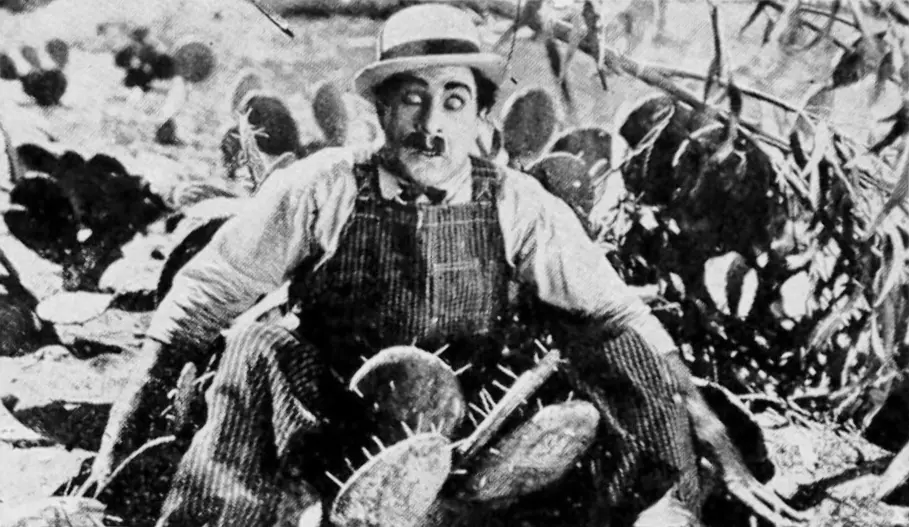
Technically, the film is a testament to the efficiency of the short-form comedy. Without the luxury of dialogue, the burden of storytelling falls entirely on the visual composition and the actors' expressions. The cinematographer captures the chaos with a steady hand, often using wide shots to allow the full scope of Aubrey’s physical movements to be appreciated. This is a stark contrast to the more experimental framing seen in European imports of the time or even the domestic mystery Fear Not. In The Hayseed, the camera is an objective observer, a silent judge of the farmhand’s unending blunders.
The use of intertitles is sparse, which is a credit to the film’s visual clarity. One does not need text to understand the mounting frustration of the farm owner or the oblivious cheerfulness of Jimmy. This universality is what allowed such films to travel across borders, finding audiences in places like Hungary, where Házasodik az uram was captivating local viewers. The language of a man falling into a trough is, after all, the same in every tongue.
Beyond the laughs, The Hayseed offers a glimpse into the American psyche of the early 20th century. The 'hayseed' character was a staple of the Vaudeville stage, a caricature of the rural citizen that urban audiences loved to mock. However, there is an underlying tension in these films. As the United States moved further away from its agrarian roots, films like this and A Self-Made Widow served as both a parody of and a nostalgic nod to the 'simpler' life. Jimmy Aubrey’s farmhand is a figure of ridicule, yes, but he is also a figure of incredible resilience. No matter how many times he fails, no matter how many times he is berated, he continues. There is a strange, almost mythic quality to his persistence.
The film also touches on the class dynamics of the farm. The owner, perpetually stressed and burdened by the need for productivity, represents the burgeoning capitalist drive of the era. Jimmy, meanwhile, represents the 'uncontrollable' element—the human factor that refuses to be quantified or optimized. In this sense, the film is a comedic cousin to the more serious examinations of labor and societal expectation found in The Magic Note. While Jimmy isn't trying to make a political statement, his very existence is a disruption of the 'efficient' farm system.
Ultimately, The Hayseed (1923) is more than just a collection of pratfalls. It is a vibrant, loud (in its own silent way), and unapologetic piece of entertainment that has managed to survive a century of cinematic evolution. Jimmy Aubrey may not have the name recognition of a Buster Keaton, but his contribution to the grammar of physical comedy is undeniable. He understood that the funniest thing in the world is not a man succeeding against the odds, but a man failing with spectacular, unbridled enthusiasm.
For the modern cinephile, watching this film is an exercise in historical empathy. We are looking through a window into a world that was just beginning to understand the power of the moving image to reflect and distort reality. It is a world of mud, of manual labor, and of the eternal struggle between a man and his pitchfork. In the grand tapestry of 1923 cinema, alongside the dramas and the burgeoning epics, The Hayseed stands as a reminder that sometimes, the most profound thing a film can do is make us laugh at the sheer, beautiful absurdity of being alive and being utterly, hopelessly incompetent.
As we look back at the filmography of the era, from the mystery of Fear Not to the romantic entanglements of I'll Get Him Yet, Jimmy Aubrey’s chaotic farmhand remains a singular, jester-like figure. He is the ghost in the agricultural machine, the wrench in the gears of progress, and a testament to the enduring power of a well-timed stumble. To ignore The Hayseed is to ignore a vital branch of the comedic tree, one that grew in the dirt and reached for the stars with a clumsy, mud-covered hand.
IMDb 5.9
1932
Community
Log in to comment.