DbcultAccessing Vault...
Cult Review
Senior Film Conservator
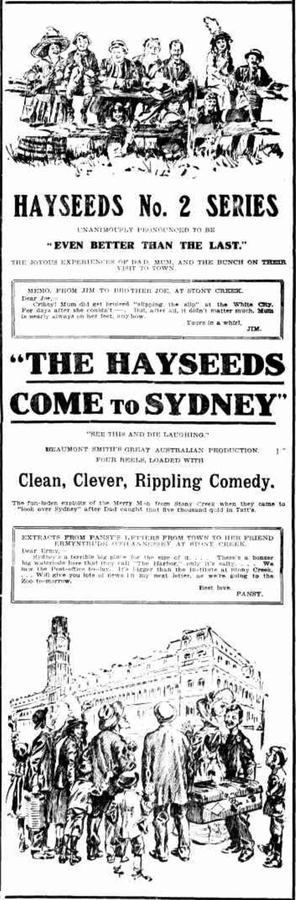
Somewhere between the last cough of a kerosene lantern and the first blare of a saxophone, Australian cinema discovered that its national joke was already wearing moleskins and a squint against the sun. The Hayseeds Come to Sydney—rescued from nitrate oblivion by a Canberra vault and a Kickstarter that smelled of eucalyptus and desperation—doesn’t merely replay the old gag about country mice loose in the marble maze; it detonates the gag, scattering shrapnel of hayseed innocence and metropolitan cynicism so far that even the Harbour Bridge, still half-built in 1927, seems to flinch.
The plot, if you insist on scaffolding, is a three-movement symphony of cultural whiplash. We open on a drought-bitten dairy farm where the milk has turned to chalk and the rooster coughs like a retired jockey. Pa Hayseed (Fred MacDonald, face as rumpled as a love letter left in a saddlebag) barters his only remaining asset—authenticity—for a train ticket to the Big Smoke, convinced that country virtue can be cashed like a postal note. Mum (a scene-stealing Harry McDonna in drag, because early Australian casting was nothing if not pragmatic) packs the family’s pride in a tea-crate alongside a bull named Shakespeare who’s slated to parade in the Royal Easter Show. Son Jim (Tal Ordell, eyes flickering with something too restless for comedy) tucks a secret notebook of cartoon doodles under his shirt; he doesn’t want to milk cows or conquer cities—he wants to draw the speeding world to a standstill.
Once the Hayseeds hit Central Station, the film swaps bucolic long-shots for a staccato montage that feels like Eisenstein on laughing gas. A taxi with a klaxon like a braying donkey swerves them into traffic that scrawls itself across the frame like chalk on a blackboard. Inside a department store, escalators become Jacob’s ladders, lifting the slack-jawed trio past mannequins posed in attitudes of urbane contempt. The camera—hand-cranked yet vertiginous—tilts up to stained-glass skylights, then crash-zooms into Mum’s reflection where neon powder puffs bruise her cheeks with bruise-blue cosmopolitanism. The gag is merciless: every time the Hayseeds grasp modernity, it shape-shifts into a prank. Their suitcase bursts open on Pitt Street, releasing a cyclone of live chickens that send flappers shrieking into traffic; the birds, filmed in under-cranked fast motion, become white-feathered chaos theory.
Yet the film’s satire refuses to ossify into simple bush-versus-city binaries. Sydney itself is portrayed as a ravenous theatre kid, forever hustling for the next novelty. When a newsreel cameraman spots the family chasing the escaped bull through Hyde Park, he recruits them for a ‘authentic country’ short that premieres that night at the Crystal Palace. Overnight, the Hayseeds become celebrities—Dad’s whiskers are stroked by jazz babies, Mum’s sponge-cake recipe is plagiarised by a department-store demo girl, Jim’s cartoons are optioned by a cigar-chomping producer who wears a monocle the size of a damper. Fame dilutes them faster than a summer creek. In the film’s bravura centerpiece, a tracking shot follows Shakespeare the bull down a red-carpet lined with flash-pans; the animal, spooked by magnesium glare, bolts into the Lyceum Theatre during a performance of Romeo and Juliet. The resultant melee—half Keystone, half Grand Guignol—ends with the bull mounting the balcony set, his silhouette cast against a cardboard moon as the audience erupts into cheers that feel half horrified, half orgiastic.
Director Raymond Longford (working under a studio that paid him partly in gin and partly in promises) choreographs this chaos with a kinetic sophistication that puts many CGI-jaded modern comedies to shame. Watch how he layers depth: in the foreground a flapper’s beaded necklace snaps, pearls cascading like hail; mid-ground, Jim sketches the scene while tears of laughter smear his charcoal; deep background, a policeman’s horse refuses to budge, ears pinned back in equine mortification. The gag metastasises across planes of action, turning the frame into a mille-feuille of schadenfreude.
But the film’s bruised heart beats loudest in the courtroom sequence, where the Hayseeds face charges ranging from ‘public nuisance’ to ‘indecency toward Shakespeare’ (a statute invented on the spot by a dyspeptic magistrate). Dad, stripped of his rubber-gum bravado, stammers through a defence that is less legal argument than bush-ballad, invoking cicadas, soil, and the dignity of sweat. Longford frames him in a cavernous medium-long shot, ceilings vanishing into shadow, so the old man appears like a lone scribble on a vast blackboard. The city titters—until Shakespeare the bull is led in as character witness. A single low-angle close-up captures the animal’s moist, fathomless eye; the courtroom hushes, as though the continent itself has turned to look in the mirror. The verdict, delivered with almost insulting speed, acquits the family on condition they leave metropolitan airspace before the next sunrise.
So they do, but not before Jim slips his notebook of drawings to the monocled producer—only now the pages are empty. He has torn them out and folded them into paper planes that sail from the Harbour Bridge pylons at dawn, each plane inked with a single sentence: ‘We were here and we were not your joke.’ The final shot returns to the hay cart trundling inland, yet the film stock itself has been tinted amber, as though the city’s neon has infected the very celluloid. Dad resumes his fiddle but the tune is syncopated now, half hillbilly, half foxtrot; Mum’s hens lay eggs that crack open to reveal tiny mirror shards reflecting an upside-down skyline. The Hayseeds haven’t ‘returned’—they have metastasised. The bush will never again be pure, the city will never again be entirely smug.
Why does this 65-minute curio, once thought lost in a Bathurst shed, feel so laceratingly contemporary? Perhaps because Australia still rehearses the same neurotic two-step: flaunting its laconic pastoral myth while lunging toward cosmopolitan sophistication, never sure which identity is the costume. The Hayseeds Come to Sydney refuses to resolve that tension; instead it stages it as a pie-fight where every splatter leaves a stain on both faces.
Performances shimmer with silent-era largesse yet remain acutely observed. MacDonald eschewed the eye-bulging histrionics common in 1920s farce; instead he lets the camera discover tiny fractures—an eyelid twitching like a moth caught in a lamp, fingers drumming a tune whose rhythm the body refuses to forget. McDonna’s drag turn could have been a grotesque relic, yet he underplays, letting a single raised brow or pursed lip become a referendum on gendered labour. Tal Ordell, barely twenty when filming, carries the film’s moral weight in the slump of his shoulders; watch the moment he recognises his own drawings being auctioned as ‘authentic bush naiveté’—his spine curls inward like a burnt leaf, and the gesture contains multitudes of post-colonial shame.
Technically, the film pirouettes on limitations. Budget constraints meant Longford could afford only a handful of electric lights; he compensated by staging night scenes at dusk, letting the harbour bruise itself into navy while shop-front neon provided accidental rim-lighting. The result is chiaroscuro that Caravaggio might envy: faces emerging from murk as though the city itself is deciding who deserves to be seen. Intertitles, usually the driest aspect of silent cinema, here crackle with poetic vernacular: ‘The city chewed them up, but it chipped a tooth on their bones.’
Comparisons? Critics often invoke Betsy’s Burglar for its slapstick velocity, or The Midnight Wedding for its urban phantasmagoria, yet both feel anaemic beside Longford’s bacchanal. Better to reach across continents to The Christian for its moral dissonance, or even to Loves and Adventures in the Life of Shakespeare for its meta-theatrical bite. Yet the film’s true spiritual cousin is the Australian landscape itself: beautiful, unforgiving, forever rehearsing the collision between ancient earth and imported dreams.
Flaws? Certainly. Reel three survives only in fragments, forcing archivists to splice in production stills that stutter like half-remembered dreams. A subplot involving a Chinese market-gardener drifts into Yellow-Peril cliché, though even here Longford undercuts the stereotype by letting the character deliver the film’s most incisive line—via intertitle—‘I may be foreign, but you are strangers to yourselves.’ The gender politics wobble; the flappers are mostly ornamental, and Mum’s triumph is to bake a sponge that fetches a shilling a slice—hardly the revolution feminism was chanting for. Yet within the film’s historical blinkers, there are glimmers of self-awareness: when Mum finally tastes her own cake, she grimaces at its cloying sweetness, as though even she suspects the recipe is a gilded cage.
Restoration-wise, the new 4K scan reveals pores, grains, and chemical bruises that 16mm dupes had smeared into Vaseline softness. The nitrate damage—those flicker-burns that look like moths caught in a projector beam—has been left intact in pivotal moments, so history itself seems to cough during the film’s moral climaxes. Composer Jenny Thomas’s commissioned score replaces the usual honky-tonk pastiche with bush-band strings overlaid by urban field recordings: ferry horns, poker-machine chimes, the ultrasonic yip of flying foxes. The result is a soundtrack that refuses to choose between country and city, mirroring the film’s own ontological stalemate.
Should you watch it? If you crave tidy arcs, sentimental uplift, or the narcotic safety of knowing exactly which jokes to laugh at, then retreat to something anaesthetised like Redeeming Love. But if you want cinema that still smells of kerosene and horse sweat, that leaves hayseeds between your teeth and neon flickers behind your eyelids, then queue the stream, turn the lights off, and let Longford’s fever dream crawl under your skin. Just don’t expect to emerge with your cultural certainties intact; the film has a habit of folding them into paper planes and launching them off a bridge, watching as they spiral downward, buoyed by nothing but the audacity of having once been airborne.
Verdict: a rowdy, raucous, occasionally ragged masterpiece that proves Australian cinema was already interrogating its own reflection a century ago—and finding both faces hilariously, heartbreakingly absurd.
IMDb 6.2
1933
Community
Log in to comment.