DbcultAccessing Vault...
Cult Review
Senior Film Conservator
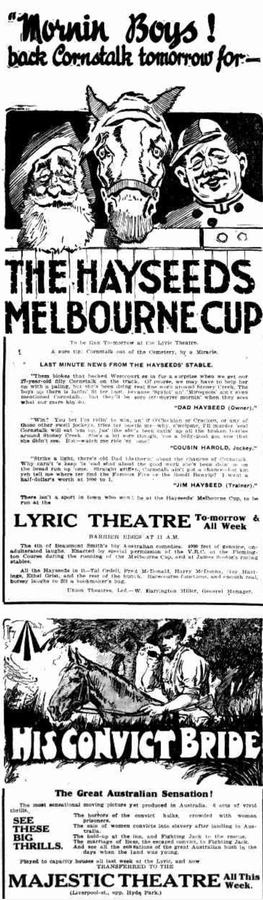
A scrawny colt, a clan of hay-chewing visionaries, and a city drunk on its own grandeur—The Hayseeds' Melbourne Cup is Australia’s cinematic time-capsule that refuses to stay buried. Ninety-odd years after its premiere, the film gallops back into conversation like a reprobate uncle gate-crashing Christmas lunch, reeking of eucalyptus, bootleg whisky, and possibility.
Forget the Wikipedia one-liner. Beaumont Smith stitches a patchwork aria of larrikin ambition: the Hayseeds abandon their drought-bitten selection, hitch the horse to a rattling dray, and ride the railway’s steel arteries toward the smoky promise of Melbourne. Each frame drips with antipodean surrealism—feral goats loitering outside Flinders Street Station; a bookmaker sporting a monocle carved from a beer bottle; a flapper with a kookaburra feather boa. Smith’s camera, restless as a brumby, tilts skyward to catch tramlines bisecting storm clouds, then plunges to gutter level where urchins gamble with stale bread tokens.
When Drowsy—rib-showing, ears like signal flags—lines up against glossy thoroughbreds, the mise-en-scène erupts into a kinetic hymn: hooves drumming like war-taiko, confetti snowing from grandstands, a trumpeter whose cheeks glow like bushfire coals. The race itself is a masterclass in montage predating Eisenstein’s Battleship Potemkin by five years; splice-shots of reins, sweating jockey silks, and bookies’ chalk-slate odds jitter past in percussive crescendo until Drowsy’s snout snaps the ribbon, bending time itself.
Guy Hastings’ Jim embodies the laconic bush archetype—eyes squinting against horizons only he can see—while Harry McDonna’s Dad oscillates between buffoon and sage, a Shakespearean clown with straw in his hair. Fred MacDonald’s villainous turf commissioner chews scenery like it’s saltbush, yet there’s pathos in his wilted carnation: colonial impotence masquerading as bravado. Among distaff players, Mattie Ive’s Nell radiates tomboyish radiance; her flirtation with city slicker Tal Ordell is staged atop a haystack under a cobalt crescent moon—pure Australiana romanticism before The Road to Love made such tableaux cliché.
Restoration chemists have salvaged tints thought lost to vinegar syndrome: cyanotype nights, amber dawns, and a climactic magenta Cup Day that throbs like a bruise. Grain swarms like blowflies, but the imperfection is the aesthetic—scratches are scar-tissue, history’s dermatology. Compare this tactile patina to the hygienic monochrome of Ashes of Hope; Smith’s film revels in grubby authenticity, fingernail dirt and all.
No synced dialogue, yet the intertitles crackle with idiomatic genius: “He’s got a face like a dropped pie” or “Busier than a blowfly at a barbie.” A live pit orchestra of 1920 would have accompanied screenings; today’s Kino release supplies a jaunty score by Jenny Thomas—banjo, didgeridoo, and brushed snare—evoking both hoedown and heartbreak. Every pluck telegraphs Dad’s foot-stomp anxiety; every drone echoes the Indigenous jockey’s sidelined fate, a critique of white Australia that quietly predates modern revisionism.
Under the slapstick runs a razor-sharp ledger on colonial capitalism. Bookmakers are bloated spiders spinning odds-webs; aristocrats wager fortunes reaped from stolen Wiradjuri land. When the Hayseeds stuff their winnings into a flour-bag and flee, the film stages a proletarian revenge fantasy reminiscent of Marrying Money yet more anarchic—money here is not matrimonial bait but hot coal, burning holes in elite pockets.
Against Eye for Eye’s melodramatic swagger, The Hayseeds' Melbourne Cup opts for communal farce; versus Time Lock No. 776’s urban claustrophobia, it sprawls into pastoral daydream. Only Shannon of the Sixth matches its egalitarian pulse, yet lacks the carnival crescendo that makes Smith’s climax a national allegory.
For decades the negative languished in a NSW shed, home to itinerant possums who treated the celluloid like gourmet jerky. Thanks to Australia’s National Film Archive and a crowd-funded Kickstarter, 4K reels now shimmer on Blu-ray. Still, seven minutes remain missing—rumoured to depict a post-race brawl between squatters and unionists—leaving lacunae that scholars debate like Schliemann’s Troy. Perhaps the gap itself is poetic: history never finishes its sentences.
Because in an era of algorithmic blockbusters, The Hayseeds' Melbourne Cup reminds us cinema can be a hand-painted picnic crate, rough-hewn yet humming with ghosts of laughter. Watch it for the bruised sunsets, for the horse that outruns empire, for the mum who beats a constable with a frying-pan of righteous sizzle. Watch because every scratch on the print is a scar of survival, and because Australia’s voice—raw, irreverent, secretly tender—gallops on, immortal as hoofbeats across an endless outback plain.
“When the Cup is run and the dust settles, the bush reclaims its own—not through victory but through memory etched in flickering silver halide.”
Stream it, project it on a bedsheet strung between gum trees, let the lightning bugs roam like spilled pixels. Invite your neighbours, pass around billy-tea, argue whether Drowsy’s win was fluke or fate. Above all, savour a film that believes the underdog can outrun tomorrow—a belief Australia, and the world, can always afford to bet on.
IMDb —
1916
Community
Log in to comment.