DbcultAccessing Vault...
Cult Review
Senior Film Conservator
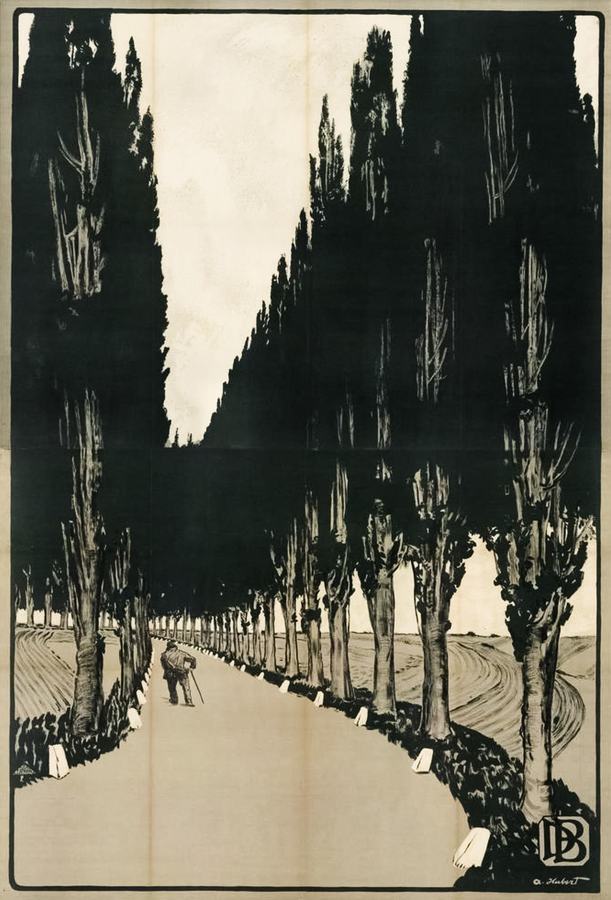
The camera never blinks in Die Landstraße; it stares, unflinching, until the viewer feels the gravel of moral compromise under bare feet. Released in the autumn of 1913, when Europe still balanced on the lip of a conflagration it could not yet name, this 41-minute tone poem distills the century’s coming dread into a single stretch of country road. Paul Lindau’s scenario, distilled from his own 1892 novella, strips melodrama to sinew: no mustache-twirling villains, no last-act reprieves—only the cold arithmetic of culpability.
Director Rudolf Klein-Rhoden—a name half-swallowed by archive silence—blocks scenes like woodcuts: high-contrast chiaroscuro, perpendicular shadows that slice faces into guilty and guileless hemispheres. Notice how the escaped convict’s first appearance is a smear of darkness against a frost-brittle field; the lens holds so long on negative space that when the figure finally detaches from it, we feel the landscape itself has birthed him.
Midway, the actual killing happens off-screen—an ellipsis as cavernous as any Hitchcock would later exploit. We glimpse only the aftermath: a flung wooden shoe, a dog that circles the hayrick with nostrils flared, a child’s kite snared on the weathercock, its tail dripping red streamers against grey sky. In that austerity, the film anticipates post-war realism by a full decade; blood is implied, never decoratively splashed, making the moral stain feel internal rather than epidermal.
Paul Bildt, still years away from the patriarchal gravitas he brought to Ingeborg Holm, plays the fugitive with feral minimalism: cheekbones sharpened by hunger, gaze flicking like a trapped sparrow’s. His breathing—yes, you can sense respiration in the 18fps flutter—becomes the film’s secret metronome. Meanwhile, Carl Goetz embodies the beggar with stooped dignity, allowing us to watch the light gutter out behind his eyes as the mob’s noose tightens. It is a duet of bodies, not speeches.
Compare this narrative architecture to the Biblical tableaux of From the Manger to the Cross or the swashbuckling pomp of The Three Musketeers, both also roaming cinemas in 1913. Where those films externalize conflict through pageantry, Die Landstraße excavates the interior: culpability, projection, communal panic. Its true protagonist is the village itself—half-timbered houses leaning together like gossiping crones, a church bell whose bronze tongue measures out the seconds until conscience calcifies.
The film’s visual grammar invents proto-noir grammar before the genre had nomenclature. Watch how low-angle shots make the rural gendarme loom, shoulders squared to the horizon, his helmet a black planet eclipsing the sun. Or consider the beggar’s final march: camera positioned behind, horizon tilted 15 degrees, so the road ascends like a Calvary slope while faces in the crowd jut forward, gargoyles hungering for atonement they refuse to grant themselves.
Intertitles—sparse, ascetic—function like splinters of a trial transcript. One card reads merely “And the stranger passed on.” Five words, yet the cut to the next shot (villagers dispersing, snow beginning to fall) stretches the phrase into cosmic indictment. We sense an entire social contract dissolving between the syllables.
Cinematographer Gustave Willuhn (uncredited in most vintage sources) shot on Agfa stock with a yellow filter that turns daylight the color of old parchment. The palette anticipates the nicotine-stained melancholia of later Scandinavian auteurs—think The Student of Prague’s Germanic angst crossbred with Dreyer’s austerity. Grain clusters around torchlight like moths; every flare becomes a moral interrogation.
Historically, the picture nests between two currents: on its left, the last gasp of Victorian moral parables such as Oliver Twist; on its right, the storm-bruise of Expressionism about to break in The Student of Prague. It is both elegy and prophecy, a celluloid vanishing point. Contemporary critics, writing under the looming shadow of The Life of Moses’s biblical spectacle, dismissed the film as “provincial gloom.” Posterity corrects them: the provincial here is universal, the gloom an unacknowledged blueprint for post-war nihilism.
Sound would have ruined it. The creak of leather boots on frozen loam, the hush of accusatory whispers, the caesuras of winter wind—all are more chilling when the audience supplies the frequencies. In silent darkness, you become co-author of guilt, an acoustic accomplice.
Notably, women occupy negative space. Wives are seen wringing aprons, never voicing verdict; a daughter offers the beggar a heel of bread, but the edit jumps before her fingers uncurl. The film refuses the sentimental trope of feminine mercy prevalent in Little Jack or The Child of Paris. Here, patriarchy devours its own offspring, and silence is the only mother left to cradle the falsely accused.
For decades only a 9.5mm Pathé-Baby condensation circulated among collectors, its emulsion scarred like the face of the beggar himself. Then, in 2018, the Deutsche Kinemathek unearthed a 35mm nitrate at the former Babelsberg labs. The restoration—4K, yet retaining gate weave—premiered at Il Cinema Ritrovato, accompanied by a new score for string quartet and musical saw. Those wavering, metallic wails replicate the wind that haunts the road, reminding viewers that history itself is a re-recording, never a perfect playback.
Home viewers now encounter the film via streaming, but resist the temptation of smartphone multitasking. Let its quiet invade; notice how the lack of close-ups until minute 28 forces you to project empathy across spatial gulfs—an emotional telepathy reverse-engineered by later Soviet montage.
What lingers longest is the film’s refusal to balance equations. The killer vanishes into the forest, never seized by poetic justice; the beggar’s fate—left ambiguous—hovers like wood-smoke in the lungs. Compare this open wound to the neat retributions of Les Misérables or the cosmic comeuppance in The Last Days of Pompeii. Lindau and Klein-Rhoden posit that injustice, once institutionalized, cannot be retroactively cured; it can only be acknowledged, like a scar you press to remember you’re alive.
In an era of viral misinformation and trial-by-feed, Die Landstraße feels eerily algorithmic: a faceless mob assigns guilt, metrics of suspicion outweigh evidence, and the loudest voice inherits the gavel. The film’s 1913 calendar may be horse-drawn, but its psychic engine is Silicon Valley. Cinephiles who admire the social paranoia of Traffic in Souls will find here a more austere ancestor, shorn of reformist sermonizing.
Yet within the austerity glints a perverse beauty. Snowflakes descend on the guilty and innocent with democratic indifference; a lone birch sways, its white bark echoing the stripes of prison garb. These grace notes prevent nihilism from curdling into despair; they insist that while morality may be fragile, the world itself remains indifferent, and that indifference can be weirdly consoling.
Bildt’s later career would typecast him as paternal authority—see Anna Karenina adaptations—but here he channels feral cunning. Watch his hands: fingers drum against thigh in 3/4 time, a subconscious waltz of liberty regained. The performance is silent yet syncopated, a master-class in micro-gesture that would later influence Kinski’s unhinged turn in Aguirre.
Carl Goetz, primarily a stage actor, lets his eyes sink into shadow sockets, transforming physiognomy into a topography of defeat. When false verdict is pronounced, his knees buckle—not theatrically, but with the slow fold of a carpenter’s ruler—an authentic collapse rarely captured even in later Method realism.
Film histories lionize directors; here, authorship disperses like chimney soot. Lindau supplies the parable, Klein-Rhoden the visual rigor, Willuhn the chiaroscuro, Bildt the corporeal anxiety. The synthesis feels proto-Wellesian before Welles had a lens to peer through. One senses future masters storing its grammar in muscle memory: Lang would remember the courthouse silhouettes, Hitchcock the transferential guilt, Dreyer the spiritual abrasion.
To watch Die Landstraße is to step onto a treadmill of complicity: every spectator becomes another villager willing to accept convenient guilt. The film ends, but the road continues beyond the frame, bending toward horizons that will soon host trenches and barbed wire. Yet in that bleakness lies a fierce, almost perverse honesty. It refuses to reassure, and in 1913 that refusal is revolutionary. A century later, it still burns like frostbite: you leave the screening warmer only because you have felt something freeze inside you, and recognition itself becomes a kind of fire.
IMDb 5.7
1930
Community
Log in to comment.