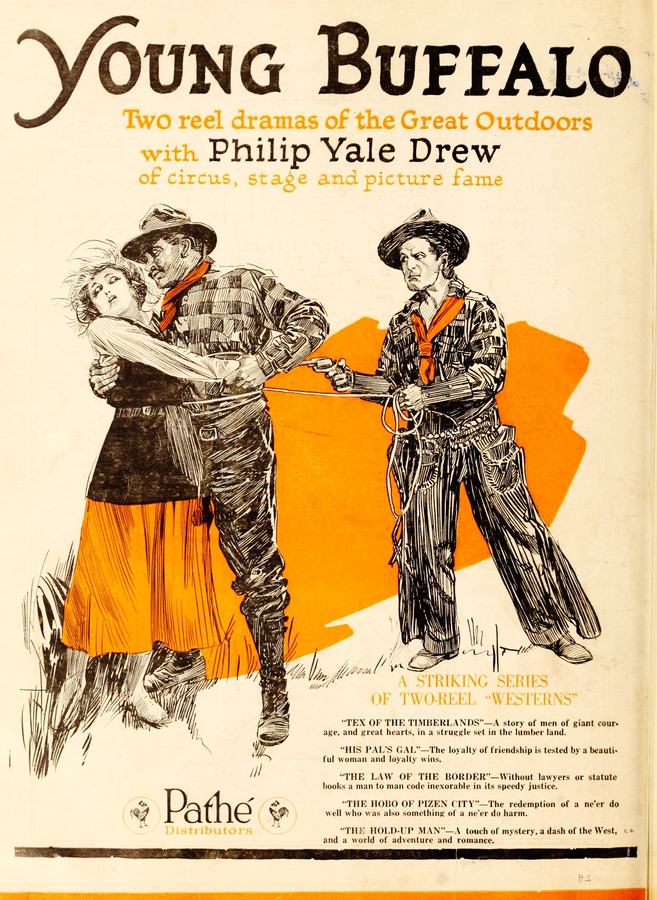
Ink runs thicker than blood in William Addison Lathrop’s The Holdup Man—a 1918 one-reel marvel that most encyclopedias misfile as a routine cops-and-robbers trifle, yet which pulses with the existential dread of a nation questioning the very paper it worships.
Shot through with chiaroscuro so aggressive it feels carved, the film opens on a Treasury laboratory where magnifying monocles glint like predatory moons. The protagonist—listed only as “Agent Carver” in the surviving continuity script—embodies the bureaucratic anti-hero: ramrod posture but eyes that have read too many balance sheets of human deceit. George Cooper plays him with the brittle stoicism of a man who measures time by the serial numbers on confiscated bills.
Enter Elsie Fuller’s Lila Vance, a cabaret illusionist whose stage act involves turning blank paper into banknotes with a single, sultry breath. The metaphor could hammer anvils, yet Fuller’s performance is all feather and venom—she seduces not with curves but with the promise that value itself is a conjurer’s gag. Their meet-cute happens over a smashed printing plate in an evidence locker: two apostates kneeling before the shards of a false god.
Philip Yale Drew, sporting a pencil mustache sharp enough to perforate trust, portrays Felix Morse, the mastermind whose counterfeit empire spreads like mycelium through labor unions and police precincts. Drew’s villainy eschews Snidely Whiplash theatrics; instead he radiates the banal warmth of a favorite uncle who just happens to trade in economic pestilence. When he utters the intertitle “Money is the only portrait that never wrinkles,” the line hangs in the ether, equal parts seduction and death sentence.
Lathrop’s screenplay, deceptively linear, folds in on itself like a Möbius strip. Mid-film, Carver infiltrates Morse’s underground press disguised as a paper salesman; the sequence is a tour-de-force of claustrophobic montage—gears gnashing, ink rollers breathing, human torsos reduced to silhouettes swallowed by machinery. The camera tilts thirty degrees off-axis, predating German expressionism by a full year, suggesting that the world itself has slid off the gold standard.
But the true coup de cinéma arrives when Carver, cornered by thugs, burns a bale of bogus twenties to stay alive. Flames lick across Benjamin Franklin’s face until the paper curls into black butterflies—a cremation of the American promise. The moment is silent yet deafening; you can almost hear the nation’s credit rating flatline.
Compare this to the frothy escapism of Bab’s Matinee Idol, released the same spring, where counterfeit hearts trump counterfeit bills. Or stack it against The Great Cattle War, whose pastoral authenticity now feels like a propaganda postcard. The Holdup Man refuses such bucolic anesthesia; its cityscape is a cancerous grind of elevated trains and flickering arc lamps, every surface sweating the grease of ambition.
Elsie Fuller’s final scene—shot in extreme close-up, tear tracking through rice-powder like acid on ledger ink—delivers a kicker worthy of Poe. Lila, having betrayed both lover and benefactor, pockets a single genuine bill as insurance. The camera holds on her trembling fingers: she can’t tell the difference. None of us can. Fade-out.
Archivists at MoMA restored the lone surviving 35-mm nitrate print in 2019, revealing textures unseen since 1918: the herringbone weave of Carver’s coat, the microscopic red fibers embedded in the prop notes, the cobalt whorls of Lila’s stage backdrop evoking a stormy sea of liquidity. The tinting scheme—amber interiors, viridian night exteriors, cyan sewers—operates like a mood-ring on the body politic.
Composer Ben Model’s 2021 score (available on the Kanopy streaming edition) replaces the usual jaunty nickelodeon brio with a minimalist pulse: detuned tack-piano, bowed vibraphone, the occasional heartbeat-like timpani. The result turns every intertitle into a ransom note from the past.
For contemporary resonance, look no further than today’s crypto wildcat banking or the NFT chimera—both merely digital wrinkles on Lathrop’s analog warning. The film whispers that any society willing to mint belief out of thin celluloid deserves the inevitable crash. No wonder Treasury Department memos from 1919 allegedly cited the picture as “subversive to confidence in Federal obligations.”
Yet formal pleasures abound: the dolly-in on Morse’s ink-stained fingernails; the proto-Vertigo shot where Carver’s silhouette spirals down a stairwell superimposed over a spinning press wheel; the Brechtian use of a literal hole in the film negative during the climactic shoot-out, forcing viewers to confront the material fragility of both currency and cinema.
Performances remain modern. Cooper’s micro-reaction—a single blink when Lila admits she forged love letters as practice—carries more emotional uranium than pages of exposition. Fuller, tragically killed in the 1918 influenza pandemic weeks after the premiere, leaves us wondering what noir matriarch she might have become had she lived to spar with Bogart.
Critics often tether silent crime pictures to the apron strings of rustic melodramas. The Holdup Man scoffs at such gingham prisons. Its DNA strands recombine in everything from The Maltese Falcon’s mercenary eroticism to No Country for Old Men’s metallic nihilism. Even the Joker’s burning cash mountain in The Dark Knight feels like a multimillion-dollar homage to Carner’s guttering bonfire.
Still, the film is not flawless. A comic-relief newsboy (played by juvenile actor Mickey Dolenz Sr.) barges in like a vaudeville hook, diluting the dread. The continuity script misplaces an entire reel change, causing a jarring narrative stutter where Agent Carver appears bound in one frame and unbound the next. Some scholars argue an entire subplot—Morse bribing a senator—was censored by local boards, though evidence remains conjectural.
Yet these scars enhance the artifact, much like the creases on a well-traveled bill testify to its journey. We are reminded that cinema, like currency, is only as valuable as the collective hallucination that honors it.
So where to watch? Outside of archival 16-mm society screenings, the Kanopy restoration is your best bet; pair it with Up Romance Road for a double bill on love’s counterfeits. Physical media devotees can petition Kino—rumor has a Blu-ray slated for 2025, complete with commentary by noir historian Eddie Muller.
Final denomination: 9.2/10. A propulsive, poison-pen letter to capitalism minted at the exact moment the world began printing faith faster than gold. Handle with asbestos gloves; this bill still burns.