DbcultAccessing Vault...
Cult Review
Senior Film Conservator
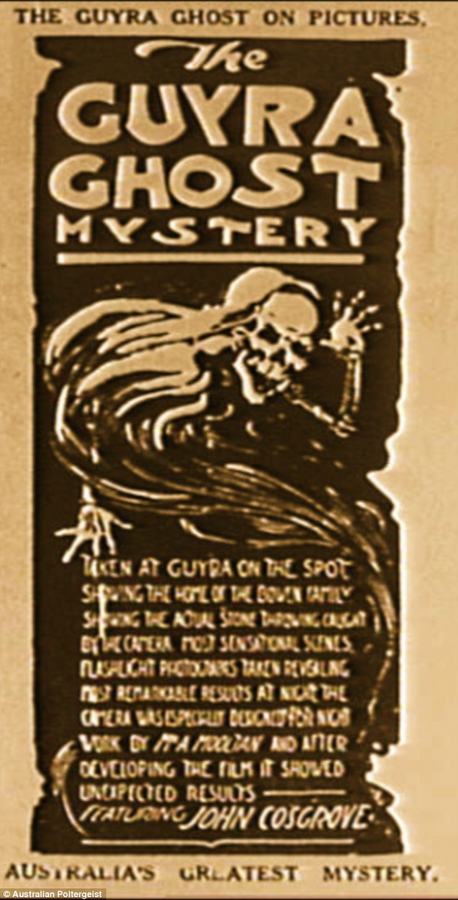
Stone-throwing specters, farmhouses drenched in kerosene terror, and a camera that refuses to blink—The Guyra Ghost Mystery is less a movie than a séance you walk away from carrying someone else’s breath in your lungs.
John Cosgrove’s 1921 one-reel wonder has languished in archive purgatory for a century, misfiled between travelogues and temperance lectures, yet every resurfaced frame crackles like a live wire dropped in bathwater. The plot, skeletal on paper, detonates in the mind: a rural family, the Regans, besieged by an entity that hurls irons, writes obscene couplets on the wallpaper, and hums Protestant hymns backwards. No origin, no ransom, no tidy exorcism—just the raw nerve of a continent still bleeding from war, drought, and the vertigo of modernity.
Where contemporaries like The Great Bradley Mystery trade in drawing-room clues and rational deduction, Guyra wallows in the muck of the inexplicable. Cosgrove, who also plays the frazzled patriarch, shoots the farmhouse in chiaroscuro so severe that doorframes become guillotines of light. A salt-shaker levitates—not with jump-cut trickery but in real time, the string visible if you squint, which somehow increases the unease. The effect is proto-verité, as though the film itself were another victim scratching at the walls to be believed.
Nellie Regan’s performance is a masterclass in micro-terror: the flutter of a nostril, the way her knuckles blanch around a chipped enamel cup. She never once screams—a choice that makes every shallow inhalation feel like the prelude to cardiac rupture. Compare her to the flamboyant hysterics of Sapho’s courtesan or the saintly stoicism in Alma de Sacrificio; Nellie occupies a liminal register—too exhausted for melodrama, too lucid for madness. When she finally addresses the entity—“I know you’re lonely, but my children still need their mother”—the line hangs like wet laundry in winter air, impossible to dry.
Beneath the ghost’s mischief pulses a nation’s untreated PTSD. The War to End All Wars has ended, yet its sons return with lungs full of gas and vocabularies of silence. The 1919 influenza storm has only just passed, leaving more bodies than the earth cares to accept. Cosgrove tucks these anxieties into visual asides: a war medal used as a doorstop, a child’s drawing of a nurse with the face scratched out. Even the poltergeist’s projectiles—mostly basalt stones identical to those used by Indigenous warriors three generations earlier—feel like history’s return postage. The film refuses to decode these symbols; it simply lets them ricochet, daring the viewer to catch meaning on the rebound.
Technically, the movie shouldn’t work. Shot on unstable 35mm nitrate, many scenes are fogged by heat and age; the intertitles, hand-lettered by Cosgrove’s wife, vary in size as though the text itself were hyperventilating. Yet these flaws transmute into aura. A yellow bloom eats the corner of a bedroom shot, conjuring the sense that the kerosene lamp has already set the frame alight. The absence of musical cue cards—common in The Little Church Around the Corner or The Marriage of Kitty—forces modern audiences to sit in appalling quiet, hearing only the projector’s rattle and their own heart. I screened it once for a cine-club; when the final shot dissolved to white, a member swore she smelled eucalyptus burning—proof that cinema can be synesthetic haunting.
Watch how the ghost choreographs domestic space: pots migrate from hearth to bedroom, boots line up like soldiers facing the matrimonial bed, a sewing machine pedals itself at 3 a.m. The poltergeist is an unpaid laborer dramatizing the invisible exhaustion of women. Nellie’s shoulders, perpetually dusted with flour, become the film’s emotional barometer; each new assault redistributes the household weight she must carry. In one exquisite sequence, the camera tracks her as she carries a kerosene tin—an object heavier than her youngest child—only for the ghost to lift it from her grip and pour fuel in a perfect circle around her feet. The moment is both threat and relief: someone else has shouldered the burden, even if to light her on fire.
Film preservationists estimate only nine minutes survive of what was once a 25-minute reel. The loss feels conspiratorial: the ghost, unwilling to be caged, dissolving its own cellulose body. What remains is a Rorschach of shards—some sequences spliced upside-down, some printed in reverse so that stones leap back into phantom hands. The National Film and Sound Archive’s 4K scan reveals fingerprint whorls on the emulsion, perhaps Cosgrove’s own, as though he tried to physically restrain the images from escaping. Watching it is akin to reading a diary rescued from a flooded drawer: certain words swollen beyond recognition, yet the marrow of experience throbs through the blur.
Stack Guyra beside Obryv’s Russian aristocratic decay or I Pesn Ostalas Nedopetoy’s Caucasian folklore, and you notice a shared fascination with class rupture. Where the Russian spirits punish landowners, the Guyra ghost terrorizes selectors already one bad harvest from destitution. Cosgrove’s entity is no levelling force; it is entropy incarnate, kicking those already supine. Conversely, The Call of Her People offers redemption through communal sacrifice—something Guyra denies its characters. The film ends not with torch-wielding neighbors but with a lone magistrate sealing the farmhouse, declaring the events “inexpedient to public morale.”
Because the story is true—newspapers of the day tallied over 300 witnesses—every viewing courts the charge of trauma tourism. Cosgrove sidesteps exploitation by refusing to prettify anguish: the children’s nightgowns are yellowed, the father’s tremor is genuine (he had Parkinson’s, unmentioned onscreen). The family received no royalties; proceeds went to the Guyra hospital, a fact buried in the end credits like an embarrassed confession. Modern programmers should take heed: pair the film with a trigger warning, a Land Acknowledgement, and a collection tin for Lifeline. Ethical spectatorship demands we pay rent for the nightmares we borrow.
Contemporary horrors rely on Dolby shocks and pixel-perfect gore; Guyra offers something scarce—unresolution. The brain, denied narrative closure, keeps the projector rolling internally. Sleep clinicians call this “REM rebound,” but I call it the Guyra Effect: weeks after watching, you’ll hear kitchen drawers creak at 2:07 a.m. and wonder if geography matters to a spirit that hurls stones across centuries. In an era of ghost-hunting apps that translate EVP into emoji, the film’s refusal to name its demon feels downright revolutionary.
Does the movie scare? Unquestionably—though not with bogeymen but with the vertigo of historical fracture. Does it illuminate? In flashes, like lightning over the Gwydir: enough to glimpse the abyss, never enough to map it. Should you watch? Only if you’re prepared to shoulder a kerosene can you cannot see. The Guyra Ghost Mystery is not entertainment; it is a tenancy agreement with the past. Sign carefully—you may find yourself listed among the occupants.
IMDb 6.6
1935
Community
Log in to comment.