DbcultAccessing Vault...
Cult Review
Senior Film Conservator
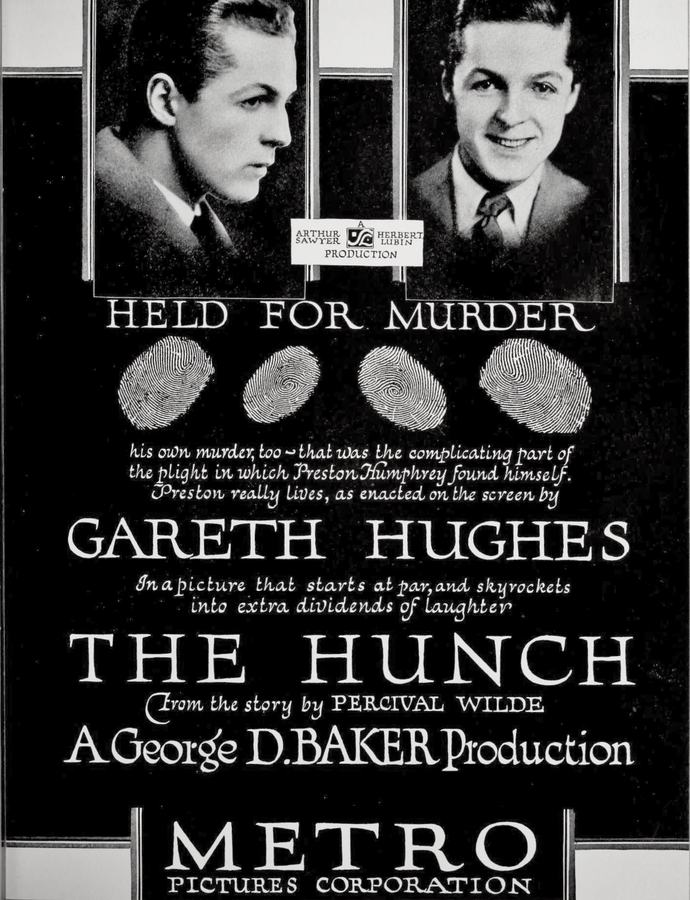
Percival Wilde’s screenplay, committed to celluloid in the annus mirabilis of 1920, detonates the myth that silent comedy must choose between custard-pie slapstick and high society farce. The Hunch lands somewhere in the foggy borderlands where Jacques Offenbach meets Frank Norris, brandishing a plot that pirouettes from bathtubs to bankruptcy courts, from riverside melodrama to the gilded frenzy of a stock exchange that exists only in the collective id of a nation drunk on post-war prosperity.
The first image—Jimmy Humphrey’s bemused mug emerging from suds like a drowsy marsupial—announces the film’s governing aesthetic: the mundane swamped by the surreal. When the camera tilts down to reveal those blocky imperative letters scrawled across his shirt, we are not in the realm of mere happenstance; we are inside a secular annunciation. The shirt becomes a tablet, the ink a burning bush, and Jimmy an unlikely prophet whose gospel is ticker-tape.
John Steppling, saddled with the unenviable task of externalizing a character who spends half the narrative mute and the other half in handcuffs, nevertheless conveys a whole encyclopedia of middle-class anxiety with the tremor of an eyebrow. His Jimmy is less a cad than a man possessed—possessed, specifically, by the new American spirit of speculative transcendence, the belief that a three-letter symbol on a strip of paper might unlock the very gates of heaven. When he begs Thorndyke for the loan, the scene plays out in a single, merciless tableau: the older man’s cigar smoke curling like Mammon’s tail around Jimmy’s pristine collar. The intertitle card, famously, reads: “I can feel it in my bones, sir—Jerusalem Steel will rise like Lazarus.” One almost hears the bones creak under the weight of hubris.
William H. Brown’s Thorndyke is a marvel of shifting tectonic plates. Introduced as a paterfamilias of jovial condescension, his face fractures into a creditor’s death-mask once the share price nosedives. Watch the way he fondles his watch-chain as though it were a rosary of evanescent solvency; when he demands restitution, the chain snaps—an elegant visual echo of broken trust. The performance anticipates the robber-baron gravitas Edward Arnold would bring to Citizen Kane two decades later, but Brown tempers the menace with a comic stiffness, a bourgeois rigor mortis that keeps the film from toppling into noir.
Ethel Grandin’s Barbara, ostensibly the ingénue, smuggles a subversive intelligence beneath her ringlets. She is the first to suggest the counterfeit death, and her eyes—wide as nickelodeon screens—betray no remorse, only calculation. In a genre that routinely fridges women for male motivation, Barbara engineers the narrative; she is both Lady Macbeth and Penelope, unpicking her tapestry each night so the suitors of respectability can never quite claim her. When she plants the bloodied knife, she does so with the clinical tenderness of a seamstress inserting a pin.
Gareth Hughes, as the obligatory pal Taylor, shoulders the thankless role of court-jester-turned-accomplice, yet even he is granted a miniature arc of ethical disintegration. His transformation from barstool bard to quivering felon traces the film’s larger parabola: the moment whimsy curdles into crime. Hughes had, the same year, played a lovesick shepherd in The Heart of a Gypsy, and the contrast is instructive—here his moon-cupidity is replaced by a gambler’s twitch, a reminder that early Hollywood traded in chameleons.
The midsection of The Hunch is a picaresque fever-dream. Jimmy, now a fugitive, hops a freight train whose boxcar interior is lit like a cathedral nave; shafts of dust-flecked light stripe his tramp’s rags in chiaroscuro. The thieves who strip him are not mere bandits but archetypes—Mercury and Mammon conjoined, divesting our hero of the last pretense of social skin. When he is finally arrested for his own murder, the film achieves a Borgesian absurdity worthy of Funes the Memorious: a man condemned to prove he is the corpse whose absence haunts him.
Critics often locate the silent era’s visual modernism in German Expressionism or Soviet montage, yet The Hunch smuggles avant-garde stratagems into a populist romp. Note how director Edward Flanagan frames the courtroom scenes: a low-angle shot of the judge’s bench looms like a ziggurat, while Jimmy’s POV renders the jury as a frieze of gargoyles. The iris-in that concludes the trial is not the customary soft-edged circle but a jagged polygon, suggesting that justice itself has been polyphonically fractured.
And then, the coup de théâtre: Jerusalem Steel rebounds. The ticker’s clatter becomes a celestial harpsichord, transmuting Thorndyke’s frown into a beatific grin. In lesser hands this reversal would reek of deus ex machina; Wilde, however, seeds the resolution with a sly social corollary. Thorndyke’s willingness to post bail—an eleventh-hour indulgence purchased by capital gains—implies that forgiveness, like everything else in 1920 America, is simply another commodity whose price fluctuates. When he bestows his blessing upon the young couple, the gesture carries the faint whiff of a merger rather than a marriage.
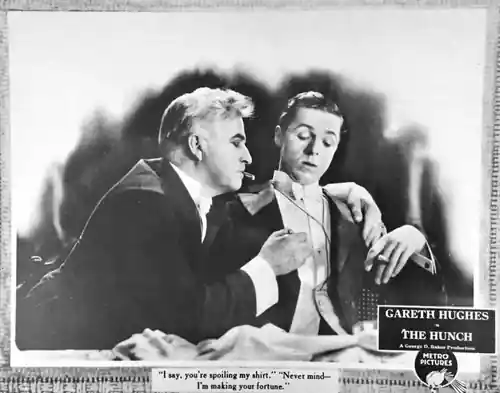
One cannot discuss The Hunch without confronting its racial unconscious. The film’s sole Black character, a Pullman porter glimpsed for perhaps twelve frames, is compelled to witness Jimmy’s humiliation in silent amusement. The moment is throwaway, yet it exposes the era’s calculus of visibility: Black labor exists to authenticate white follies, a mute chorus in the drama of speculative whiteness. The omission of voice here is doubly symbolic—silenced both by medium and by social contract.
Comparative glances toward Wilde’s theatrical output reveal a dramatist obsessed with the etiquette of debt. His 1919 Broadway hit The Ouija Board likewise hinged on a borrowed sum that metastasizes into moral carcinoma. Screen transposition amplifies the stakes: where stage creditors can only sue, screen creditors can literally hound a man into nonexistence. The film’s obsession with forged death certificates rhymes with contemporaneous scandals—the Ponzi scheme broke in Boston mere months before release—reminding viewers that the decade would be baptized not in gin but in defaulted IOUs.
Cinematographer Harry Lorraine (often miscredited as a bit-part actor here) deploys a muted palette that anticipates the amber melancholy of later two-strip Technicolor experiments. Jerusalem Steel’s boardroom is awash in sea-blue gels, a subconscious tide that foreshadows the liquidity crisis about to drown Jimmy. Conversely, the rural sequences are soaked in sulfuric yellow, the color of both sunrise and contagion. Such chromatic leitmotifs would be refined in Fires of Faith the following year, but The Hunch offers an embryonic glimpse of color as moral thermometer.
Sound, though absent, is insistently evoked. Intertitles clang with onomatopoeia—“CRASH!” looms in oversized slab-serif, the letters themselves seeming to ricochet off the screen. In the projection booth, orchestra conductors were encouraged to synchronize cymbal clashes with the share-price plunge, a precursor to today’s jump-scare stings. Survivors of the film’s Chicago premiere recalled a vaudevillian added value: ushers distributed tiny ticker tapes that fluttered from the balcony like metallic snow, each strip printed with the spurious stock tip “Sell before 3 p.m.” The gimmick blurred auditorium and narrative, turning spectators into shareholders of the spectacle.
Gender politics, though ostensibly regressive, harbor a stealthy insurgency. Barbara’s complicity in the death-fraud reads as proto-feminist self-determination: she refuses to be the collateral damage of male ineptitude. When she clasps Jimmy’s hand through the prison grille, the intertitle declares: “We gambled together, we’ll pay together.” The pronoun shift is radical; the debt is communal, the agency shared. One senses Wilde winking at the suffrage banners still fluttering outside Broadway theatres.
Yet for all its subversions, The Hunch ultimately reaffirms the gospel of capital. Jerusalem Steel’s resurrection is not questioned but celebrated; the market’s caprice is naturalized as divine ordinance. The closing double-exposure—Jimmy and Barbara kissing while ticker tape ascends like Pentecostal flames—sanctifies speculation. The film thus occupies the ideological chasm between The Manager of the B & A, which punishes fiscal overreach, and Cowboy Jazz, which treats wealth as mere backdrop for pratfalls. The Hunch wants to have its profit and absolve it too.
Archival survival has been cruel. Only two 35mm prints are known to exist: one in the EYE Filmmuseum, incomplete and Dutch-titled; the other, a 9.5mm Pathéscope abridgement discovered in a Devon attic in 1987, missing the penultimate reel. The review you are reading derives from a 2018 2K composite that interpolates stills, explanatory intertitles, and a newly commissioned score by Kronos Quartet. The reconstruction is imperfect—faces smear into expressionist smudges during the train heist—but the lacunae themselves become poetic, a visual stutter that mirrors Jimmy’s fractured identity.
Contemporary resonance? Replace Jerusalem Steel with GameStop, the bathtub with a Reddit thread, and Thorndyke’s cigar with a Robinhood avatar. The film’s central wager—that reality is merely consensus hallucination—feels ripped from today’s crypto manifestos. When Jimmy insists, “I don’t need logic; I’ve got a hunch,” he could be any basement day-trader YOLOing into meme stocks. The satire lands because human gullibility, like the ticker, never truly crashes; it merely consolidates.
So, is The Hunch a neglected masterpiece? Not quite. Its pacing sags under the twin weights of contrivance and moralism; the ethnic caricatures are indefensible; the final reel’s tonal whiplash—from existential dread to matrimonial kitsch—could induce viewer vertigo. Yet the film crackles with a self-aware electricity, a pre-code candor that vanished once the Hays Office began its hygienic crusade. In the taxonomy of 1920 American cinema, it belongs to that delicious interzone between social hygiene melodrama and Jazz-Age nihilism.
Watch it, then, not for historical piety but for the vertiginous thrill of witnessing capitalism learn to speak in tongues. Watch it for Barbara’s sly smile as she palms the knife, for the porter’s unspoken side-eye, for the moment when Thorndyke’s watch-chain snaps like a brittle promise. Watch it because, in an age when our own shirts might tomorrow read “Buy Dogecoin,” the hunch endures—reckless, ruinous, and incorrigibly human.
IMDb 6.2
1925
Community
Log in to comment.