DbcultAccessing Vault...
Cult Review
Senior Film Conservator
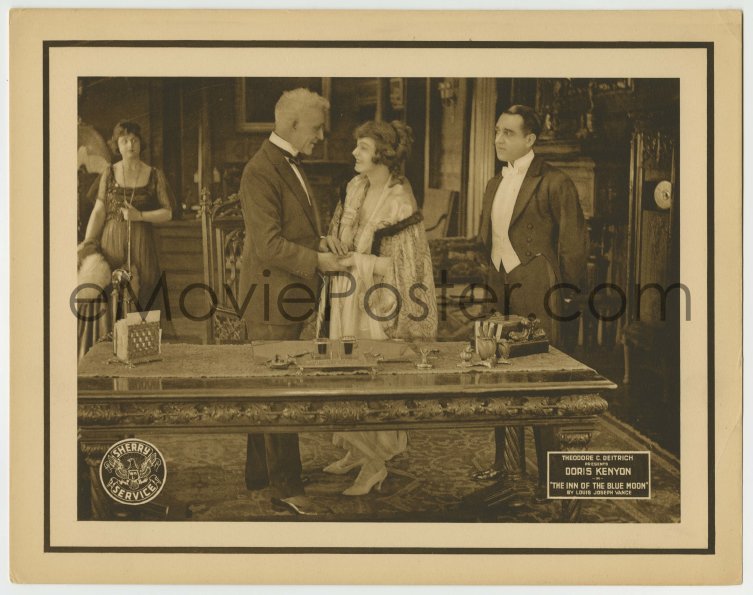
Ah, the silent era! A time when narratives unfurled with a grand theatricality, relying on the eloquent gesture, the profound glance, and the meticulously crafted intertitle to convey the full spectrum of human emotion. Among the many cinematic treasures from this period, 'The Inn of the Blue Moon', a 1918 offering penned by the prolific Louis Joseph Vance, stands as a fascinating testament to the era's predilection for intricate melodrama, the enduring power of family, and the delightfully tangled threads of mistaken identity. It's a film that, even a century later, invites us to ponder the forces that shape our lives – be it fate, choice, or the sheer serendipity of a car overturning on a lonely road.
The genesis of our tale lies in a domestic tragedy: the dissolution of the marriage between Justus and Dorothy Druce. This foundational fracture doesn't merely signify a personal heartbreak; it acts as the seismic event that cleaves their twin daughters, Dorothy and Justine, onto divergent life paths. One, Dorothy, finds solace and seclusion in the verdant embrace of the Catskills, accompanying her mother into a life perhaps less glamorous but imbued with a quietude that shapes her gentle spirit. The other, Justine, remains in the bustling metropolis of New York with her father, exposed to the city’s relentless pace and sophisticated demands, forging a more worldly, perhaps more assertive, temperament. This initial division is not just a plot device; it's a profound exploration of how environment and upbringing can sculpt two genetically identical individuals into distinct personalities. The film subtly asks: how much of who we are is inherent, and how much is a product of where we are nurtured?
Years later, the threads of these separated lives begin their inevitable, often tumultuous, re-entanglement. Justine, now a young woman, finds herself engaged to Charlton Sloane, a man whose intentions appear noble, even chivalrous. His offer to alleviate Justus Druce's financial woes by pawning the family jewels seems a straightforward act of generosity. Yet, as with many grand gestures in cinematic narratives, it carries an unforeseen cost. Enter Adelaide, Justus's niece, a character steeped in the bitter tincture of unrequited love for Charlton. Her disappointment curdles into a venomous resentment, prompting her to weave a cunning fabrication, convincing her uncle that Charlton has, in fact, absconded with the precious Druce heirlooms. This act of malicious deception serves as the primary engine for the film's unfolding drama, highlighting the destructive power of jealousy and the fragility of trust.
Justine, reeling from what appears to be a betrayal, seeks legal redress, leading her to the doorstep of Warde MacMahon, a young lawyer vacationing in the Catskills – a location that, unbeknownst to her, holds the key to her past and future. MacMahon, portrayed with a blend of earnestness and burgeoning romanticism, becomes an unwitting pawn in fate's intricate game. His journey to Justine is dramatically interrupted when his car overturns, a seemingly calamitous event that, in the grand tradition of melodrama, becomes a pivotal turning point. It is here that the sequestered Dorothy Druce enters the narrative proper, tending to Warde's injuries with an innate kindness, transforming her childhood hideaway – the titular "The Inn of the Blue Moon" – into a crucible for an unexpected romance. This accidental meeting, this blossoming love, is a beautiful counterpoint to the treachery unfolding elsewhere, suggesting that even amidst chaos, new connections can forge themselves with an almost fated certainty.
The film truly hits its stride when the twin sisters, Dorothy and Justine, finally meet. This long-anticipated reunion is not a simple embrace; it's a catalyst for a series of delightful and dramatic adventures centered around their striking physical resemblance. The mistaken identities that ensue provide both comedic relief and heightened dramatic tension, a classic trope expertly deployed by Vance. The brilliance of having Doris Kenyon in a potentially dual role (a common and celebrated practice in silent cinema for twin characters) would have undoubtedly been a highlight, allowing her to showcase her range by embodying two distinct personalities despite identical visages. Her performance, alongside Crauford Kent as Warde MacMahon and Jack Hopkins as Charlton Sloane, would have been crucial in grounding these fantastical elements in believable human emotion. Harriet Ross as the mother, Harry C. Browne as the father, William Walcott, and Lyn Donelson round out a cast tasked with conveying complex emotions without the aid of spoken dialogue, relying instead on nuanced expressions and gestures – a true art form of the era.
At its core, 'The Inn of the Blue Moon' is a profound meditation on identity. How do we define ourselves when an exact replica of us exists, living a completely different life? The film explores the inherent tension between individuality and the inescapable pull of genetic connection. Beyond identity, it delves into the enduring power of family, portraying its initial fragmentation as a deep wound that ultimately seeks healing. The journey of the Druce parents, from separation to eventual reunion, mirrors the larger narrative of reconciliation and speaks to a universal longing for wholeness. The quest for justice, the clearing of Charlton Sloane's name, underscores the importance of truth prevailing over deceit, a comforting moral compass in a world often fraught with ambiguity.
Louis Joseph Vance, the esteemed writer, weaves a narrative that is both intricate and emotionally resonant. His ability to craft compelling plots, often brimming with intrigue and romance, translated remarkably well to the silent screen. The film's pacing, guided by intertitles that must succinctly advance the story and convey dialogue, would have been a masterclass in visual storytelling. The shifts between the serene Catskills and the vibrant New York would have provided a rich visual contrast, underscoring the different worlds the twins inhabit. The rustic charm of the "Inn of the Blue Moon" itself isn't just a setting; it's a symbolic haven, a place where healing and new beginnings are fostered, a sanctuary where fate intervenes.
The performances in a silent film are a unique beast. Without spoken dialogue, actors like Doris Kenyon (who had a remarkable career spanning decades, often praised for her expressive eyes and graceful demeanor) had to convey entire emotional landscapes through facial expressions, body language, and carefully choreographed movements. The heightened physicality, often perceived as melodramatic by modern audiences, was the lingua franca of the silent screen. Each gesture, each tear, each smile, had to be magnified to reach the back rows of a cavernous theater. The subtlety we associate with modern acting was present, but it was often framed within a larger, more demonstrative style. Observing these performances is akin to watching a living tableau, a ballet of human feeling where every movement tells a story. The ability of Crauford Kent and Jack Hopkins to convey their characters' respective dilemmas – Warde's burgeoning love and Charlton's unjust accusation – without uttering a word speaks volumes about their craft.
Consider the dramatic weight carried by Harriet Ross as the mother and Harry C. Browne as the father. Their initial separation and eventual reconciliation, a narrative arc that bookends the daughters' adventures, relies heavily on their ability to project regret, longing, and finally, profound relief and joy through non-verbal cues. This aspect of silent film acting, often underestimated, is a vital component of 'The Inn of the Blue Moon''s charm and enduring appeal. It forces the viewer to engage more actively, to interpret and empathize on a deeper, more visual level.
In the grand tapestry of silent cinema, 'The Inn of the Blue Moon' occupies a comfortable niche. It's not a sprawling epic like Salambo, a $100,000 Spectacle, nor is it a gritty western à la Durand of the Bad Lands. Instead, it thrives on the domestic drama, the romantic entanglement, and the satisfying resolution of moral dilemmas that were immensely popular with audiences of the time. The film's narrative complexity, particularly the interwoven plots of financial distress, false accusation, and romantic destiny, echoes the intricate storytelling found in other contemporary films, such as the mysterious intrigue of The Voice in the Fog, which similarly built tension through veiled truths and unexpected revelations. It speaks to a common desire for narratives that, despite their dramatic twists, ultimately affirm justice and the triumph of good.
The film's focus on family reunification and the healing of old wounds resonates deeply with the human experience. Much like the emotional depth explored in films such as Le crépuscule du coeur, which often delved into the intricacies of human relationships and their fragile nature, 'The Inn of the Blue Moon' offers a poignant look at the consequences of familial discord and the enduring hope for mending what is broken. It's a reminder that even in an era without synchronized sound, filmmakers were adept at crafting emotionally rich and thematically significant stories that transcended mere spectacle.
As the narrative hurtles towards its conclusion, the various threads are deftly woven into a satisfying tapestry of resolution. Charlton's name is cleared, the shadow of Adelaide's bitterness finally receding. The twin daughters, having navigated their personal odysseys, are united with their respective suitors, fulfilling the romantic promise hinted at throughout the film. And, in perhaps the most emotionally resonant outcome, the long-separated parents, Justus and Dorothy Druce, find their way back to each other, their initial fracture mended by the very children whose lives it had so profoundly shaped. This full-circle resolution, where love triumphs, justice is served, and family is restored, is a hallmark of classic storytelling, providing catharsis and a sense of harmonious closure.
In an age dominated by CGI and multi-sensory experiences, revisiting 'The Inn of the Blue Moon' offers a refreshing perspective on the foundational elements of compelling narrative. It reminds us that powerful storytelling doesn't require elaborate special effects or booming soundtracks; it requires well-drawn characters, a captivating plot, and themes that resonate with the human spirit. Louis Joseph Vance's original vision, brought to life by a dedicated cast and the unique visual grammar of silent cinema, offers a delightful escape into a world where true love finds its way, justice prevails, and family, ultimately, finds its way home. It's a charming piece of cinematic history, well worth rediscovering for its intricate plot, emotional depth, and the sheer artistry of silent film acting.
IMDb 5.7
1932
Community
Log in to comment.