DbcultAccessing Vault...
Cult Review
Senior Film Conservator
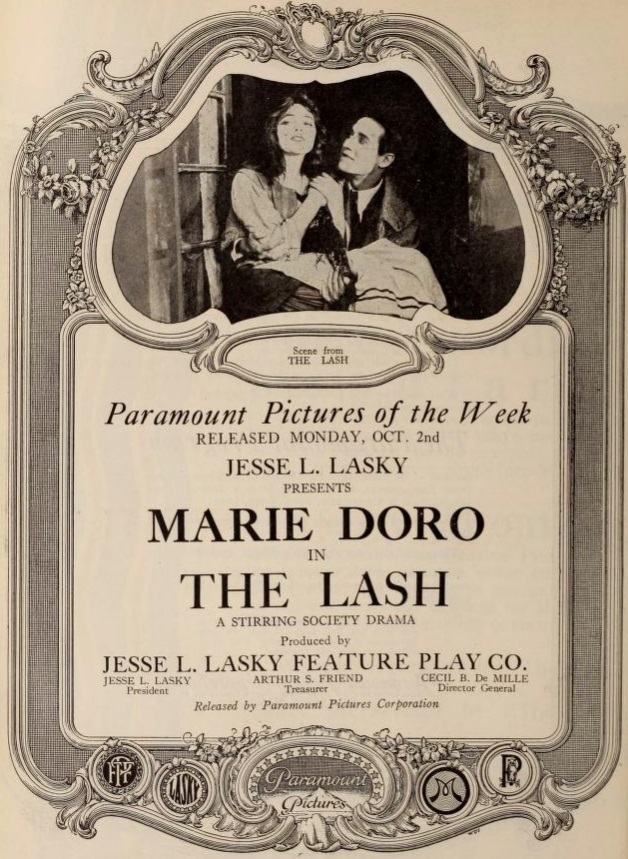
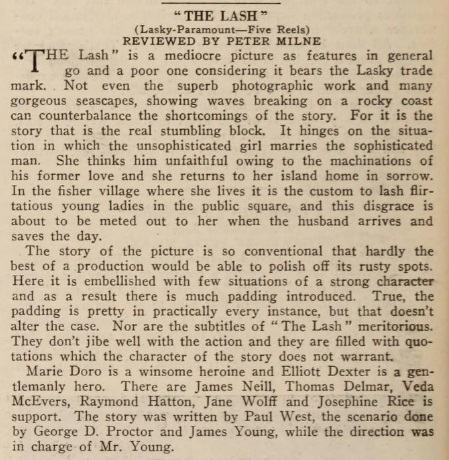
St. Batiste, a craggy pustule on the lip of the Atlantic, keeps its women in line the way sailors keep canvas from tearing—by lashing it. In this 1916 one-reeler that somehow feels like a mural stretched across a cathedral wall, Sidonie—played by the incandescent Marie Doro—becomes both victim and reluctant priestess of that creed. The film’s very title is a dare: a whip cracked before you even press play.
James Young and Paul West adapt George DuBois Proctor’s story with Calvinist severity, yet every frame aches with erotic contradiction. Note the first close-up of Sidonie’s eye reflected in a pewter cup: the iris trembles like a trapped moth, forecasting the moment society’s judgment will pin her wings. Cinematographer de facto (no credited D.P. survives) shoots the island as if it were a fever dream carved from obsidian—beaches so white they look like pages awaiting ink, skies bruised lavender, a color scheme that anticipates Via Wireless by almost a decade.
The lash itself is not mere prop; it is a character, a serpent coiled in every parlour corner. Its braided leather whispers through the soundscape of intertitles—yes, you can almost hear it—promising that pleasure purchased in darkness will be repaid in daylight blood. When Sidonie accepts Warren’s invitation to abandon husband and hovel, the cut is swift: a splice from her bare feet on Breton sand to her buttoned boots stepping onto English cobblestones. The edit is so abrupt it feels like a scar forming before the skin has finished bleeding.
Doro, better known for musical-comedy grace, here moves with the stunned poise of a doe that suspects every glade hides a crosshair. Elliott Dexter’s Warren is less a man than a tourist brochure of Edwardian entitlement: spine of a jellyfish, smile of a shark. Their London sojourn—rendered in two interior shots and a montage of theatre programs—collapses the empire’s capital into a boudoir. When Sidonie discovers him atop a socialite whose face is obscured by a curtain of champagne-colored hair, the camera pivots 180 degrees, flipping the world as neatly as a flipped mattress. In that instant, colonial sin boomerangs back to its island point of origin.
What follows is a reverse exodus: a woman marching toward the very scaffold she once sprinted from. The boat that ferries Sidonie home slices through a fogbank like a scalpel through gauze. Back on St. Batiste, the elders have polished the whipping post until it gleams like café au lait. Children rehearse the cadence of the drum on upturned buckets. Even the gulls seem to rehearse their screams. The sequence is intercut with flash-frames of Warren’s tryst—each memory flash a splinter under the fingernail—until past and present bleed together in a chiaroscuro of guilt.
Marie Doro’s face, stripped of rouge for the penitent walk, becomes a palimpsest: every suppressed lash she ever witnessed as a child now ghosts across her cheekbones. When she kneels, the camera tilts downward so the horizon skews, as if morality itself had become unbalanced. The drum stops. The crowd inhales as one organism. And then—
Warren bursts through the human palisade, coat tails flapping like torn flags. He does not merely halt the punishment; he swallows it, wrapping the whip around his own wrist until beads of blood stipple his cuff. The gesture is absurd, operatic, yet within the film’s hermetic moral universe it scans as the only liturgy left. Compare it to the climax of The Sparrow where the heroine’s virtue is rewarded by marriage; here, redemption is wrested rather than bestowed, and the price is flesh, not vows.
The final intertitle reads: “Because love has bled, no further blood need flow.” One expects a fade-out on reconciled lovers, yet Young lingers on the villagers’ faces—each a miniature gargoyle of disappointment. The whip falls limp, but the law remains. The last shot frames Sidonie and Warren against the outbound tide, two silhouettes clinging like parentheses around an empty clause. The ocean keeps counting time, indifferent.
Doro’s acting style straddles the Victorian and the modern: her eyes telegraph interior monologue without the semaphore arm-flailing that dates many 1910s performances. In the London betrayal scene, she registers four emotions—disbelief, fury, shame, and predatory resolve—in the span of a single close-up. Dexter, meanwhile, weaponizes his profile: chin lifted in colonial arrogance, then cracked like a porcelain plate when confronted. Jane Wolfe, as the unnamed other woman, has perhaps three minutes of screen time, yet the contortion of her back under the whip—half ecstasy, half anguish—lingers like a bruise.
The film’s palette survives only in Desmet color-tinted prints: nocturnal scenes soaked in cobalt, interiors ambered like preserved insects, the climactic square awash in sulfuric yellow. These hues aren’t decorative; they codify sin and absolution. Note how Warren’s city frock coat is charcoal, but upon return he sports a fisherman’s ecru sweater—visually shedding imperial polish to merge with the island’s salt-stung morality. The edit rhythm accelerates like a pulse: leisurely cross-dissolves in the affair phase smash-cut to staccato exchanges once the punishment looms. The effect anticipates Soviet montage by three years, yet serves emotion rather than ideology.
Unlike Audrey where female rebellion ends in comic matrimony, The Lash dangles the prospect of systemic change only to jerk it back. The island’s statute targets women exclusively; male adulterers suffer nothing more than gossip. The film acknowledges this asymmetry—Sidonie’s husband openly keeps a mistress who serves him bouillabaisse at midday—yet refuses reformist catharsis. Instead, it implicates the viewer: we crave spectacle, and spectacle demands a body. By forcing Warren to absorb the blow, the narrative momentarily inverts power, but leaves the scaffolding intact for the next woman who strays.
Viewed beside The Unwelcome Wife or The Galloper, this film’s coastal Calvinism feels uniquely Breton, yet its DNA proliferated. The DNA of the “fallen woman flogged” trope resurfaces in everything from The Scarlet Letter updates to exploitation shockers of the seventies. What distinguishes The Lash is the absence of a moralizing narrator; the camera simply watches, level and cold as a lighthouse beam, letting viewers impute their own verdicts.
For decades the sole print languished in a Parisian basement, mislabeled as La Fessée. A 2018 4K restoration by the Cinémathèque de Bretagne salvaged much of the original tinting. The new Blu-ray, available via Kino Lorber, pairs the film with a 1918 short about Channel smugglers; the juxtaposition underscores maritime fatalism. Streaming rights remain fragmented, but cinephile trackers routinely post rip-of-rips on Archive.org—grainy, ghosted, yet potent as bathtub gin.
A century on, the film still raises weals. It asks whether love can ever be more than a transfer of wounds, whether escape from patriarchy is merely a wider circle drawn by the same lash. When the credits flicker, the drum in your chest keeps time with the surf. You realize the title refers not just to leather against skin, but to the slow, repeated bruise of hoping that this time, the world might choose mercy—only to hear the familiar crack echo again.
Verdict: A savage poem etched in nitrate, equal parts sensuous and sadistic. Seek it out, but bring iodine for the soul.

IMDb 6.5
1930
Community
Log in to comment.