The nickelodeon curtain lifts on a world where thought travels faster than a Colt .45 and memory proves more malleable than candle wax. The Invisible Power, a 1914 one-reel wonder now exhumed from archival dusk, is less a story than a séance: viewers peer into the era’s collective id, mesmerized by the new century’s intoxicating notion that minds might be hacked like telegraph wires.
William H. West’s Major Dean stalks each iris-tinted frame as both healer and puppeteer—part Army sawbones, part Prospero in epaulettes. His introductory parlor trick—coaxing a barfly to lower a glass without spoken command—announces cinema’s nascent fascination with the occult. Notice the cut: from medium shot to an insert of the glass kissing the tabletop, the edit itself enacting the abrupt severance of free will. Visual grammar schools us long before intertitles opine.
Enter the dance hall, a chiaroscuro cavern where tobacco fog swirls around Cleo Ridgely’s Mabel like stage-made ectoplasm. Ridgely, whose wide eyes seem perpetually bracing for the next catastrophe, plays the ingénue as hairline fracture—beauty laced with hair-trigger dread. Her employer, Lorenzo (a serpentine Paul Hurst), slinks through scenes with top-hat arrogance, the embodiment of fin-de-siècle anxieties: urban svengali, pimp-as-mesmerist, capitalism’s grinning skull beneath the powder-puff.
When bullets shred the chandeliers—an orgy of sparks achieved by hand-cranked under-cranking and gunpowder squibs—the film pivots from moral fable to trauma parable. Mabel’s head wound is not bloody; rather, the bullet’s impact is implied through her subsequent tabula-rasa stare. Dean’s diagnosis arrives via intertitle in florid Victoriana: “Pressure upon the cerebral cells hath erased the tablet of remembrance.” The flourish is risible, yet historically precise: pre-1920 neurology still borrowed phrenology’s baroque lexicon.
What follows is the picture’s most unsettling coup: Dean’s deliberate rewriting of identity. While Mabel lies comatose, the surgeon’s ghostly double-exposure looms over her cot, thought-bubbles hand-drawn on the negative—an early stab at depicting internal monologue. He repeats, like lullaby-cum-catechism, “You are my daughter.” The scene anticipates modern anxieties about grooming, gaslighting, even the Stockholm-addled scripts of cult indoctrination. Yet the film refuses to condemn; camera and intertitle stay stubbornly neutral, allowing unease to ferment in the viewer’s own cranium.
Silent cinema rarely gets credit for psychological noir; The Invisible Power argues otherwise, positioning mind-control not as sci-fi garnish but as domestic horror decades before Hitchcock pickled it in Freudian brine.
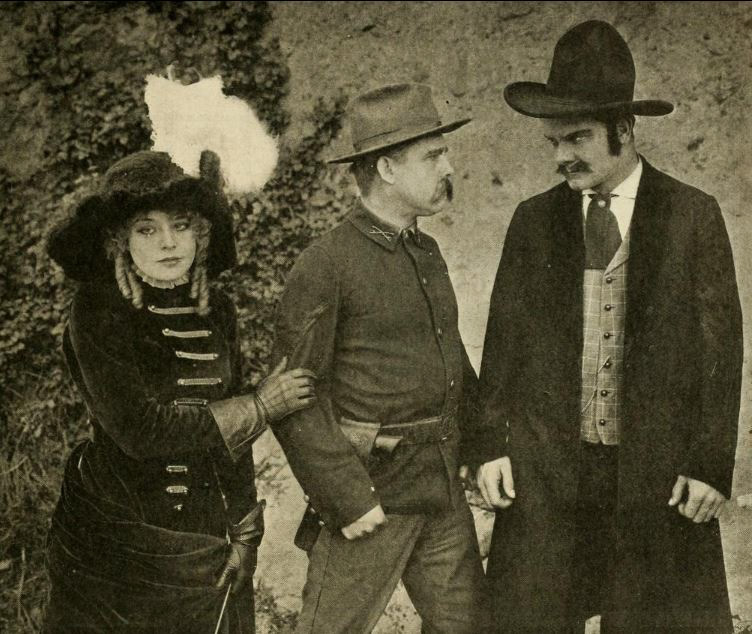
Scene from The Invisible Power
Cinematic perspective: Exploring the visual vocabulary of The Invisible Power (1914) through its definitive frames.
Transported to a frontier outpost whose barracks sit dwarfed by Monument-Valvian buttes, Mabel blossoms under borrowed biography. She stitches Dean’s tunics, learns parade drills, even flirts with dewy Lieutenant Sibley (Thomas Gillette). The desert sunlight, painted via amber tinting, bathes her in rebirth hues—until Lorenzo’s silhouette rears on the horizon, a black splotch against hand-tinted crimson sky. Their psychic duel is staged like a gunslinger showdown, only the holstered weapons are intentions. Dean, framed within a window sash, clutches field-glasses that serve as proto-cinematic viewfinders; he transmits willpower across negative space while Lorenzo counters with his own ocular assault. The sequence is a masterclass in silent-era montage: cross-cuts ping-pong between three points of perception—villain, heroine, savior—until subjectivity itself wobbles.
Viewers versed in The Temptations of Satan will spot parallel threads: the villain’s ability to infiltrate dreams, the heroine’s somnambulant compliance. Yet where Satan externalizes evil into goat-footed spectacle, The Invisible Power internalizes the diabolic, locating it in synaptic crevices. The film’s horror is not monstrous but medical—identity theft performed with surgical calm.
Sergeant Whitney’s vengeance subplot supplies the final narrative powder-keg. James W. Horne plays the aging trooper with stoic gravitas; his confession—overheard by chance—ignites a chain of violence worthy of Jacobean tragedy. The climactic grapple, lit by a solitary kerosene lamp, sees two men wrestle across a Spartan quarters strewn with regulation blankets. Hurst’s Lorenzo gains the upper hand via revolver, yet Whitney’s dying lunge—hands clawing for throat—channels primordial retribution. When the camera tilts to the gambler’s inert form, shadow pools where his eyes should be: a literal erasure of vision, mirroring Mabel’s earlier memory wipe.
Mabel’s post-carnage awakening is filmed in medium-close, dawn light tinting her face a spectral blue. She recalls nothing, blames a nightmare. Viewers must decide whether this amnesia is mercy or ultimate violation: a woman denied both trauma and agency, left to marry Sibley while patricidal blood soaks the floorboards beneath her bed. The camera doesn’t linger; iris-out contracts like an eyelid refusing to testify.
Performances & Direction
West underplays Dean’s omnipotence, favoring micro-gestures—an eyebrow twitch, the faintest curl of lip—over theatrical histrionics. The restraint makes his mental intrusions feel unsettlingly plausible. Ridgely oscillates between doe-in-headlights and serene domesticity without jarring dissonance; her body language—shoulders rounded inward, wrists perpetually mid-flutter—externalizes a mind perpetually bracing for intrusion. Hurst oozes decadence: fingers drum on waistcoat, cane twirls like idle malice. In a decade when villains twirled mustaches, Hurst opts for stillness—predatory patience.
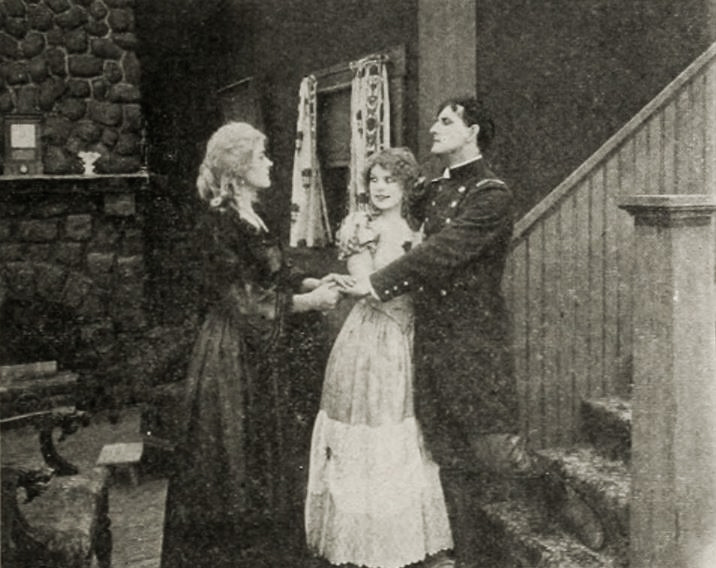
Director/scribe James W. Horne (who later co-helmed Buster Keaton’s college comedies) reveals early formal daring. Watch how he rhymes interior compositions: the dance hall’s checkered floor reappears in the fort’s mess hall, implying fate’s circular trap. Match-action cuts—Mabel lifting a spoonful of broth mirrored later lifting a canteen—subtly chart subconscious conditioning.
Scene from The Invisible Power
Cinematic perspective: Exploring the visual vocabulary of The Invisible Power (1914) through its definitive frames.
Cinematography & Visual Ethics
Shot by the unsung Frank Jonasson, the film revels in chiaroscuro. Candlelight carves cavernous shadows across Lorenzo’s office, turning mundane décor into Freudian recesses. Day-for-night scenes, achieved via cobalt filter and under-cranked exposure, render the frontier an oneiric wasteland. A hand-cranked flutter occasionally destabilizes motion, imbuing horseback rides with frenetic urgency. These primitive means anticipate the subjective cinematography later refined in On the Fighting Line and One Wonderful Night.
Ethically, the film’s stance remains ambivalent. Dean’s brainwashing is framed as protective, yet the absence of narrative comeuppance leaves a sour aftertaste—comparable to modern series that let antiheroes off moral hooks provided ratings stay robust. Contemporary critics, however, lapped up the telepathic malarkey; Moving Picture World hailed it as “a scientific thriller that electrifies with plausibility.”
Historical Context & Legacy
Released months before Europe burst into WWI, The Invisible Power channels pre-war nerves: the dread that unseen forces—ideologies, technologies—might hijack autonomy. Its depiction of mental suggestion dovetails with contemporaneous fad for spiritualism, just as The Exploits of Elaine exploited proto-science gadgetry for thrills.
Sadly, only a 35 mm print at the Library of Congress survives; most circulation prints decomposed in the flammable-nitrate inferno that claimed roughly 75 % of U.S. silent output. Hence any modern viewing carries archaeological gravitas—each flicker feels like séance, each splice a wound in collective memory.
Verdict
For aficionados who revere the hallucinatory melodrama of The Napoleonic Epics or the gendered power-plays in The Rival Actresses, The Invisible Power offers a compact, 24-minute punch of psychogenic noir. It interrogates identity as fluid text, anticipates post-war interest in psychoanalysis, and foreshadows everything from Manchurian Candidate to Inception.
Yet its triumph lies in ambiguity. No scene moralizes; no intertitle sermonizes. When end cards roll, we exit the nickelodeon unsure whether we’ve watched a rescue, a kidnapping, or a mutual folie à deux. That lingering moral vertigo makes this relic feel startlingly modern, a ghostly reminder that the most potent colonialism is not of land or capital but of consciousness itself.