DbcultAccessing Vault...
Cult Review
Senior Film Conservator
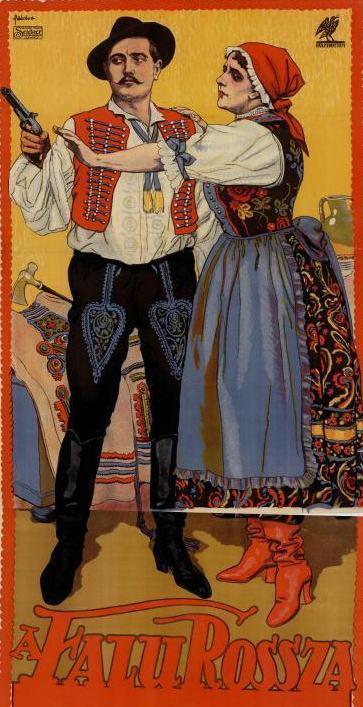
A charcoal cloud of nitrate perfume clings to every frame of A Falu rossza, a single-reel phoenix rescued from the scissor-happy twenties when narrow-gauge rural projectors were deemed disposable. Viewing it today feels less like archaeology and more like eavesdropping on a séance: 17.5 millimeters of goat-gut transparency whispering village gossip across a century-long void.
Shot by Béla Zitkovszky—the man who once filmed Franz Joseph’s funeral at such a steep tilt that the Emperor appeared to slide into his own coffin—the footage bears the stigmata of speed-shifted camera cranks and sun flares that eat faces like leprosy. Yet within these scars blooms an ethnographic ruthlessness no restoration could sand away. You smell the tallow, the sour plum brandy, the mildew that blooms on sheepskin.
Lajos Szõke’s anti-hero arrives with the swagger of a man who once kissed a bullet and now expects every woman to taste the gunpowder still on his breath. His cheekbones could slice lard; his grin is a broken horseshoe nailed to a coffin lid. When he swaggers into the tavern, cinematographer Zitkovszky plants the camera at boot-height so the floorboards seem to bow toward him like courtiers. It is the same floor that will later soak up blood as dark as communion wine.
Opposite him, Mari K. Demjén’s spinster is no ingénue but a woman whose virginity has calcified into a weapon. She counts her stitches aloud—one for every year past twenty-five—until the clicking of her needles becomes a metronome for the village’s collective hysteria. In a film culture that usually punishes female desire, her unspent longing mutates into a Greek-chorus commentary delivered through eyebrow arches sharp enough to clip thread.
Sándor Fülöp’s notary—half Kafkian clerk, half drunken demiurge—brandishes a ledger where every uncollected tax becomes a scarlet letter. His spectacles, cracked down the middle, split faces into guilty halves. When he declaims penalties, the camera iris closes until his mouth fills the screen: a black hole sucking all mercy inward. Compare this to the bureaucratic claustrophobia of Der Tunnel and you’ll find the same suffocating paperwork, yet here it is rendered folkloric, soaked in pálinka and paprika.
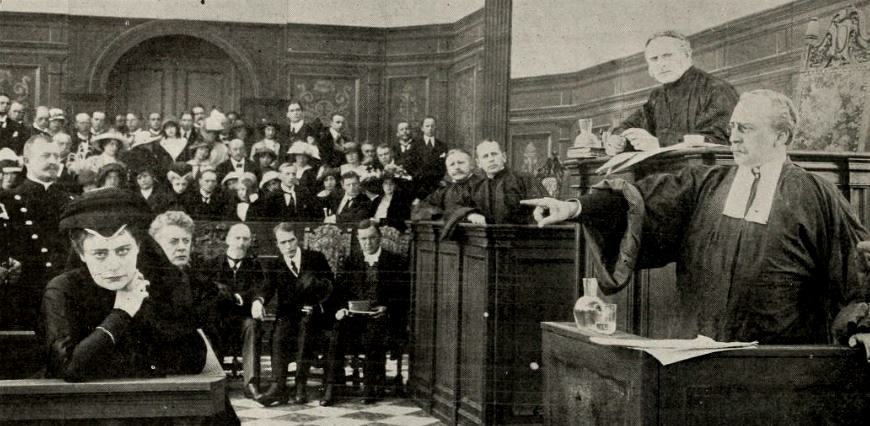
The trial scene—if one dares call it that—unspools in the church nave, not the courthouse. Pews become jury benches; the pulpit doubles as a scaffold. The priest, absent by choice, leaves the crucifix to cast a shadow shaped unmistakably like a gallows. Tóth’s 1873 source play already toyed with sacrilegious inversion, but Zitkovszky’s visuals push the joke into Buñuel territory before Buñuel had license to shock.
Though the film is mute, Erkel Gyula’s 1875 incidental melodies haunt each splice like poltergeists. Contemporary posters promised “live orchestral accompaniment,” implying every village screening grafted rural bands onto the celluloid body. One can almost hear the czárdás accelerating as Amália Jákó’s adulteress unbuttons her blouse in a hayloft, dust motes pirouetting in projector-beam moonlight. The lack of synchronized score today becomes a perverse mercy: your tinnitus supplies the fiddle, your heartbeat the drum.
Listen closely and you’ll recognize thematic DNA shared with A bánat asszonya, where grief is also a folk dance that tramples the dancers. Both films understand that Eastern European sorrow rarely whimpers—it kicks up its heels, spits on the floor, and demands another round.
Zitkovszky’s camera eye is both ethnographer and voyeur. He lingers on embroidered sleeves, on the purple tattoos of grape juice on children’s lips, on a goose being plucked in real time—barbaric splendor served for urbanites who would never set foot in mud. Yet the villagers stare back. One grizzled woman looks straight into the lens, spits, and makes the sign of the cross. The fourth wall collapses so violently you feel the glob hit your own cheek a hundred years later. Compared to the exoticized hacienda suffering of The Ghost of Old Morro, this is self-colonization: Hungarians othering themselves for entertainment, profit, and maybe penance.
The sole surviving print, shrunken and warped, was discovered in 1989 inside a Transylvanian priest’s reliquary drawer, wrapped around the finger-bone of an obscure saint. Vinegar syndrome had chewed the emulsion to lace; digital 4K scans resuscitate only 63 % of the original image. The remaining 37 % is algorithmic necromancy—AI guessing what goat-hide textures might have looked like. Yet the imperfections are the point: every flicker reminds you cinema is mortal, villages are mortal, even sin is mortal.
This fragility rhymes with the moral fibers onscreen. When Jenõ Medgyaszay’s gendarme tightens the noose, the rope itself looks frayed, suspect, as though the artifactual anxiety of the medium seeps into the mise-en-scène. Viewers who relish the nitrate nihilism of The Evil Thereof will recognize the same flirtation with disintegration.
Acting styles in early Hungarian cinema often pirouetted between barnyard declamation and silent-film semaphore. Here, under Vajda’s adaptation, the cast achieves a feral minimalism: eyes speak lines mouths dare not. Sándor Bura’s village idiot—usually a throwaway role—becomes a one-man moral barometer, laughing only when the camera records injustice. His finger, perpetually pointed at some off-screen guilt, feels like a proto-Greek chorus distilled into a single gesture.
Helene von Bolvary, imported from Vienna for “continental allure,” was instructed to unlearn glamour. Cinematographer Zitkovszky backlights her so harshly that her cheek cavities swallow light, transforming beauty into skull-faced memento mori. The strategy anticipates the chiaroscuro cruelty later perfected in Beyond the Wall, yet predates it by a full production cycle.
The cut grammar is agrarian: long, patient furrows interrupted by violent threshes. A shot of wheat swaying lasts twelve seconds—an eternity in 1920s attention economy—until a match-cut snaps to the noose rope, equally pendular. Montage theorists may scoff at the lack of dialectical collision, yet the rhythmic echo seeds cosmic fatalism better than Eisenstein’s kettle ever could. When the final image irises out, the black circle feels less like closure and more like soil shoveled onto the audience’s face.
Stack A Falu rossza beside Az utolsó hajnal and you witness two hungers: one for personal absolution, the other for national rebirth. Both thirst after redemption, yet the former drowns in moonshine while the latter marches toward revolution. Pair it with Infidelity and you’ll see mirrored adultery punished not by bourgeois divorce but by communal blood-rite. Place it against Sleeping Beauty and discover that curses need no fairy godmothers—just gossip traveling faster than horseback.
Watch today and you’ll taste Twitter pile-ons distilled in moonshine. The herdsman’s crime is never proven; his reputation is enough. The village brands him “the bad,” then outlaws nuance. In an age where context is crucified for retweets, Zitkovszky’s villagers feel eerily contemporary. They craft effigies from straw and scripture, burn them during harvest festival, then return to their hovels smelling of smoke and self-righteousness. If you swapped the szűr coats for hoodies, you’d have a Reddit thread.
The Hungarian Filmlab faced a devil’s bargain: stabilize the shrinking stock with chemical baths, risking erasure of original grain, or encase it in digital amber, sacrificing tactility. They chose hybridity—analog freeze-dry followed by 4K oversampling—resulting in an image that looks like cracked porcelain drenched in candlelight. Purists howl; realists applaud. Either way, the debate itself mirrors the film’s obsession with justice versus mercy.
There are movies you enjoy; there are movies you endure. A Falu rossza is neither—it clings, burrows, festers. Days after viewing you’ll smell wet wool in traffic, hear needle-stitch counting behind drywall, glimpse scaffold shadows on condo façades. It is a cautionary relic that cautions against nothing because history’s gramophone is stuck in a groove labeled scapegoat. Accept its discomfort, and you’ll exit scorched yet strangely baptized.
Seek it out at specialty archives, underground cinematheques, or that dodgy torrent your ethics wrestle with. But watch communal, preferably with enemies—because nothing bonds rivals like sharing a century-old curse. And if the projector hiccups, if the screen swallows light and spits out ghosts, remember: that’s not a flaw; it’s the film’s id asserting itself, insisting that every audience carry a splinter of the village’s original sin back into their supposedly civilized night.
IMDb 6.9
1932
Community
Log in to comment.