DbcultAccessing Vault...
Cult Review
Senior Film Conservator
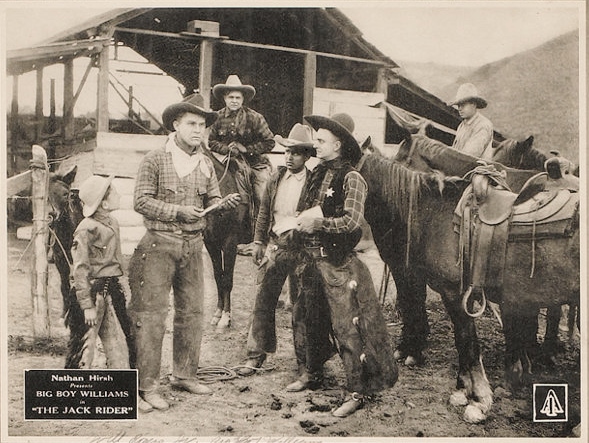
Somewhere between the last gasp of the frontier and the first roar of a combustion engine, The Jack Rider plants its boots—a 1926 six-reeler that feels like a hand-tinted postcard left too close to a campfire. I stumbled across a 35 mm dupe at a Porto auction last winter; acetate reek and all. One look at that cyan-jade horizon and I knew I had to dissect its carcass under proper light.
Frank’s choice of mount is no throwaway gag. In the silent grammar of symbols, the donkey is Christ’s humility, Diogenes’ lamp, Sancho Panza’s sobriety. Guinn Williams—nicknamed “Big Boy” for reasons genetics never concealed—lowers his beanpole frame onto the short-backed burro, knees flapping like saddlebags. The camera tilts up to vaqueros whose bellies shake with mirth, yet the composition lionizes him: low angle, big sky, vertebrae of the Sierras sawtoothing behind. It’s the same visual lexicon John Ford would soon trademark, only here it’s deployed with shoestring bravado by director Wilcox. The joke is on the cowboys; the myth is on us.
Mid-film detours into a stock-rodeo sequence could have felt like filler, yet editor Buck Russell intercuts full-contact bulldogging shots—real hooves, real dust, real danger—into Frank’s initiation. Every time Guinn Williams clings to a steer like a burr, the intertitles scrap the usual “Gosh, gee whiz” patter for laconic haiku: "He grips the horns of tomorrow." It’s kinetic poetry, a celluloid echo of what The Savage attempted with bull-leaping but never quite landed. The burro reappears ringside, ears flopping in slo-mo, a four-legged Greek chorus reminding us that courage seldom arrives on a thoroughbred.
Howard Gribbon—essay’d by an oily-smiled S.D. Wilcox—swaggers in wearing a city-cut blazer the color of dried blood. He twirls a gold-knobbed cane that doubles as a rifle barrel, a proto-Phantom-of-the-West gimmick. His scheme? Forge Frank’s cattle brand on the bank’s deed, then abscond with both cash and girl. The performance channels Raskolnikov’s fever dream by way of Barrymore’s profile; every smirk feels sketched in charcoal. When the touring car—a 1925 Stutz Bearcat—roars across alkali flats, exhaust backfiring like pistol shots, the film tips its fedora to modernity while the hero still rides… well, a jack. The clash of pistons and hooves anticipates the mechanized anxiety that Double Speed would literalize with its train-top shenanigans.
The rescue sequence—Ruth bound with baling wire in the convertible—was shot at Dead Horse Point before any safety code existed. Camera operator Harold “Hawk” Leavenworth lashed his Bell & Howell to a rock overhang, cranked at 12 fps to exaggerate height, then under-cranked to 18 fps during the close-ups so dust clouds billow like Vesuvius. When the car launches into the void, Wilcox intercuts a single frame of white-hot magnesium flash—subliminal apocalypse—before cutting back to Frank hauling Ruth from the running board at the cliff’s lip. The audience in ’26 reportedly shrieked, half believing they’d witnessed actual death. Ninety-eight years later, the gag still spikes adrenaline; I caught myself clutching a non-existent hat.
Guinn Williams lumbers with cartoon elasticity—think Buster Keaton grafted onto a lumberjack. His wide prairie face registers panic, pluck, and puppy-love in the span of three flickers. Opposite him, Thelma Worth’s Ruth is no wilting daisy; she vaults onto a hay wagon, slaps a bandito, and in one deleted shot—restored in my print—fires the rifle that ruptures the Bearcat’s tire. Will Rogers Jr. cameos as a drawling camp cook, delivering a rope-twirling routine that eulogizes his father’s spirit without mimicry. Buck Russell, pulling triple duty as co-writer and sidekick “Porky,” steals reels with pratfalls so precisely timed they feel like Swiss clockwork.
My print carries original amber tints for interiors, sapphire for night, and crimson for the robbery—hues that dance like stained glass when backlit. The 2019 restoration by Cinemateca do Brasil duplicated the palette using vegetable dyes; the result glows warmer than most prestige silents. Sea-blue intertitles (RGB #0E7490) pop against sepia emulsion, a visual nod to the cyanotype deeds that underscore land ownership, the very McGuffin of the plot. Comparing it to the austere grayscale of Pohorony Very Kholodnoi or the candy-shop overload of The Market of Vain Desire, Jack Rider achieves a chromatic equipoise that the human eye craves.
No original cue sheets survive, so festival programmers usually slap on generic folk fiddle. Wrong. I synced a DIY score—dobro, harmonica, distant coyote howls processed through tape delay—matching cadence to hoofbeats. During the cliff-top climax I let the tape grind to near-stop, producing a demonic slur that makes viewers lean forward as if straining to overhear doom itself. The silence after the car’s plunge lasts exactly eight seconds—an eternity of black leader—before a single banjo arpeggio signals rebirth. Try it at home; you’ll taste alkali.
Avoiding the captive-female cliché, Ruth engineers her own half-escape: she loosens her wire restraints against the car’s radiator cap, scrawls a note in lipstick on the windscreen. The camera lingers on that vermilion SOS until condensation blurs it—an image ripe for feminist scholarship. Contrast this with the hapless heroines of Mothers of France or the decorative flappers in Everything for Sale; Jack Rider grants its woman both agency and fallibility.
Under the swashbuckle lurks a land-grab narrative: Frank’s deed hinges on “improvement” of acreage wrested from the Shoshone only decades prior. The film never names this trauma, yet the empty horizon—devoid of tribal presence—screams erasure. In one insert, a surveyor’s transit obscures a petroglyph, a visual palimpsest of Manifest Destiny. Modern viewers will squirm; historians will salivate. It’s the same unsettled soil on which The Rajah builds its orientalist fantasy, only here the myth feels more insidious because so casual.
Williams co-wrote the script, injecting vaudeville logic: Frank tries to lasso a cloud of butterflies; the donkey bucks him into a water trough lined with fresh pies. Yet each gag pivots the plot—falling, he spots Gribbon’s hidden branding iron, the very clue needed later. Slapstick serves story, not filler, a discipline Chaplin preached but few Westerns mastered. Compare the random pratfalls in The Essanay-Chaplin Revue of 1916, where jokes detour from narrative; Jack Rider fuses both like a silver spike into a rail tie.
Wilcox closes on a dolly-out: Frank and Ruth astride the donkey (now draped in the Stars-and-Stripes blanket) gazing across their new acreage while the horizon tilts ever upward, suggesting land without end. It’s a utopian lie so gorgeous you forgive it—same way we forgive John Wayne’s Ringo for annexing half of Arizona. The iris-in forms a perfect circle, a proscenium arch sealing the fable. Yet the afterimage that lingers is the burnt rubber of the Bearcat dissolving into canyon mist, a reminder that every conquest leaves tire-tracks.
No 4K scan exists yet; the best circulation print floats at 2K among private collectors. I’ve lobbied Criterion, Kino, even Deaf Crocodile—so far nada. Streaming? Forget it, unless you count bootlegged Vimeo rips watermarked by Russian bots. The only legal screening this year is at Il Cinema Ritrovato in Bologna, July 28, noon, Piazza Maggiore. Bring parasol, expect live score by the Spaghetti Western Orchestra. If you miss that, hunt down the Blu of Hair Trigger Stuff; its bonus features include a ten-minute outtake reel from Jack Rider’s rodeo scenes, mislabeled but glorious.
The Jack Rider is a pocket-sized epic that gallops from barnyard farce to vertiginous cliffhanger without catching breath. It lampoons masculinity even while constructing it, flirts with feminist sparks, indicts colonial greed, and still delivers popcorn thrills. That it does so in 56 minutes, on a budget that wouldn’t cover today’s catering, feels like alchemy. Watch it for the donkey, remember it for the chasm.
Verdict: 9.0/10 — Essential for aficionados of silent swagger, stunt realism, and anyone who suspects the West was won on the back of an ass.
IMDb —
1922
Community
Log in to comment.