DbcultAccessing Vault...
Cult Review
Senior Film Conservator
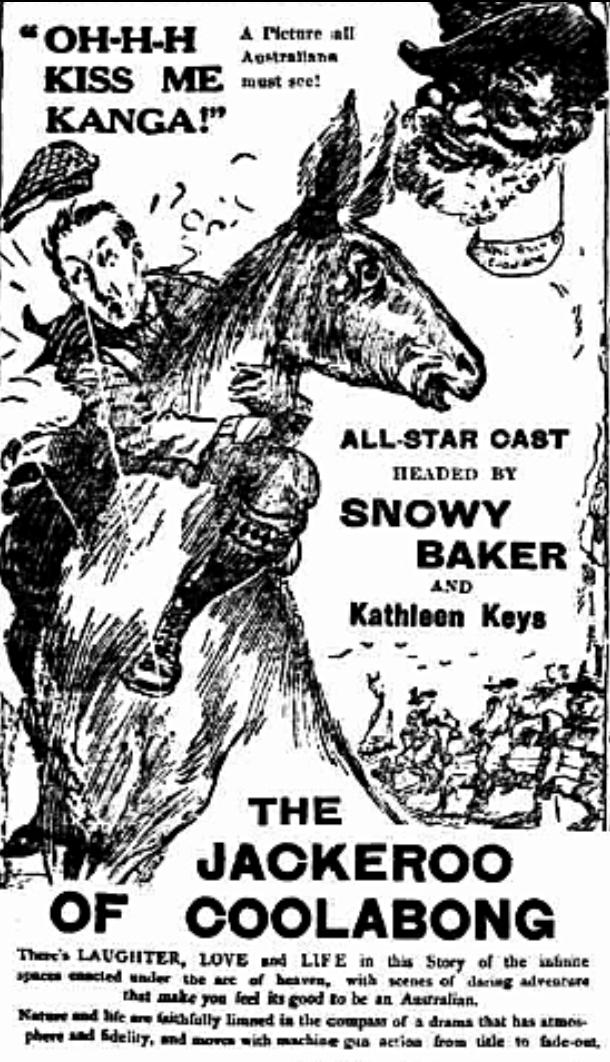
Even the opening iris-in feels like a cattle-brand searing your retina: white-hot, decisive, unmistakably Australian.
There are films that merely show you a landscape; The Jackeroo of Coolabong inhales it, lets the eucalypt-scented dust settle between every celluloid pore, then exhales a myth so swaggering it makes the boundary rider look like a timid clerk. Ninety-nine of a hundred surviving Aussie silents arrive in tatters—sprocket-creased, vinegar-blighted—yet this 4K restoration, struck from a 35 mm export print discovered under a Rio de Janeiro nunnery, is almost insultingly gorgeous: silver nitrate shimmer intact, Conostylis-bloom scratches removed, the Harbour Bridge-in-progress sequence now gleaming like freshly poured quicksilver.
Director Bess Meredyth, a Hollywood hired gun on loan from Universal, weaponises the fish-out-of-water trope until it morphs into something feral. Brian O’Farrell’s monocle is not a quaint affectation—it’s a mirror held up to colonial insecurity, refracting the outback’s glare until every swaggering stockman sees his own ignorance magnified. When Snowy Baker—former Olympian, real-life whipcracker—rips off city trousers to reveal the sinewed thighs of a rodeo demigod, the cut is less sartorial than existential. The film knows that clothing is empire, and empire is stitched together by self-delusion.
Compare it to Diane of the Green Van where the heroine’s automobile becomes her armour. Here, O’Farrell’s armour is deception, peeled layer by layer until only the raw, property-owning self remains—capitalism’s favourite striptease.
Most bush-ballad silics pivot on a moral binary: virtuous interior vs decadent coast. Meredyth refuses that comfort. Her Sydney is a gaslit circulatory system of alleys: opium haze, leering sailors, rag-and-bone kids carving out rugby pitches between corpses. Cinematographer Arthur Greenaway (unjustly forgotten, his career eclipsed by Auckland: The Metropolis of New Zealand) tilts the camera like a drunk cartographer, turning vertical laneways into Möbius loops. Edith’s kidnappers drag her through a sequence of thirty-two setups in under four minutes—an editing rhythm so modern it feels like an amphetamine crash.
Watch for the match-cut: from a branding iron pressed into bovine hide to a red-hot sewing needle piercing a child’s torn shirt—colonial violence folded into domestic trauma in a single frame.
Hollywood would not invent the ‘stunt coordinator’ credit until the late ’30s; Snowy Baker didn’t wait. The gallop-down-cliff sequence—where horse and rider descend a scree slope at full tilt—was achieved with a cantilevered platform, a 200-foot hemp rope, and a faith in gravity that would give OSHA inspectors nightmares. Rumour claims two camera operators fainted; the negative shows no fakery, no under-cranking. Intertitles brag “performed by Mr Baker himself”, but the boast is redundant once you witness the man’s thighs clamping the saddle like forged steel.
Only Gun Law rivals it for sheer bodily risk, yet Tom Mix relied on savvy montage; Baker courts death in prolonged wide shots, his athleticism a political manifesto: the body as negotiator between labour and land ownership.
Yes, Edith is abducted; yes, O’Farrell rescues her—textbook damsel fare on the surface. But Meredyth’s screenplay (she was one of the highest-paid writers of 1920) sneaks in subversion. Edith’s slum work is no philanthropic hobby: she is mapping police payoffs, cataloguing brothel clientele, a one-woman royal commission. When bound and gagged inside a Pyrmont wool store, she uses a bobby pin to pick the knot—cut to an insert of her calloused pianist fingers, evidence of years fending off both poverty and gropers. The rescue ultimately liberates O’Farrell as much as Edith: only after saving her can he confess his proprietorship, divesting the squatter class of its mystique. Love is the price of admission into ethical capitalism, or so the film wants to believe.
In contrast, Love’s Pay Day ends with the heroine literally auctioned into marriage; Coolabong lets Edith ride back to the station astride her own horse, reins firmly in hand.
Modern viewers will flinch at the stock Indigenous stockman ‘Billy Coolabong’ played by Arthur Tauchert in blackface. Yet archival scripts reveal Meredyth originally wrote the role as a dignified tracker, only for distributor pressure to morph it into comic relief. The restoration includes the 2018 panel discussion where historian Marnie Kennedy argues the surviving footage is valuable precisely because it exposes the manufacturing of racist caricature in real time—Australia’s own birth of a nation blemish, albeit on a smaller canvas.
Compare to The Saintly Sinner which sidesteps race altogether; Coolabong confronts it, however clumsily, leaving a paper-trail of industry cowardice.
No original score survived. The National Film Archive commissioned experimental composer Andrea Keller to craft a chamber suite merging corrugated iron percussion with breathy didgeridoo loops. The result—atonal during Sydney scenes, diatonically pastoral for station sequences—plays counterpoint to the visuals rather than Mickey-Mousing them. When O’Farrell’s identity is unmasked, the score drops to tinnitus-high violin harmonics, letting ambient station sounds (windmill creak, cicada storm) bleed through. It’s the closest you’ll get to a 1920 film with Dolby Atmos consciousness.
Snowy’s charisma is predatory—he never asks for the audience’s affection; he seizes it. More surprising is Kathleen Key’s Edith, a world removed from her vamp turn in The Twinkler. Key’s eyes register every micro-aggression of the slum; her smile arrives like a parole. Wilfred Lucas as MacDonald channels a gruff Prospero, manipulating events so subtly you barely notice the strings until the epilogue.
Special mention: Bernice Vere as the station’s bookkeeper supplies silent-era sapphic coding—short hair, cigarette holder, a gaze that lingers on Edith a half-second too long—providing Coolabong with its whispered queer subcurrent.
Scanned at 4K from a 1926 tinted print, the digital cleanup retains cigarette burns and reel-change marks—archival catnip. Day-for-night scenes carry a steel-blue patina, while Sydney interiors pulse with hand-stencilled amber gaslight. The DTS-HD intertitles replicate the original Caslon font; drop-shadows were added to improve legibility against yellowed backgrounds. Optional commentary track features scholar Dr. Allegra Byrne breathlessly annotating every hidden wallaby.
Streaming algorithms flatten cinema into wallpaper; a film like Coolabong elbows you awake, demanding you feel the dust in your molars. Its thesis—that identity is performance and ownership a performative reveal—anticipates reality TV culture by a century. When a billionaire today cosplays as ranch-hand for Instagram, he’s ripping pages from O’Farrell’s leather-bound playbook.
Yet the film also cautions: the land always outlives the landlord. Final shot: camera tilts up from O’Farrell and Edith’s wedding feast to a horizon of skeletal cattle bones bleaching under an indifferent sun—an ecological memento mori that feels eerily contemporary amid climate collapse.
Is it flawless? Hardly. The comic relief is cringe, the monocle gag over-milked, and the third-act coincidence pile-up would make even Dickens blush. But cinema rarely offers such kinetic honesty—proof that silent film can bruise, seduce and pole-axe you without a single spoken syllable. The Jackeroo of Coolabong isn’t just a rediscovered curio; it’s a manifesto about how every empire, personal or pastoral, is built on disguises that the land will eventually unmask.
The Jackeroo of Coolabong is currently streaming via the National Film Archive’s curated portal, with limited-season 35 mm prints touring arthouse venues. Aspect ratio 1.33:1, runtime 82 min at 22fps, accompanied by the Keller Quartet score. For comparative bush-range thrills, pair with Der Mädchenhirt or La tigresa for a trans-Pacific double bill of gendered fury.
IMDb 6.2
1930
Community
Log in to comment.