DbcultAccessing Vault...
Cult Review
Senior Film Conservator
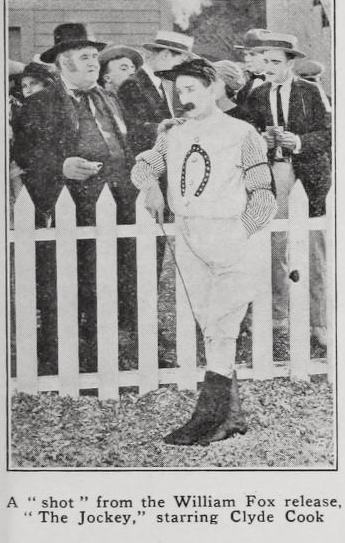
Picture, if you can, a Saturday matinee in 1921: nickelodeon chandeliers flicker, a war-weary audience inhales the perfume of roasted peanuts, and onscreen a wiry stable boy vaults from hay bales to horseflesh with the elastic athleticism of a Chaplin cameo. That boy is Clyde Cook’s Clyde, a grease-pencil grin stretched across a face that has never known indoor plumbing. His life is a concatenation of wheelbarrows, curry-combs, and the sour stink of liniment—until the plot, lean as a greyhound, snaps taut.
Lois Scott’s Lois—sunbonnet askew, eyes the color of rainwater in a barrel—inherits nothing save a cottage mortgaged to the rafters. Her father, a compulsive punter who would wager the laces off his boots, has staked everything on one last flutter: a velvet-black mare rumored to outrun her own shadow. Enter Clyde, whose devotion mutates from mucking stalls to risking vertebrae at 40 mph atop an animal that treats the bit like a suggestion rather than a command.
The racetrack becomes a secular cathedral: railbirds chant in dyspeptic unison, bookies brandish chalk like priests of probability, and the dust that powders every brimmed hat is transubstantiated into the very dust of dreams.
Director Edward Sedgwick—later to helm The Skipper’s Scheme—shoots the hoof-clatter in staccato silhouettes, intercut with close-ups of betting slips trembling like Pentecostal tongues. The camera, starved of dialogue, clings to sinew: a calf muscle twitching above a leather boot, the mare’s flank foaming like surf against rocks, Clyde’s Adam’s apple bobbing as he swallows terror. These are the hieroglyphs of silent cinema, and they spell out a single sentence: everything you love can vanish between two heartbeats.

Yet the film is no mere cliffhanger; it is a social x-ray. Notice how the grandstand’s upper tier is reserved for silk-hatted plutocrats who never soil their spats, while stablehands hustle below, nostrils caked with dung. When Clyde dons the jockey’s rainbow silks, he crosses a caste line stitched in satin. The costume change is both fairy-tale and proletarian revolt—Cinderella in reverse, swapping rags for armor.
Modern viewers, spoiled by Dolby hoof-thumps, may assume a silent race sequence feels anemic. Wrong. The absence of Foley-artist thunder forces us to imagine the percussion of 16 hooves against loam; the mind supplies a timpani more visceral than any studio mix. Try it: watch the final furlough with earplugs and you’ll swear you feel cardiac resonance in your molars.
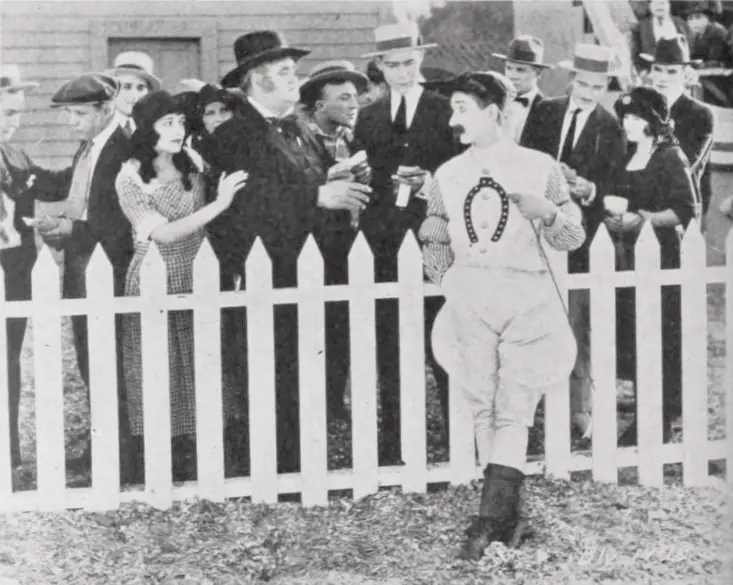
Compare this to Frenzied Film, whose Keystone mayhem relies on speed-cranked slapstick. The Jockey slows the shutter instead, letting motion blur smear across the frame like wet oil paint. The mare becomes a charcoal comet; Clyde’s face, streaked with sweat-caked dust, resembles a trench soldier. The effect is expressionist, closer to The Cabinet of Dr. Caligari than to Way Out West.
Clyde Cook, an Australian vaudeville contortionist, moves as though his joints are strung on bungee cord. Watch the way he vaults a stable door: feet tucked, spine parallel to the ground, a human boomerang. But beneath the pratfalls lurks a Stanislavskian truth—his pupils dilate when Lois enters the barn, a micro-gesture that wordlessly confesses I would ride through fire for you.
Lois Scott, often relegated to ingenue wallpaper in The Small Town Girl, here wields her silence like a rapier. She doesn’t weep when the mortgage papers flutter; she freezes, the breath caught between clavicle and corset, letting the audience project oceans of dread into that stillness. It is a masterclass in negative space.

The surviving 35 mm print—recently restored by EYE Filmmuseum—reveals tinting that does narrative heavy-lifting. Day-for-night sequences glow cerulean, instilling nocturnal menace; the paddock erupts in amber like a kerosene lantern. During the climactic race, individual reels flash blood-orange, a subliminal countdown to cardiac detonation. These chromatic cues, absent from talkies, operate like synesthetic chapter headings.
Note how the mare—nameless, merely “the speedy mare”—functions as triple metaphor: she is locomotive, lottery ticket, and feminine body. When Clyde straddles her, the sexual subtext is unmistakable yet tactfully Victorian. The film refuses to dismount into the rodeo misogyny that hobbles Blazing the Way; instead, power oscillates between rider and ridden. In one electrifying insert, the mare rears, jerking the bit; Clyde’s hat tumbles, and for a heartbeat she surveys him, a queen auditing her subject.

Stack it beside L’hallali, a Belgian hunting drama that likewise equates survival with pursuit; both films end with a freeze-frame of breathless ambiguity. Contrast it with Ambrose in Turkey, where colonial slapstick trivializes peril—The Jockey treats destitution as apocalypse. Finally, hold it against Treason, a wartime parable; whereas Treason externalizes villainy into enemy soldiers, The Jockey internalizes it into bookie ledgers and compound interest.
As of this month, the 4K restoration tours arthouses (DCP, 1.33:1, Dutch intertitles with English subs). For home cinephiles, Kino Cult offers a Blu-ray with commentary by scholar Denise Dal Vera; she excavates production memos that reveal the racetrack scenes were shot at the defunct Emeryville Speedway, its curves still scarred by Prohibition-era tire grooves. Digital renters can find it on FilmBox+ or snag a 99-cent hi-def on Internet Archive—but caveat emptor: the cheaper file lacks tinting, neutering the chromatic storytelling.
The Jockey is not a relic; it is a time-loop in which debt, desire, and destiny sprint neck-and-neck. Its brevity—under an hour—means every shot secretes narrative adrenaline. You will exit twitching for the paddock, half-tempted to pawn your phone for a betting slip, half-aware that love itself is the wildest longshot ever foaled.
Grade on the Leonard Maltin 4-Scale? A volcanic ★★★★—not because it is flawless, but because its flaws (a missing reel, jittery splice burns) only enhance its pulse. In an era when CGI stallions can outrun physics, The Jockey reminds us that genuine peril—flesh on flesh, hoof on earth—remains the most visceral FX money can’t buy.
Stable boy + speedy mare + foreclosure = 53 minutes of silent-era nirvana. Stream the 4K, survive the final furlong, thank me at sunrise.
IMDb —
1920
Community
Log in to comment.