DbcultAccessing Vault...
Cult Review
Senior Film Conservator
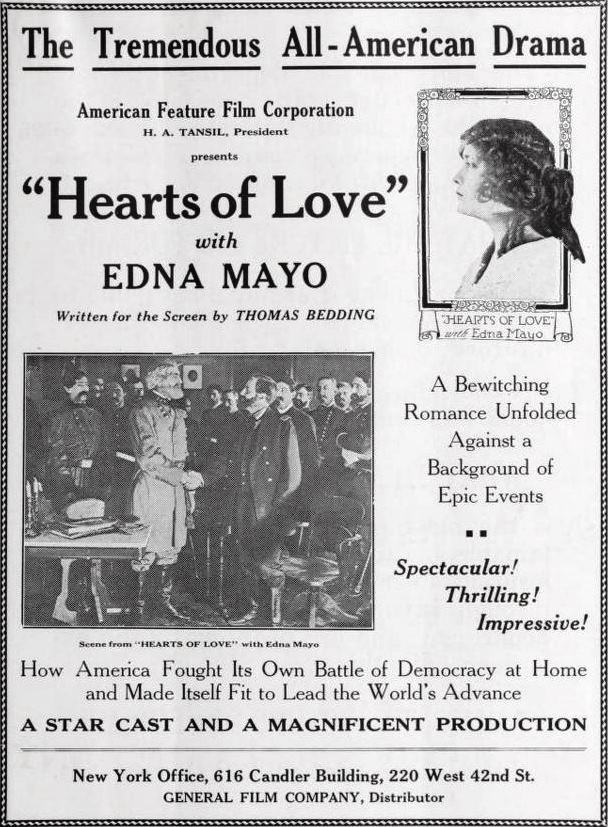
Stepping back into the silent era, one often expects grand gestures and melodramatic arcs, but every so often, a film emerges that transcends its technical limitations, speaking directly to the enduring human spirit. Such is the case with 1918's Hearts of Love, a poignant and surprisingly nuanced drama penned by Thomas Bedding. This isn't just another period piece; it’s a profound exploration of fidelity, malevolence, and the sheer tenacity of the human heart when confronted with both personal tyranny and national upheaval. The narrative centers on Virginia, a character whose unwavering devotion becomes the very crucible in which the film's most potent themes are forged.
At the core of this compelling drama is Virginia, brought to life with remarkable grace and understated power by Edna Mayo. Her portrayal is not merely an exercise in silent film acting; it’s a masterclass in conveying deep emotional fortitude through subtle expressions and compelling physicality. Virginia's sweetheart is off serving in the Union army, a distant figure whose presence, though unseen for much of the film, acts as a constant north star for her moral compass. This foundational commitment is immediately challenged by the sinister presence of a former plantation overseer, a character who embodies pure, unadulterated malice. The film, through Mayo's performance, articulates the silent suffering and quiet defiance that define Virginia's struggle. It’s a testament to her character's internal strength that she doesn't succumb to despair, even when the odds are stacked so heavily against her. Her refusal to yield, to compromise her love and integrity, forms the emotional backbone of the entire production.
The overseer, a truly loathsome figure, is depicted with chilling effectiveness by William S. Christian. His performance is a stark contrast to Mayo's quiet strength, providing the necessary antagonist to propel Virginia's journey through adversity. Christian doesn't just play a villain; he embodies the very essence of calculated cruelty, leveraging his past position and the tumultuous socio-political climate to exert control and inflict suffering. His actions are not random acts of villainy but rather a systematic campaign to break Virginia's spirit and sever her ties to her beloved. This relentless pressure creates a palpable tension that permeates every frame, making the audience acutely aware of the stakes involved. The film's brilliance lies in its ability to humanize Virginia's plight without sensationalizing the overseer's depravity, allowing the audience to truly connect with her struggle for emotional and spiritual freedom.
While Edna Mayo and William S. Christian anchor the central conflict, the supporting cast provides crucial texture and depth to the narrative. Gladden James, though perhaps not as prominent in the immediate conflict, brings a certain gravitas to his role, representing the distant hope and ideal that Virginia clings to. His presence, however brief or symbolic, is vital in validating Virginia's unwavering commitment. Frederick Truesdell, Fred Hearn, Lillian Snyder, Victor Dougherty, and Lottie Blair Parker all contribute to the rich tapestry of characters, each adding layers to the film's depiction of a community grappling with the profound disruptions of war and personal vendettas. Their performances, even in the absence of spoken dialogue, convey a remarkable range of emotions, from complicity and fear to quiet support and resistance. It's a testament to the directorial vision and the actors' craft that these secondary figures feel fully realized, contributing meaningfully to the overall emotional resonance of the film.
Thomas Bedding, credited as the writer, deserves considerable praise for constructing a narrative that, despite its period setting, feels remarkably universal in its exploration of human resilience. The plot, while straightforward in its central conflict, is rich in its emotional implications. Bedding avoids simplistic good-versus-evil tropes by imbuing the overseer with a persistent, almost bureaucratic malice, rather than just cartoonish villainy, making his threat feel more insidious and pervasive. He understands that true drama often lies not in explosive confrontations but in the quiet, internal battles fought against relentless external pressures. The pacing of the story, characteristic of the silent era, allows for moments of prolonged emotional tension, letting the audience fully absorb Virginia's predicament and her responses to it. This deliberate unfolding of events enhances the impact of her eventual triumphs, however small they may seem.
The overarching theme of loyalty is explored with profound depth in Hearts of Love. Virginia's unwavering commitment to her sweetheart is not merely a romantic ideal; it's a defiant act of self-preservation in the face of an oppressive force. Her loyalty extends beyond a single individual; it represents an allegiance to her own values, her dignity, and her hope for a better future. This theme resonates powerfully when contrasted with the destructive forces at play, mirroring, in a microcosm, the larger conflict of the Civil War itself. It reminds us that even in times of great societal upheaval, personal integrity and emotional bonds can serve as anchors against the currents of chaos.
The film also delves into the psychology of power and its abuse. The overseer's actions are not just about revenge or personal gain; they are about control, about breaking another's will. This makes his character particularly chilling, as his motivations tap into a darker aspect of human nature that transcends specific historical periods. Virginia's struggle, therefore, becomes a timeless battle against oppression, a narrative that finds echoes in countless stories of individuals resisting systemic or personal tyranny. One might draw parallels to the quiet defiance seen in films like The Secret of Eve, where protagonists navigate intricate webs of deceit and control, or even the intense emotional stakes of Her Man, which also explores a woman's unwavering devotion amidst dire circumstances.
Set against the backdrop of the American Civil War, Hearts of Love skillfully uses its historical setting to amplify its emotional stakes. The war itself is not the central focus, but its lingering effects – the societal fractures, the personal losses, the shifting power dynamics – are deeply felt. The 'former plantation overseer' detail is significant, hinting at the complex racial and class tensions that defined the post-bellum South, even if the film's primary focus remains on the interpersonal drama. This contextual depth adds another layer to Virginia's struggle, making her resistance not just personal but also symbolic of a larger fight for justice and autonomy.
In the broader landscape of silent cinema from this period, Hearts of Love holds its own. While it may not possess the epic scale of something like The Life and Passion of Jesus Christ or the intricate spy thrills of An Affair of Three Nations, its strength lies in its concentrated emotional intensity. It shares a thematic kinship with other dramas of the era that explored human relationships under duress, such as Tangled Lives (also from 1918), which similarly delved into complex interpersonal dynamics amidst challenging circumstances. The film’s ability to convey profound psychological states without spoken words is a testament to the expressive power of silent film acting and direction. The visual storytelling, though perhaps not groundbreaking for its time, is effective in establishing atmosphere and character motivation, relying on close-ups and carefully composed shots to communicate the inner turmoil and external threats faced by Virginia.
Even a century after its release, Hearts of Love retains a surprising degree of emotional potency. Its central conflict – an individual fighting to preserve their dignity and love against malicious forces – is a narrative that transcends time and medium. The performances, particularly Edna Mayo's, offer a window into the nuanced acting styles of the silent era, demonstrating how much could be conveyed without a single spoken word. The film serves as a valuable artifact, not just for its historical context but for its enduring message about the resilience of the human spirit. It reminds us that love, in its purest form, can be a revolutionary act, a defiant stand against even the most formidable adversaries. Unlike many forgotten films of its time, Hearts of Love manages to articulate a universal truth, making it a compelling watch for anyone interested in the foundational narratives of cinema and the timeless power of human connection.
The film's exploration of emotional fortitude, set against a backdrop of national strife and personal persecution, makes it a compelling study in silent storytelling. It's a reminder that even when external circumstances are bleak, the internal landscape of loyalty and hope can remain vibrant and unyielding. Thomas Bedding’s script, combined with the evocative performances, crafts a narrative that is both deeply personal and broadly resonant. It’s a film that quietly asserts the enduring power of love in the face of seemingly insurmountable odds, a message as relevant today as it was in 1918.
IMDb —
1929
Community
Log in to comment.