DbcultAccessing Vault...
Cult Review
Senior Film Conservator
A Canvas of Shadows and Satin
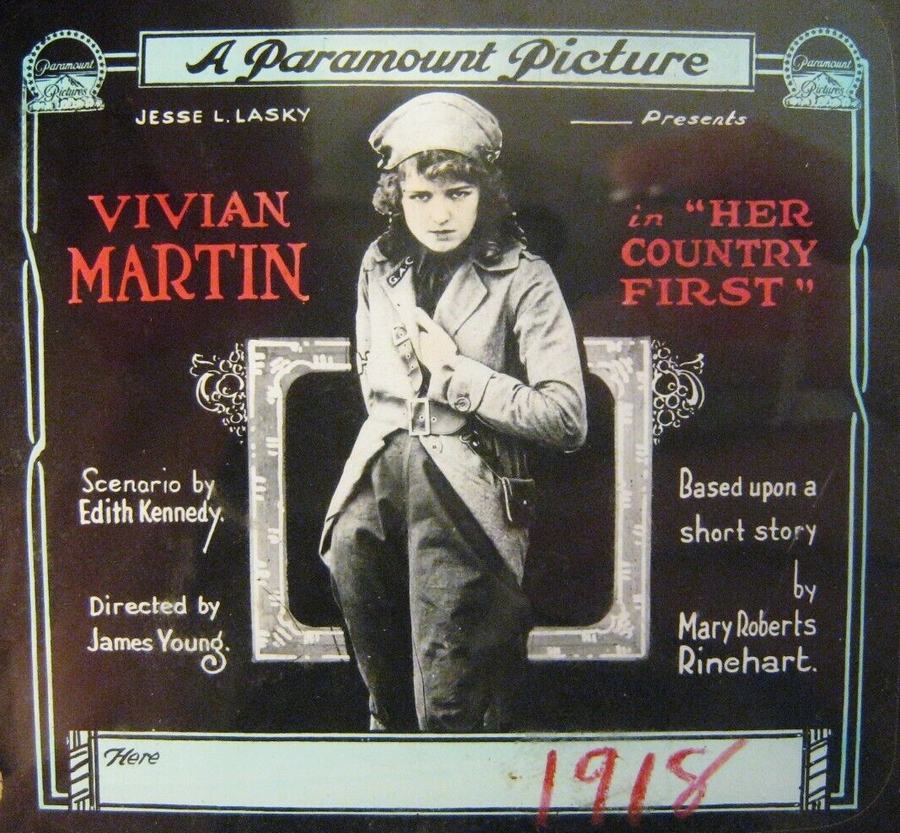
Edith M. Kennedy and Mary Roberts Rinehart stitch Her Country First from contradictory cloth: part society-page satire, part munitions-plant powder keg. The tonal whiplash is deliberate; the film wants you laughing at petticoat drills one moment and fearing the hiss of a fuse the next. Director Louis Willoughby—never a household name, always a conspirator of atmosphere—shoots the Grant mansion like a cathedral of privilege: marble staircases spiral upward in chiaroscuro, gaslight pools tremble across parquet seas. Notice how the camera lingers a half-second longer on door hinges, on gloved hands hovering over grapefruit rinds—everyday objects turned harbingers. The result is a home-front noir five years before When a Man Sees Red flirted with urban shadows, and a full decade before Lang’s Spione codified the genre.
Dorothy Grant: Flapper Joan of Arc
Vivian Martin plays Dorothy with the brittle radiance of a champagne flute—one high C away from shattering. Watch the micro-shifts in posture: spine ramrod beneath military cape, then a sudden wilting when the password slips from her mouth like an accidental confession. Martin’s eyes perform double duty, toggling between zealot’s fire and doe-in-headlights dread. In the climactic factory sequence, her face is half-lit by the red glow of emergency bulbs, half-swallowed by abyssal black; it is a silent-era piéta framed against machinery built to dismember. Feminist critics often hail Pretty Mrs. Smith for its proto-liberated heroine, but Dorothy Grant predates and outflanks her: she does not merely seek a husband’s permission; she commandeers the very mechanisms of war.
Espionage as Etiquette
The script’s genius lies in weaponizing parlor civility. Espionage here is not trench-coated lurkers on foggy docks; it is the hush that follows an after-dinner anecdote, the pause before a silver cloche lifts. When Dorothy accuses Williams of espionage because of his citrus bisection, the moment is absurd on paper yet chilling onscreen—an Alice-through-the-looking-glass inversion where table manners become cryptography. Compare this to Rasputin, the Black Monk, where mysticism cloaks political intrigue; in Her Country First, the cloak is monogrammed linen.
Gendered Militarism and the Sky-Blue Corset
Costume designer Florence Oberle delivers one of silent cinema’s most slyly subversive wardrobes. The Girls Aviation Corps uniforms are cadet-sharp—wool tailored to imply epaulets without violating 1917 decency boards—yet the skirts stop an inch above the ankle, revealing puttees that corset the calf like fetish gear for patriots. In drill scenes, the camera pans slowly across these hybrid ensembles, part finishing-school chic, part doughboy utility. It is impossible not to recall The Sawdust Ring, where circus spangles mask female grit; here, the spangles are stripped to khaki, but the performative DNA remains.
The Butler Didn’t: Racial Semiotics in a Wartime House
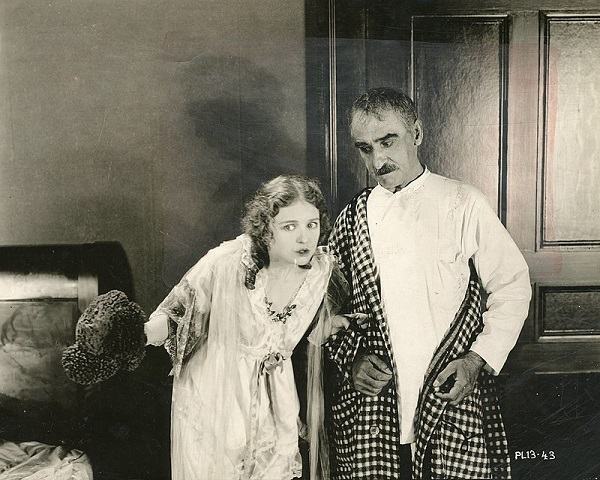
Williams, played by Jim Farley with stoic elegance, is the film’s ethical barometer. The script toys with audience prejudice—expecting the Black domestic to be either comic relief or clandestine villain—then yanks the rug. His grapefruit ritual, later revealed as a vestige of Caribbean boarding-school etiquette, becomes a metaphor for misread Otherness. In an era when Too Fat to Fight trafficked in corporeal caricature, Her Country First dares a quiet humanism, letting Williams’ eventual vindication echo louder than any sermon.
Munitions Melodrama: When the Home Becomes Battlefield
The final reel detonates the illusion that oceans buffer America. Cinematographer J. Parks Jones films the factory floor like a Futurist canvas: diagonal beams of light slice through metallic vapor, workers become silhouetted cyphers of industrial might. When saboteurs finally coax the password from Dorothy, the explosion is rendered through negative inserts—white flashes that feel like retina scars. The sequence predates and possibly influences the combustible climaxes of Peril of the Plains, yet its emotional payload is closer to Love Letters: devastation measured in trust incinerated, not merely structures razed.
Sound of Silence: Music as Munitions
Original exhibitors received a cue sheet calling for Sousa marches transposed into minor keys during drill scenes, and a lone cello line—pizzicato like distant artillery—when suspicion festers. Contemporary restorations (e.g., 2018 Pordenone premiere) commissioned composer Bernadine Zuber to expand the motif into a full score that interpolates period foxtrots with atonal dread. Under this lattice, Dorothy’s march toward self-reckoning feels both inexorable and hallucinatory.
Box Office & Afterlife: From War Bonds to Film School
Released nationally in March 1918, the picture grossed a respectable but unspectacular $180,000 (roughly $3.6 million today), outpaced by splashier propaganda like The Coming Power. Yet itinerant exhibitors folded it into war-bond drives, billing it as “The Film That Flies You to the Front.” Prints were thought lost until a 35mm nitrate reel surfaced in a defunct Montana church basement in 1995; the restoration required frame-by-frame digital decompensation, a process so painstaking it became a case study on CineTech’s cover.
Final Approach: Why It Still Soars
We are living, once again, in an age when civic paranoia metastasizes faster than truth can lace its boots. Her Country First resonates because it understands that every generation weaponizes innocence—be it through TikTok militias or avocado-spotting spy hunters. Dorothy’s arc is both time-capsule and mirror: her zeal to serve outruns her capacity to discern, a predicament not exclusive to 1917. The film offers no bumper-sticker moral; instead it gifts us an image—girl and sky and smoldering factory—inviting us to ask who we suspect, who we recruit, and what passwords we blithely surrender.
Seek it out on any platform streaming silent restorations; watch it with lights dimmed, grapefruit in hand, and perhaps—just perhaps—cut it the way you always have. The film will notice. The spies always do.
IMDb —
1921
Community
Log in to comment.