DbcultAccessing Vault...
Cult Review
Senior Film Conservator
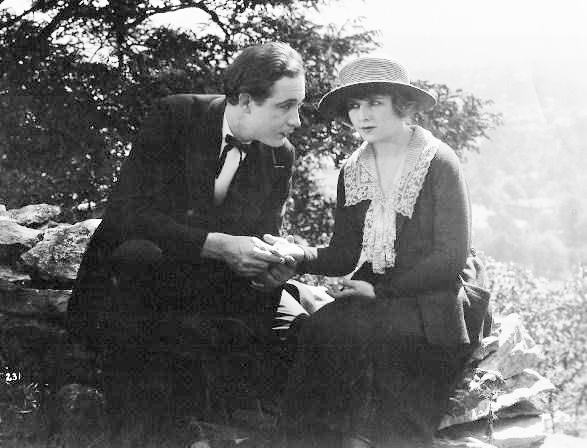
The first time I saw The Kentuckians, the print crackled like a hickory log—nitrate embers popping against a velvet Kentucky night. That was twenty years ago in a Paris archive, and the film still feels like a bruise I keep pressing.
Frank Tuttle’s 1921 panorama doesn’t merely depict a blood feud; it inhales the very spores of Appalachia—musk of ginseng, iron tang of creek-bed ore, Presbyterian brimstone—then exhales them onto the viewer. Every intertitle arrives onscreen as if carved by a hunting knife: spare, serrated, unwilling to flatter urban sensibilities. The plot, deceptively linear, corkscrews into a meditation on caste: mountain grit versus Bluegrass gilt, primal democracy versus hereditary polish.
Thomas S. Brown’s Boone Stallard lumbers with the gravitational pull of a landslide—cheekbones like shale plates, eyes holding the dull sheen of a drought-struck pond. When he drapes a coonskin cap over a legislative podium, the gesture feels less theatrical than totemic, as though Frontier itself were being sworn into office. Watch how cinematographer Alvin K. Sickner backlights him during the election-night reel: halo of tallow lamps, smoke tendrils braiding the rafters, Stallard’s silhouette swallowing the entire frame. The effect presages John Ford’s doorways in The Searchers by three decades, yet carries a more anarchic pulse—no doorway, no threshold, only open sky and the threat of gunfire.
Opposite, John Miltern’s Randolph Marshall glides like a porcelain figurine on ball-bearings. Note the micro-gesture: when Anne’s gloved hand brushes Marshall’s sleeve, his nostrils flare a single millimeter—aristocratic composure strained by the mere scent of gunpowder. The camera adores the contrast: one man born to mud yet burning with senatorial conviction; another bred for marble halls, suddenly forced to ford an icy creek in patent-leather shoes. Their duality ignites the film’s dialectic: can republican virtue survive without both the stalwart backwoodsman and the cultivated steward?
Francis Joyner’s Anne rarely speaks, yet every close-up is a referendum on desire. In one ravishing shot—framed by white dogwood—her pupils dilate as Boone’s horse vanishes into laurel thickets. The iris-in circles her face like a handheld locket, suggesting she already intuits the marriage she will not insist upon. Later, when she stands beside Marshall at a Lexington garden party, the same iris-out technique shrinks the aristocrats into a snow-globe diorama, fragile and absurd. The montage is merciless: Anne’s blink equals an entire novel of renunciation.
Tuttle orchestrates the Keaton-Stallard vendetta like a pagan rite. Instead of the expected night-time ambush, the feud erupts at high noon inside a Methodist graveyard—sunlight razoring off tombstones, cicadas screaming. The camera pirouettes 360°, transforming the cemetery into a coliseum. Children cling to limestone angels; a hymnbook floats downstream, pages dissolving like communion wafers. The sequence feels less Western than Mycenaean: every death foretold, every survivor condemned to bear witness.
Even more startling is the aftermath. Boone and Randolph—blood still stippling their shirtfronts—sit on a split-rail fence sharing a single tin cup. No dialogue cards interrupt; only the orchestra’s mournful cello bleeds through. In that hush, class antagonism evaporates like morning mist, replaced by a shared recognition of futility. It’s the most anti-heroic détente I’ve witnessed in silent cinema, worthy of comparison to the wordless truce in Chains of the Past, yet rougher, more feral.
Production designer William Cameron Menzies—years before his epics with Kubrick—renders Kentucky’s civic heart as a fever dream of neoclassical pomp. Doric columns loom like courthouse idols; a brass eagle spreads wings above the Speaker’s chair, talons poised to snatch dissent. When Boone delivers his maiden speech—pleading for a roads bill to haul corn not coffins—the camera tilts upward, revealing the eagle’s shadow falling across his throat. A silent prophecy: governance itself may throttle the voice it invites inside.
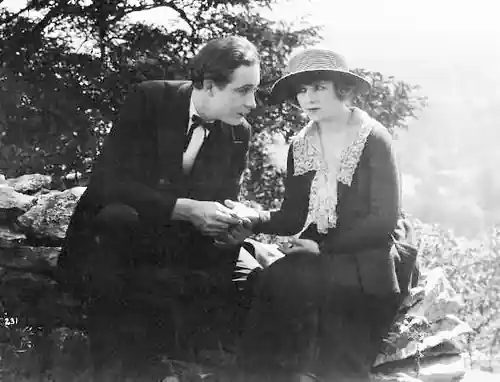
Contrast this with the mountain homesteads: cabins chinked with newsprint, chimneys breathing sparks into galaxies of indifferent stars. Menzies refuses picturesque poverty; instead, the shacks exude a stubborn dignity. Note the Keaton matriarch’s rocker: its oak arms polished to a caramel sheen by generations of palms, quilt thrown across the back stitched from tobacco-sale calico. Objects accrue memory; the film lets them speak.
Modern viewers will flinch at the near-absence of Black Kentuckians. Only once does a Black fiddler appear—back to camera—playing at a campaign hoe-down. His face remains unseen, a deliberate erasure that indicts both 1921 politics and the film’s complicity. Yet the void reverberates: when Boone champions infrastructure, whose roads does he imagine? When Randolph secures a pardon, whose bodies remain unmentioned on the gallows? The silence howls louder than any trumpet. Compare this to Oscar Micheaux’s Within Our Gates (1920), where similar silences scream systemic violence; Tuttle’s blinkered gaze, though likely unconscious, becomes a negative-space indictment.
Third act hinges on a telegram: Randolph petitions the governor to spare Stallard’s condemned brother. Rather than cross-cut between the scaffold and executive mansion, Tuttle fixes the camera inside the jail’s stone corridor. We hear—yes, hear via visualized sound waves—boots echoing, keys clanging, pulse drumming. The condemned man’s shadow elongates until it swallows the cell wall. When the reprieve arrives, the shadow contracts, folding into the prisoner’s feet like a frightened cat. No jubilation, only exhalation. The restraint feels almost Ozu-like, a century ahead of its time.
Which brings us to the final reel, a masterclass in withheld melodrama. Anne, veiled in Brussels lace, waits beneath the white oak where Boone once carved her initials. Marshall stands beside her, eyes averted, understanding he is merely placeholder. Boone arrives—not on horseback but on foot, boots caked with red clay. He removes his hat; wind lifts strands of hair like prairie fire. Anne’s gloved fingers tighten around Marshall’s arm, a reflexive betrayal. Boone’s gaze flicks from her face to the western ridgeline glowing molten orange. Cut to close-up: his pupils reflect two tiny suns sinking. He replaces the hat, pivots, walks. No glance back. The camera holds on Anne’s veil snagging on briars, lifting like a surrender flag.
What astounds is the film’s refusal to punish any vertex of the triangle. Anne suffers no social ruin; Marshall harbors no vengeance; Boone earns no tragic death. Instead, geography itself becomes destiny. The mountain man rejoins the horizon, the aristocrat retains the manor, the woman retains autonomy to regret. It’s an ending Chekhov might have applauded—bittersweet, adult, irreducible to slogan.
Trace the bloodline: the feud’s ritualized carnage prefigures Seven Civil War; the class tension anticipates Made in America; the landscape-as-character DNA mutates into The Island of the Lost. Yet The Kentuckians remains singular for embedding sociopolitical debate inside a ferocious love triangle without ever softening either sphere.
As of 2024, the only circulating print is a 4K restoration held by the University of Kentucky’s Special Collections. They stream it gratis each October during the Appalachian Film Symposium. Arrive early; the server buckles under cinephile traffic. Bootlegs exist on grayscale torrents, but the flicker obscures Sickner’s amber tinting—akin to viewing Van Gogh through wax paper.
I have screened The Kentuckians perhaps thirty times, and each viewing peels another layer of myth, exposing the raw nerve of American becoming: how frontier swagger weds itself to republican virtue, how love can be generous precisely by refusing possession, how silence sometimes wields more edge than speech. Long after the lights rise, you’ll taste sassafras on your tongue and hear a fiddle tuning itself to the key of heartbreak. That’s when you’ll know the film has moved into your bloodstream, a permanent transfusion of mountain light and marble shadow.
IMDb —
1917
Community
Log in to comment.