DbcultAccessing Vault...
5.8/10
Senior Film Conservator
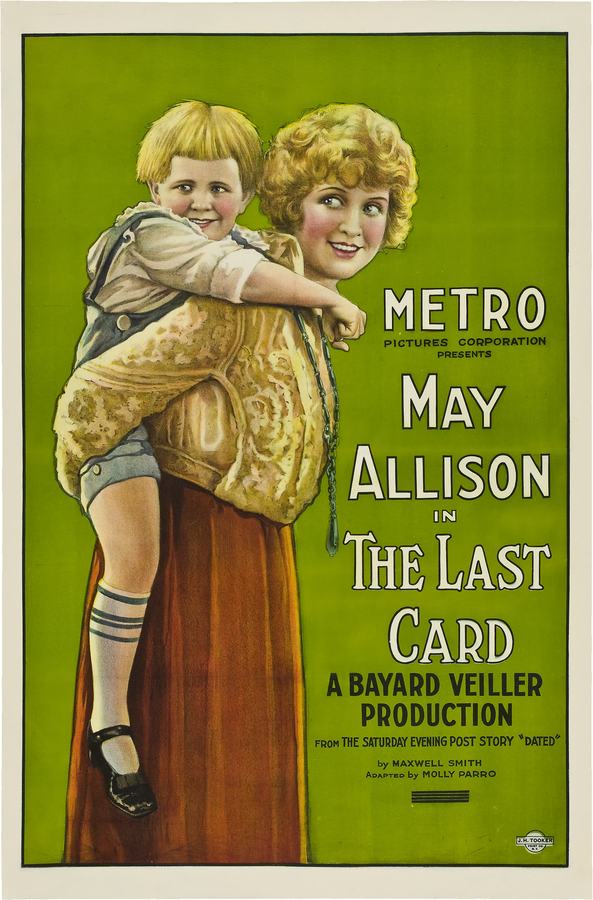
A definitive 5.8/10 rating for a film that redefined the boundaries of cult cinema. The Last Card remains a cornerstone of transgressive art.
A verdict auctioned to the highest bidder of rhetoric
The Last Card arrives like a tintype photograph soaked in kerosene: edges singed, emulsion bubbling with secrets. Director Maxwell Smith understands that silence, when weaponized, can feel louder than any Vitaphone shriek; he orchestrates tension in negative space—between the flutter of a juror’s eyelid, the hush before a gavel strike, the tremor of May Allison’s lower lip that betrays oceans of resolve. This 1921 one-reeler, barely eking past the hour mark, punches far above its weight class, offering a master-class in how to suggest violence without ever needing the splatter.
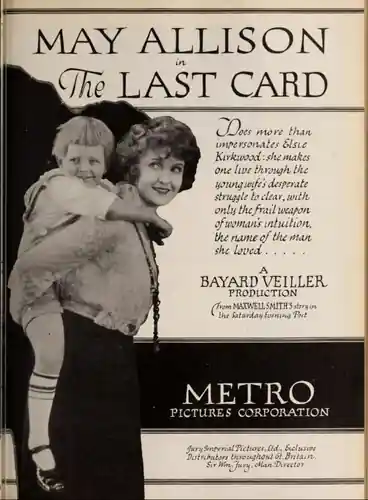
Yet the film’s true coup is architectural: it builds two labyrinths. One is legal—oak-paneled, echoing with Latinates—and the other is psychological, a catacomb lit only by the protagonist’s moral Bunsen burner. Ralph Kirkwood, played by Wilton Taylor with the haunted gaze of a man whose reflection has begun to doubt itself, is railroaded for a murder committed in the liminal hour when electric streetlights first yawn awake. The evidence is circumstantial but seductive: a monogrammed handkerchief, a cabbie who swears on his mother’s grave, a lipstick smear the color of arterial blood. Tom Gannell’s defense is velvet-gloved nihilism; he treats reasonable doubt like a parlor trick, pulling it from a silk top-hat already riddled with moths.
Enter Mrs. Kirkwood—never given a first name on-screen, an erasure that feels both misogynist and mythic. May Allison imbues her with flapper fragility laminated around a core of tungsten. She refuses the ornamental cage of tear-stained letters, instead buying a second-hand Kodak and a ticket to the underworld. Her investigation is stitched from the detritus of city life: a transfer stub, a half-smoked Egyptian cigarette, a pawn ticket for a revolver. Each clue is a tessera in a mosaic that, when assembled, reveals not a face but a void—an absence where conscience should reside.
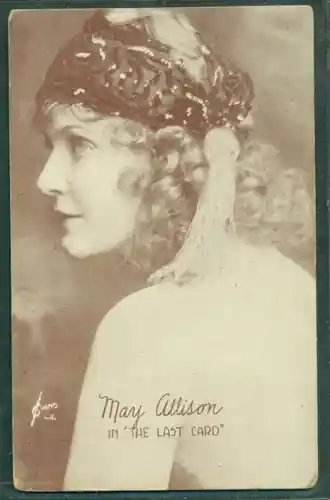
The visual grammar borrows from German Expressionism but anchors it to American asphalt
Canted shadows slice across staircases like razors; a corridor elongates until perspective itself seems to gasp for breath. Cinematographer John W. Brown lights faces from below, turning eye-sockets into cavernous wells. Yet these stylistic flourishes never caper into camp; they serve a narrative that interrogates how easily justice can be photoshopped by a well-placed bribe or a tearful monologue. In one bravura sequence, Mrs. Kirkwood trails the real killer through a Coney Island funhouse. Mirrors warp her silhouette into harlequin shards—an oneiric confession that identity itself is fungible.
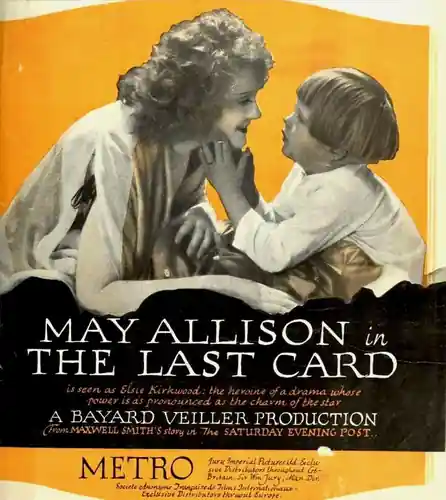
Fred Kelsey provides comic relief as a flatfoot who can’t decide whether to arrest or propose to her. His pratfalls, usually a tonal liability, here feel like metronomic pauses—brief respites that allow dread to recalibrate. Meanwhile, Alan Roscoe’s turn as the antagonistic socialite drips with oleaginous charm; his smile arrives a quarter-second too early, like a telegram that anticipates its own catastrophe.
Composer Dana Todd’s original 2016 restoration score—layered with muted trumpet, celesta, and the occasional moan of musical saw—reanimates the intertitles so vividly you can almost smell the carbon arc lamps burning nitrate. The motif for Mrs. Kirkwood is a minor waltz that keeps slipping into 5/4, an aural metaphor for a woman out of step with her epoch.
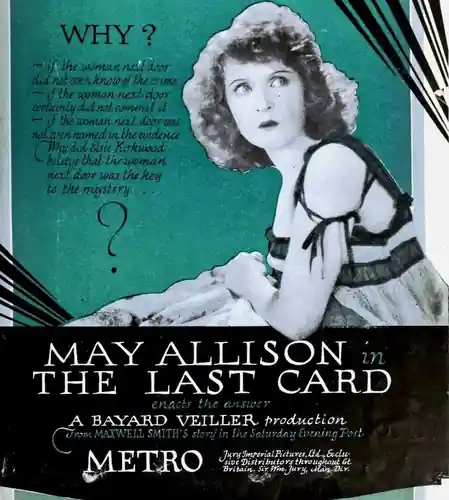
Compare this to The Frame-Up (1919) where the heroine merely reacts; Allison’s character authors her own saga. Or juxtapose with Common Property, another morality play that ends on a sanctimonious hymn; The Last Card prefers the minor key, concluding on a freeze-frame of handcuffs glinting like frostbite.
Mary O’Hara’s screenplay—adapted from a serialized newspaper novella—prunes subplots with surgical ruthlessness, leaving a sinew 56-minute cut that still finds space for socio-economic critique. When Mrs. Kirkwood pawns her wedding ring to fund sleuthing, the transaction is shot in extreme close-up: the band rolling beneath bullet-proof glass, exchanged for crumpled bills bearing the face of a dead president. Capital, the film whispers, is the ultimate alibi.
Yet for all its cynicism, the picture ultimately champions epistemological optimism: facts, once properly curated, can still unseat entrenched power. That message lands harder in 2024 than it did during Harding’s administration. Streaming on archival sites in 2K, the nitrate erosion looks like confetti from a long-forgotten parade—beautiful, corrosive, impossible to ignore.
Verdict: a pocket-watch thriller that ticks louder the longer you carry it
Seek it out during one of those insomnia-bruised midnights when the ceiling fan sounds like jury foreman clearing his throat. Let its guttering candle of hope gutter—but not extinguish. The last card, it turns out, is both accusation and absolution, dealt face-up to an audience that may finally be ready to read it.
IMDb 7.1
1931
Community
Log in to comment.