DbcultAccessing Vault...
Cult Review
Senior Film Conservator
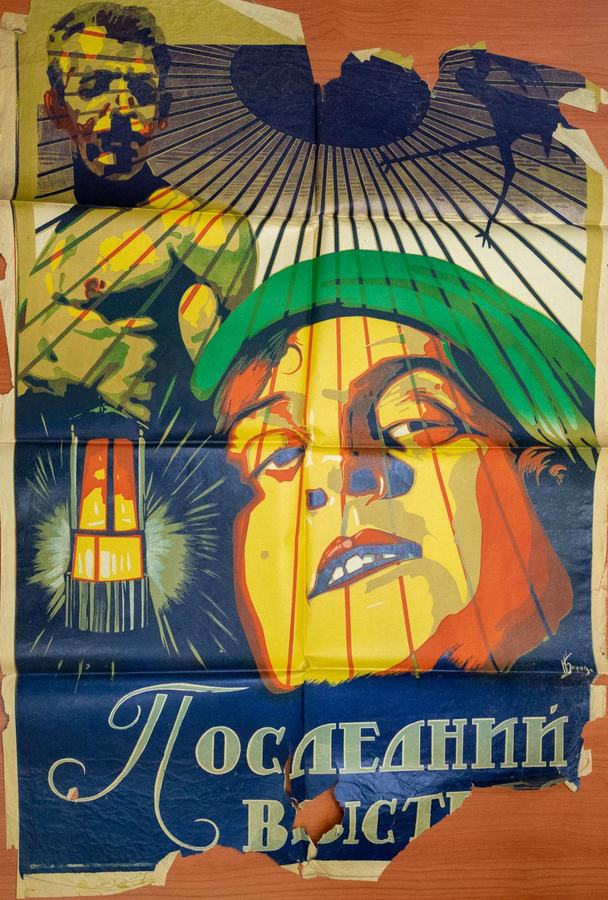
In the freezing, coal-deprived winter of 1919, the nascent Soviet state was not merely fighting on geographical fronts; it was waging a war for the collective psyche of the Russian people. Posledniy patron (The Last Cartridge) stands as a monumental, if ephemeral, pillar of this psychological architecture. Born from the ink of Andrei Smoldovskiy and the physical presence of N. Turkin, this film was never intended to be a mere evening's entertainment. It was a mobilization order flickering on a bedsheet in a crowded hall, a cinematic translation of the iconic decree: 'Citizens, hand over your weapons!'
While contemporary Western audiences were marveling at the melodramatic complexities of films like The Innocence of Ruth, the Russian audience was being fed a diet of stark, geometric reality. Posledniy patron eschews the soft-focus romanticism of its global peers. Instead, Smoldovskiy utilizes the camera as a forensic tool. The plot is an exercise in tension—not the tension of 'will they or won't they,' but the tension of 'will the state survive if the individual remains armed?' This is cinema as a social contract, signed in the blood of the first anniversary of the Red Army.
The visual language here is heavy with the influence of the ROSTA Windows. Every frame feels like a woodcut print come to life. Much like the architectural documentation found in Auckland: The Metropolis of New Zealand, which sought to define a city through its physical structures, Posledniy patron seeks to define a new society through its moral structures. The film demands a total surrender of the self to the collective, a theme that resonates far more harshly than the domestic tribulations seen in Bridges Burned.
N. Turkin’s performance is a fascinating study in early screen acting. There is no trace of the theatrical dandyism that might be found in A Roman Scandal. Instead, Turkin’s face is a landscape of the revolution itself—craggy, determined, and devoid of the bourgeois affectations that define the lead in The Brazen Beauty. In Posledniy patron, the actor is a vessel for a message. When he interacts with the weaponry—the cold steel of the rifle, the heavy brass of the cartridge—he does so with a reverence that borders on the religious. This isn't the thrill of the chase seen in The Man Hunt; it is the somber weight of historical necessity.
The film’s pacing is rhythmic, almost percussive. Smoldovskiy understands that to persuade, one must first hypnotize. The repetition of the disarmament message mirrors the repetitive labor of the factory floor. It lacks the whimsical lightness of Love and Lather, opting instead for a tonal gravity that suggests that every frame is a matter of life and death. This is not a film that asks for your attention; it seizes it with the authority of a commissar.
It is easy to dismiss early agitprop as mere political toolmaking, but to do so is to ignore the formal innovations present in Posledniy patron. There is a proto-montage sensibility at work here. The way Smoldovskiy cuts between the individual and the masses creates a dialectic that would later be perfected by Eisenstein. When compared to the more traditional narrative structures of The Land of Promise, this Soviet fragment feels remarkably modern. It understands that the camera can be used to synthesize a new reality, rather than just reflecting an old one, as seen in As in a Looking Glass.
The "last cartridge" itself is a powerful motif. It represents the tipping point of the conflict. In a world where resources are scarce, the single bullet becomes a symbol of the ultimate choice: to kill for the past or to build for the future. This moral weight is far more existential than the stakes found in a film like Baccarat, where the risks are merely financial or social. In 1919 Russia, the risk was total annihilation.
To truly appreciate the austerity of Posledniy patron, one must look at what it chooses not to be. It lacks the decadent sensuality of La lussuria and the atmospheric mystery of The Inn of the Blue Moon. While those films invite the viewer into a dream state, Smoldovskiy’s work is a cold splash of water to the face. It is a cinematic wake-up call. Even the title suggests a finality that is absent in the serialized dramas of the era, such as The Stolen Play or the inheritance-driven plots of Langdon's Legacy.
There is no room for the "Have Another" mentality—referencing the escapist levity of Have Another—in the world of the Red Army's first anniversary. Every resource, from film stock to human effort, was precious. This scarcity creates a concentrated power in the imagery. The shadows are deeper, the highlights harsher, and the message more piercing because there is no fluff to dilute the impact.
Viewing Posledniy patron today requires a shift in perspective. We must see it not as a failed attempt at a feature film, but as a successful experiment in a new genre: the poster-film. It is a work that exists at the intersection of graphic design, political oratory, and moving image. It doesn't need the 90-minute runtime of a standard drama because its impact is instantaneous. Like a punch to the gut, it delivers its message and leaves the viewer breathless.
The film’s historical value cannot be overstated. It provides a window into a moment where the future of a continent was being decided by men with rifles and filmmakers with hand-cranked cameras. While it may lack the polished sheen of contemporary Hollywood productions, it possesses a raw, unvarnished truth that no amount of studio lighting can replicate. It is a fragment of a world in flames, a testament to the power of the image to shape history, and a stark reminder that in the hands of a visionary like Smoldovskiy, even a simple instruction to 'hand over your weapons' can become a work of enduring art.
In the grand tapestry of early cinema, Posledniy patron is a thread of crimson—bright, bold, and impossible to ignore. It reminds us that cinema's first duty, in the eyes of the revolutionaries, was not to reflect the world, but to change it. And in that endeavor, Smoldovskiy and Turkin succeeded with the force of a well-aimed shot.
IMDb 6.2
1925
Community
Log in to comment.