DbcultAccessing Vault...
Cult Review
Senior Film Conservator
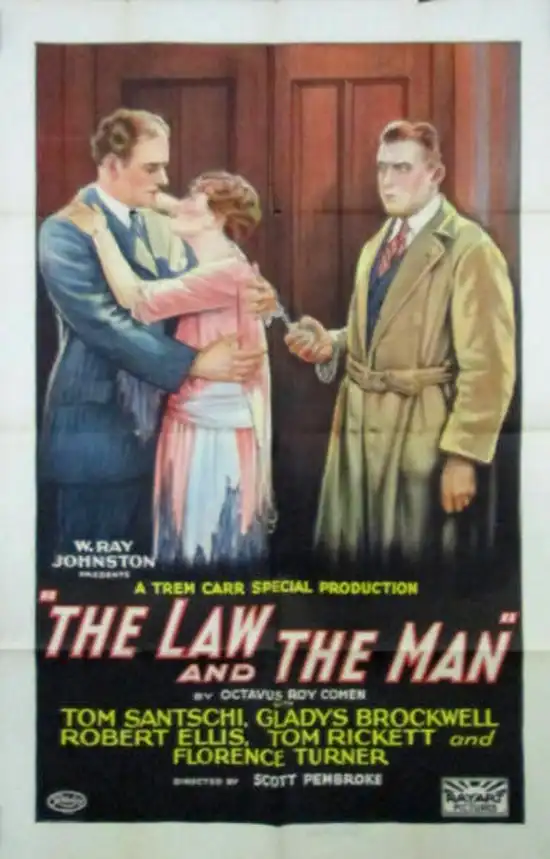
The Law and the Man is a tough one. If you're deep into silent film history, especially the later, talkie-adjacent era, there might be a few curious moments here. Otherwise, honestly, it's a hard sell. Most casual viewers will find it a slog, with its predictable melodrama and a pacing that feels stuck in first gear for a solid hour. Don't expect a lost classic; expect a very particular kind of historical curiosity, heavy on the "curiosity" part.
The film opens with a surprisingly long shot of a city street. Nothing much happens, really. A few cars go by, a couple of people walk past a storefront. It just... lingers. It feels like they were trying to establish a bustling metropolis, but it ends up looking a bit sparse, like a Tuesday afternoon in a small town. You can almost feel the director thinking, "Okay, atmosphere!" but the effect is more "Are we starting yet?"
Tom Ricketts, as the beleaguered protagonist, spends a lot of the early scenes looking confused. It's a consistent confusion, which I suppose is a choice. Every time a new piece of bad news lands, his eyebrows go up just a fraction more, and his mouth opens slightly. It’s not exactly nuanced, but it is dependable. You always know what Tom Ricketts is feeling: confused.
There's a scene in a smoky backroom, maybe a speakeasy, where a crucial piece of evidence is supposedly discussed. The lighting is all wrong. It's supposed to be clandestine, shadowy, but the main conspirator’s face is lit up like a Christmas tree. You can see every bead of sweat, every poorly applied bit of stage makeup. It pulls you right out of the moment. You're meant to feel tension, but you're just distracted by the glaring spotlight.
Gladys Brockwell, though, she tries. Her character, the woman caught between loyalties, has a few moments where you can see a real spark. There’s a particular close-up, maybe halfway through, where she’s just staring into the middle distance, and you can practically hear her character’s internal monologue. No intertitle needed. It’s a brief flash of genuine emotional weight in a film that often feels like it's just going through the motions. That shot holds for a good ten seconds, maybe more. It’s effective.
Then we cut to a courtroom, and suddenly the pace picks up, but not in a good way. It's like someone realized they were running out of film. The arguments are presented through a flurry of intertitles, one after another, barely giving you time to read them before the next one flashes up. It’s less a legal battle and more a speed-reading test. The crowd scenes have this oddly empty feeling, too, like half the extras wandered off for a coffee break. The judge, played by Henry Roquemore, mostly just looks stern. Which, fair enough, he’s a judge. But there’s no variation to it. Just stern.
The entire third act feels like it's trying to convince you that these stakes matter. You know how some films just lean on the music to tell you what to feel? This one does it with the intertitles. "A FATE WORSE THAN DEATH AWAITS!" or "THE NET TIGHTENS!" You can almost feel the movie trying to convince you this moment matters, rather than letting the performances or the plot do the work. It’s a bit much.
Florence Turner has a smaller role, as a sympathetic bystander, and she’s quite good. There’s a scene where she hands Tom Ricketts a handkerchief, and it’s such a small, human gesture. It stands out because so much else is so broad. Her costume in that scene, a dark dress with a surprisingly elaborate brooch, also caught my eye. It felt a little out of place for the setting, but maybe that was the point, a touch of elegance in a grimy world. Or maybe it was just a nice brooch they had on hand. Who knows.
The ending is... well, it’s an ending. It ties things up, but it doesn't really resolve anything emotionally. It’s more like the film just runs out of questions to ask. You're left with the sense that everyone involved did their job, but perhaps not with a lot of enthusiasm. It’s neither a triumph nor a total disaster, just a film that existed.
If you’re really looking for a silent film that explores the complexities of justice and human fallibility, you’re much better off with something like By Right of Birth or even something a bit more pulpy like Sealed Lips. The Law and the Man is mostly for the completists, or those who find a strange comfort in watching cinema history unfold, even when it’s a bit creaky.
IMDb 6.2
1936
Community
Log in to comment.