DbcultAccessing Vault...
Cult Review
Senior Film Conservator
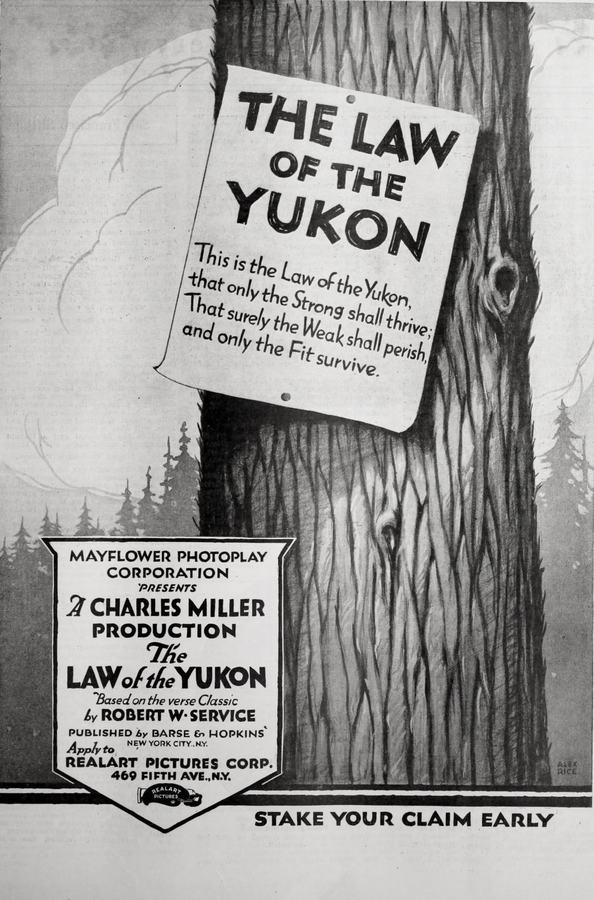
The first time I saw The Law of the Yukon I expected a moth-eaten travelogue of sled dogs and virtuous Mounties; what unspooled instead was a brittle, boreal noir—nitrate frostbite pressed into 63 bruised minutes. The print, culled from a 16 mm show-at-home edition, crackled like wet kindling, yet every missing frame only deepened its mystique: here is a film that crawls on its belly across avalanche chutes of misogyny, loyalty, and yellow-press hubris, licking its wounds between title cards handwritten with the same ink Morgan Kleath will later taste in his own blood.
Director Charles Miller—a name now entombed in footnotes—shoots Dawson City as a tintype hellscape: boardwalks slimy with molasses-thawed mud, gambling dens whose chandeliers sway to the rhythm of river ice groaning beneath them. He borrows the nocturnal cobalt tint of The Woman Under Oath and then drowns it in candle-smoke, so faces emerge like half-developed photographs, eyes too white, teeth too many. The effect is part Calvary, part gold-rush opium nightmare.
Morgan Kleath—played with twitchy, thin-lipped resolve by John Webb Dillon—is no square-jawed pioneer. He arrives already defeated, marital betrayal clinging to his coat like the smell of bay-rum left too long in the trunk. His printing press is less a livelihood than a suicide machine: he intends to write himself into relevance, to out-scoop every pick-axed secret in the territory, yet each column he sets in type becomes another breadcrumb for the hangman. Dillon lets the camera read his pulse: watch the vein that drums in his temple when Goldie’s gloved hand brushes his bandage, the way his pupils dilate not with desire but with the premonition of fresh ammunition for his enemies.
Goldie herself—June Elvidge channeling both Lillian Gish pluck and Theda Bara carnality—never quite becomes the damsel advertised in the lobby cards. She is property on paper: the ward of saloonkeeper Tim Meadows. Yet Elvidge plays her with a calculating wariness, as though every smile is a promissory note she might at any moment call due. Her wardrobe telegraphs the split: demure lace collars for the missionary-teachers, scarlet kimono sleeves that flare like signal flares when she high-kicks in the dance-hall revue. The camera lingers on her ankles not for titillation but for evidence—those same boots will later plant a footprint in the snow beside the burgled safe, a misogynistic breadcrumb trail the film half-admits is ludicrous.
Joe Duke—Tom O’Malley in oily hair and mutton-chops that look trimmed with an axe—embodies frontier toxicity: possessive, swaggering, yet faintly pathetic. His rivalry with Morgan is never about Goldie so much as about narrative ownership: who gets to script her legend, who can reduce her to a line in a ballad or a headline. Their knife-fight, staged in a fog of sawdust and flying playing-cards, feels cribbed from a barroom Macbeth: shadows stretch 12 feet high, the lantern swings so shadows stab farther than blades. When the steel finally slips between Morgan’s ribs, Miller cuts—audaciously—to Goldie’s face in close-up, her pupils reflecting the act like twin nickelodeon screens. She does not scream; she absorbs, and in that absorption decides the film’s moral ledger will be hers to balance.
Compare this compacted violence to the languid pistol-waltz of Cameo Kirby or the drawing-room poisonings of Love Insurance: here, blood is not a narrative garnish but ink for the next day’s broadsheet. The stabbing makes good copy; the copy in turn justifies more stabbing—an Ouroboros of yellow journalism.
Once Morgan is shackled for the safe-cracking, the film shifts into a bleak courtroom procedural that anticipates Wilder’s cynical noirs by two decades. The jury—miners still smelling of sulfur, one with a canary in a cage perched beside the witness stand like a chirping Greek chorus—crave a verdict before the river thaws. Evidence is circumstantial but cinematically damning: Morgan’s blood on the iron safe, editorials he wrote denouncing Tim Meadows, and—most damning—his refusal to speak. Honor becomes the noose.
Enter the wife—Nadine Nash in a mourning veil that never quite conceals her predatory smile. Her testimony is a masterclass in camp vengeance: she swears she saw Morgan and Goldie entwined in a rented room at the exact hour of the robbery, thereby providing the airtight alibi he refuses to use. The courtroom erupts; women clutch pearls, dogs bark off-screen, the judge’s gavel seems borrowed from Thor. Morgan’s silence is not gallantry but self-annihilation, and the film flirts with nihilism: truth is irrelevant, only the spectacle matters.
Just as the black-cap judge intones the sentence, a pistol shot cracks from the balcony gallery. Mrs. Kleath jolts forward, an ink-blot of blood blooming on the back of her ivory travelling coat. She collapses across the witness railing, veil fluttering down like a surrender flag. The shooter—one of Duke’s stooges—escapes in the chaos, never to be caught; the film’s contempt for comeuppance is breathtaking. With the key witness dead, the case disintegrates, Morgan is freed, and the final reel rushes toward a matrimonial dénouement that feels both obligatory and perverse.
Yet Miller withholds catharsis. The closing shot—Morgan and Goldie exiting the church doors under a shower of rice—frames them through the same printing press that once imperiled him. Its iron jaws stand idle, but on its bed we glimpse the first headline of their married life: “DUKE GANG VANQUISHED, VIRTUE TRIUMPHANT.” The letters are still wet, smearing under Goldie’s thumb as she brushes past. She looks at the ink on her glove, then at us—an unspoken admission that the next story, too, might need a corpse to sell copies.
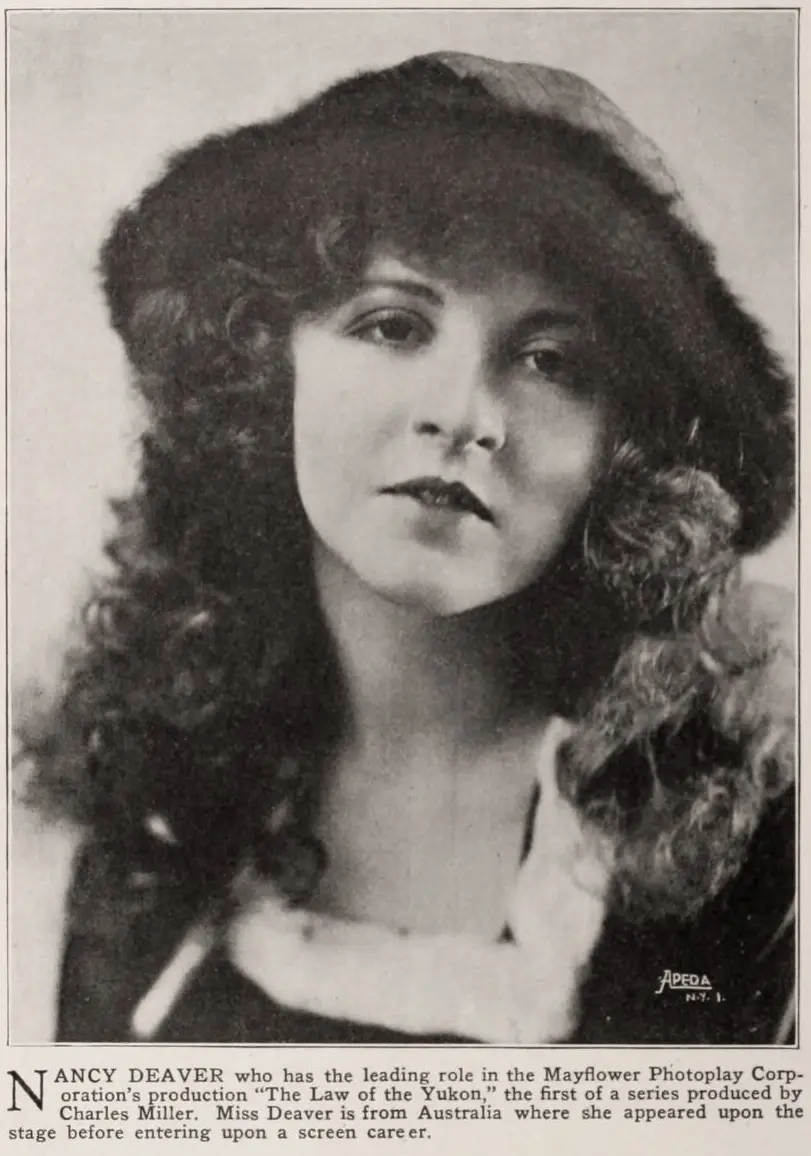
Dillon carries the picture on stooped shoulders; his voice—heard only through intertitles—echoes in the imagination as gravel rubbed on parchment. Watch the micro-twitch when Goldie bandages him: a smile starts, aborts, becomes a grimace, all in three seconds of undercranked celluloid. Next to him Elvidge is mercury, slipping between registers—coquette, confessor, avenger—without ever breaking the period vernacular. Their chemistry is less erotic than fiduciary: two bankrupt souls negotiating collateral on each other’s futures.
In support, Tom Velmar’s turn as the alcoholic defense attorney channels Barrymore by way of medicine-show huckster, delivering closing arguments while swirling a glass of who-knows-what that catches the klieg lights like liquid topaz. And Bird Millman—a real-life high-wire artist—appears in a cameo as a tightrope walker in the saloon act, her presence a meta-wink: the whole film, too, is balanced on a gossamer wire above an abyss of schlock.
The screenplay, credited to Harry Chandlee and lifted from Robert W. Service’s rollicking poem, jettisons the original’s bawdy humor and replaces it with a Calvinist gloom worthy of Hawthorne. Service’s Yukon was amoral, indifferent; the film’s Yukon is actively punitive, a Calvinist deity that sends wives as plague and gold as snare. Dialogue titles bristle with frontier aphorisms (“A man’s word up here is stamped either on lead or on gold—guess which weighs more?”) that sound pilfered from a deck of playing-card maxims, yet they stick in the craw.
Compared to other Service adaptations—say the snowbound redemption of Out of the Snows—this film refuses redemption wholesale. Grace is a marketing ploy; the only ascent is up the gallows stairs.
Director Miller, aided by cinematographer Joseph W. Smiley, employs three visual leitmotifs:
The tinting strategy is equally literate: amber for interiors (whiskey, lamplight), cobalt exteriors (hypothermic dread), and a sickly sea-green for the courtroom—a palette of moral nausea that prefigures Sirk’s Technicolor malaise.
No original score survives; modern festivals commission new ones. I caught a 2019 screening at the San Francisco Silent Film Festival where Matti Bye conjured a chamber-noir suite: bowed saw for the wind, prepared piano whose wires rattled like gambling chips. The absence of true sound leaves a vacuum that contemporary composers can’t resist filling; yet the most honest accompaniment remains the metronomic clatter of the projector itself—a mechanical heartbeat that flatlines whenever the film jams, as if the Yukon itself hiccupped.
History has buried The Law of the Yukon beneath more heroic westerns—The Ranger of Pikes Peak offers moral clarity; Glory gives us virtuous prospectors. Yet its DNA persists: the toxic newspapermen of Citizen Kane, the self-immolating lovers of Leave Her to Heaven, the cynical endings of film noir—all trace a thin red line back to Dawson’s muddy streets.
Home video prospects remain grim. A 4 K scan reportedly languishes in the bowels of a French archive, rights knotted by the same bankruptcy that shuttered the original distributor in 1923. Your best bet is a grey-market DVD-R from eBay, or pray for a 16 mm university screening. But scarcity feeds myth; the film survives more powerfully in cinephile whispers, like a claim too rich to map.
To watch The Law of the Yukon is to step onto river ice you know is thin: every creak of the plot reminds you that trust, like spring thaw, is seasonal. The film’s sexual politics are retrograde even for 1920; Goldie’s “honesty” is purchased through a widow’s blood, her autonomy traded for a wedding ring. Yet its contempt for journalistic grandstanding feels shockingly modern in an era of click-bait tribunals. Miller’s Yukon is not a place you conquer—it conquers you, buries you under type-metal, then prints your obit before the body cools.
So, yes—see it if you can. Not for uplift, but for a frost-bitten cautionary tale: that the stories we sell may write us into corners ink can’t blot out, that sometimes the only difference between a scoop and a scaffold is the byline. And as the lights come up, you’ll swear you smell newsprint and pine-tar, hear the river ice cracking underfoot, feel the weight of a headline that smudges at the slightest touch—proof that even a century later, the Yukon’s law is still out there, waiting for fresh copy.
IMDb —
1927
Community
Log in to comment.