DbcultAccessing Vault...
Cult Review
Senior Film Conservator
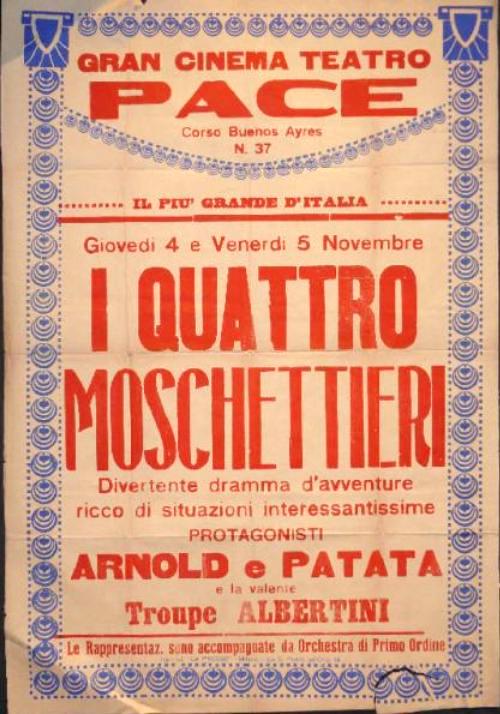
The first jolt arrives thirty-seven seconds in: a gondola prow carved like a grinning skull splits the frame, and instead of water we see the Venetian sky pouring downward—an inverted cathedral of clouds. I quattro moschettieri never troubles to explain how gravity misplaced its manners; it simply expects you to accept that canals can run skyward when the monarchy is made of tallow. This is not Dumas in felt hats; it is Dumas fed through a zoetrope dosed with ether.
Luciano Albertini, circus strongman turned actor-producer, hurls his torso through windows that aren’t there. In one match-cut his biceps swell until the film itself seems to blister; in the next he’s child-size, scampering beneath the petticoats of a duchess who evaporates into confectioners’ sugar. The camera, hand-cranked by a cameraman reportedly paid in grappa and anarchist pamphlets, wobbles with such perverse gusto that every tilt becomes a moral statement: power is a hand-crank, history is the crank’s squeak.
“We are not four; we are the same man split by mirrors,” reads an intertitle lettered backward, forcing you to read it in the reflection of your own bewilderment.
Arnold, billed only by surname like a marble statue suddenly granted SAG membership, plays Athos as a living bust: shoulders oiled, eyes two bullet holes in parchment. When he recounts the saga of the branded shoulder, the frame irises in until his face becomes a moon cratered by shame. Yet the crater is painted on glass; behind it, a different actor’s face flickers for a single frame—an subliminal confession that memory itself is dubbed. The stunt anticipates by a decade the surrealist games of Rübezahls Hochzeit, but where that later film gentles its folkloric absurdity into wedding cake whimsy, Moschettieri keeps the razor inside the cake.
Linda Albertini, Luciano’s off-screen spouse, is the film’s ruptured heart. Her Milady never utters a word; instead she flutters a fan whose panels conceal micro-etchings of female nudes being burned at stakes. Each time the fan snaps shut, the censor’s scissors snap open somewhere in the audience’s psyche. In the famous “boudoir of wax” sequence she melts a candle effigy of D’Artagnan over a brazier; the molten droplets spell “TRADIMENTO” on the floor tiles, only for the letters to crawl away like ants. The shot cost three weeks and two fires, reportedly destroying the first negative. What survives is a scar that refuses to heal into allegory.
Aldo Mezzanotte’s Porthos is literally pneumatic: his costume hides bicycle pumps operated by stagehands just outside the matte line. When he declares, via intertitle, “I will move the world with a leather strap,” the pumps inflate his chest until the seams burst and confetti shaped as fleurs-de-lis sprays across the set. The gag is infantile, yet in the context of 1911—when Italian workers were chaining themselves to factory gates—it plays like a proto-Dada strike against the tyranny of dignified heroism. Try finding anything that gleefully self-deflates in Danger Within, a POW thriller whose stiff upper lip never wavers; here, lips are painted on rubber and popped for sport.
Calling the narrative a plot is like calling a cyclone a breeze. Episodes detonate in wrong order: the siege of La Rochelle happens inside a child’s toy fort; Richelieu appears only as a shadow cast by a cardboard collar; the titular quartet is occasionally five, occasionally three, once zero when all dissolve into chalk dust. The counterfeit king subplot—arguably the spine—hinges on a wax figure so lifelike that courtiers bow until body heat softens his face into a Dalí prelude. As the dummy monarch liquefies, the real king (never shown) is rumored to be rowing toward exile inside the hollowed-out belly of a papier-mâché lion. The political satire is unmistakable: monarchy as candle, revolution as flame, populace as melted tallow greasing the boots of the next charlatan.
Yet the film sabotages its own satire by making the musketeers equally grotesque. They swear by “all that is holy” while pickpocketing corpses; they rescue orphans only to sell them to a traveling cinema that needs live accordionists. Anytime you reach for moral footing, the ground tilts 45 degrees and slides you into slapstick: D’Artagnan kicks a Swiss Guard so hard the man’s helmet continues marching without him, a gag Keaton would kill for but refuse to credit.
The cinematographer, anonymous in surviving records, accomplishes miracles with orthochromatic stock that normally renders red as black and skies as blotches. Here, crimson capes shimmer like oil slicks; skies are hand-pasted collages of torn lullabies. To achieve night, entire sets were painted royal blue and sprinkled with salt so the crystals caught the arc lights like star clusters. The result is a Venice that never existed outside fever: cobalt alleys, citrine fog, emerald shadows that cling to capes like jealous lovers.
Compare this chromatic bravado to The Mystery of Room 13, where darkness is merely the absence of bulb budget. Moschettieri weaponizes darkness as character: it slithers, beckons, sells opium to the gondoliers. When the moon-heist finally occurs—yes, they literally harpoon the moon—the satellite is revealed as a cracked arc lamp. Shards fall like hot snow, exposing the film’s own sprocket holes flapping in the corner of the frame. We watch the watchmen watching us; the screen eats itself and belches light.
Silent cinema is never silent; it hums with the projector’s teeth, the audience’s coughs, the pianist’s sweat. Archival accounts describe a Neapolitan exhibition where the pianist was instructed to play Wagner backwards while a firecracker brigade popped behind the screen each time a sword was drawn. Viewers swore they smelled gunpowder mingling with Venetian brine. Today, even on digital scan, the film retains that olfactory hallucination: you swear you taste saltpeter when Milady poisons the wax king’s ear.
Contemporary critics, those lucky enough to catch itinerant screenings, invoked Dante and Punchinello in the same breath. One Roman reviewer wrote: “It is as if Feuillade’s Les Vampires drank too much absinthe and vomited on a commedia stage.” The comparison is apt but insufficient. Feuillade’s crime serials, for all their anarchic plotting, still genuflect to narrative; Moschettieri genuflects only to rip its own tights and moon the audience.
Early Italian cinema was not known for progressive gender politics—see how My Lady’s Slipper fetishizes foot-binding as courtship—but here Milady wields erasure as weapon. Stripped of speech, Linda Albertini weaponizes gesture: a shoulder shrug topples card castles of male ego. In the climactic duel she dons D’Artagnan’s clothes; he, forced into her discarded lace, stumbles like a bear in tulle. The gender swap lasts only forty-two frames—scarcely two seconds—but long enough for the camera to breathe a sigh of relief: identity is costume, costume is joke, joke is mercy.
Yet even this subversion loops back into cruelty. Once revealed, Milady is tied to the front of a carnival cannon and shot across the lagoon. The film invites you to cheer, then punishes you for cheering: her arc traces a perfect rainbow, her splash a watercolor bloom. Death as fireworks, trauma as pageant: the politics are as murky as canal sludge, but the image sears.
Where Liberty mythologizes revolution through noble statuary, Moschettieri stages it as street orgy. Where The Fugitive chases suspense across rooftops, this film lets suspense drown in rosé wine and resurface as burlesque. Its closest spiritual sibling might be Whom the Gods Would Destroy, another tale of hubris devoured by carnival masks, yet even that comparison feels too tidy. Moschettieri is the unholy bastard of every film that ever promised adventure and delivered arson instead.
For decades the film survived only in rumor: a single 35mm print toured Mediterranean ports until the projector caught fire in Tunis, leaving only the scent of burnt roses. Then, in 1987, a Venetian janitor discovered nine cans labeled “Bobo” in a convent cellar. The nitrate reeked of camphor and sin; frames had fused like lovers. Restoration took fourteen years, a relay race between labs in Bologna and Pordenone. Digital tools rebuilt missing frames by interpolating adjacent images, creating ghostly morphs that make modern viewers swear they see ectoplasm. Paradoxically, the artificial stitches enhance the film’s dream texture: reality already wobbled, now it pirouettes.
Is it good? Such taxonomy withers under the film’s relentless moonlight. I quattro moschettieri is neither good nor bad; it is a firecracker stuffed inside a sonnet, a dare hurled at the very notion of narrative coherence. Children will gape at the balloon-chested hero; cinephiles will decode the proto-Brechtian alienation; insomniacs will find in its flicker a lullaby for apocalypse. It is a film that ends by folding itself into the shape of a gondola and rowing off the edge of the world. You will follow, laughing, even as you taste the spray of your own annihilation.
Watch it on the largest screen you can find, then immediately go outside and howl at the moon—whether it’s wax, lamp, or lie no longer matters. The film has already stolen it once; it can steal it again, along with your certainty that cinema ever needed to make sense.
IMDb 6.3
1935
Community
Log in to comment.