DbcultAccessing Vault...
Cult Review
Senior Film Conservator
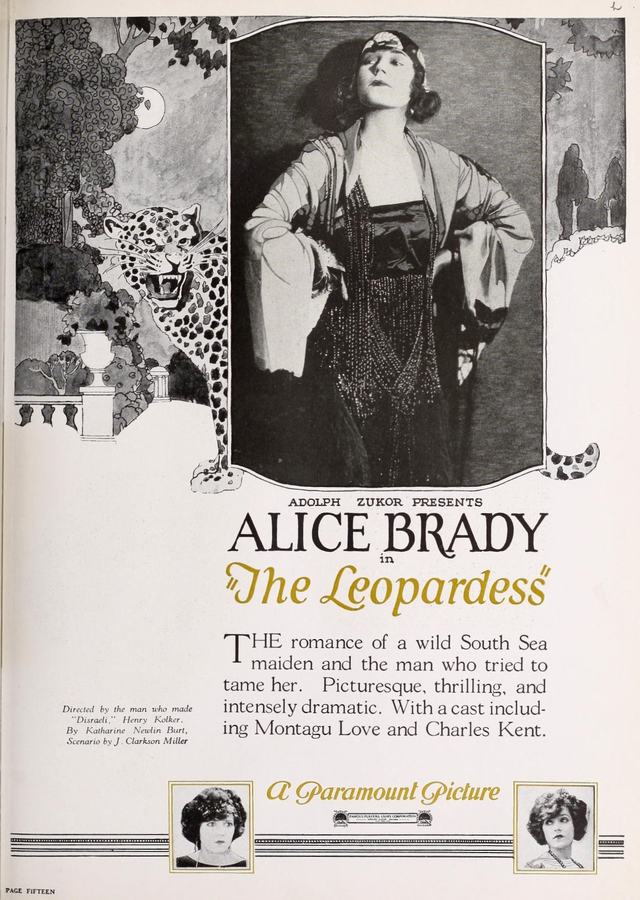
The Leopardess unfurls like a tropical tapestry, each thread a clash of cultures, power, and primal instinct. From the opening tableau of sun‑drenched palms to the stark, black‑and‑white chiaroscuro of the climactic showdown, the film invites the viewer into a world where colonial ambition collides with indigenous resilience.
\n\nScott Quaigg, portrayed with a brooding intensity by Edward Langford, epitomizes the archetypal Western hunter—wealthy, self‑assured, and disturbingly oblivious to the humanity of those he deems "exotic." His counterpart, Tiare (Glorie Eller), is rendered with a fragile yet fierce dignity that transcends the era's typical exoticism. The film's visual language—tight close‑ups on Tiare's eyes, lingering shots of the leopard's amber coat—creates a dialogue between the human and the animal, underscoring the thematic motif of taming versus being tamed.
\n\nLangford's portrayal is not merely brutish; he injects a simmering insecurity beneath his swagger, especially evident when he brandishes the whip. Eller, meanwhile, conveys a spectrum of emotions through subtle gestures—her hand trembling as she grips the rifle, the fleeting smile when she first meets Quaigg, the hardened resolve as she awaits his return. The supporting turn by George Beranger as Captain Croft provides a moral counterweight, his stoic demeanor a foil to Quaigg's volatility.
\n\nThe screenplay, credited to J. Clarkson Miller and Katharine Newlin Burt, weaves a narrative that is both linear and symbolic. The island itself functions as a character—its lush foliage and treacherous reefs mirroring the entangled relationships among the protagonists. The pivotal scene where Quaigg releases the leopard is a masterstroke of visual metaphor: the predator, once a symbol of his control, becomes his undoing. This moment resonates with the same animalistic tension found in Polly of the Circus, where the circus beast reflects the protagonist's inner turmoil.
\n\nCinematographer Charles Kent employs a palette that, while constrained by the monochrome medium, suggests color through contrast. The interplay of light and shadow on the leopard's spots evokes the dark orange hue #C2410C, while the glint of the rifle barrel hints at a sharp, sea‑blue #0E7490 gleam. The occasional use of tinted frames—particularly during the night‑time chase—infuses a fleeting yellow #EAB308 glow, evoking the phosphorescent glow of bioluminescent waves that surround the island.
At its core, The Leopardess interrogates the colonial gaze: Quaigg's attempt to dominate Tiare mirrors the broader imperial impulse to subjugate native lands. Tiare's reliance on superstition, and Quaigg's weaponization of it, illustrates a power dynamic where belief becomes a tool of oppression. Yet, the film also offers a subversive redemption arc. Croft's survival and his eventual partnership with Tiare signal a reclamation of agency, suggesting that solidarity among the marginalized can overturn tyrannical structures.
\n\nWhen juxtaposed with The Vampires: The Terrible Wedding, which also explores the collision of myth and modernity, The Leopardess feels more grounded in its human drama, despite the exotic backdrop. Its narrative pacing bears similarity to Lovesick at Sea, where maritime isolation intensifies emotional stakes. Moreover, the film's moral ambiguity anticipates later works like Madame Spy, where protagonists navigate treacherous loyalties.
\n\nDirector Montagu Love orchestrates a rhythm that oscillates between languid island reverie and abrupt, violent eruptions. The decision to film on location (or convincingly simulate it) grants the movie an authenticity that studio-bound contemporaries often lack. The production design, from Quaigg's opulent cabin to the rustic thatch of Tiare's village, is meticulously detailed, each element reinforcing the cultural dichotomy at play.
\n\nIn the silent era, actors relied on expressive physicality; here, Eller’s nuanced gestures speak louder than any intertitle could. The film’s intertitles are sparingly used, allowing the visual narrative to dominate. When they appear, they are rendered in a crisp, sea‑blue #0E7490 typeface, echoing the oceanic setting and providing a visual cue that distinguishes dialogue from exposition.
\n\nThough The Leopardess slipped into relative obscurity after the silent boom, its influence persists in modern reinterpretations of colonial critique. Scholars often cite it alongside The Birth of a Race for its daring portrayal of interracial relationships, albeit filtered through a 1910s lens. The film's daring climax—where the predator turns on its master—prefigures the narrative inversion later popularized in films like Monkey Business.
\n\nThe Leopardess stands as a testament to the silent era's capacity for sophisticated storytelling. Its blend of exotic scenery, complex character dynamics, and potent symbolism renders it a fertile subject for contemporary analysis. Whether viewed as a cautionary tale about the hubris of colonial conquest or as a melodramatic adventure, the film rewards repeated viewings, each revealing new layers of meaning hidden beneath its stark monochrome surface.
IMDb 6
1914
Community
Log in to comment.