DbcultAccessing Vault...
Cult Review
Senior Film Conservator
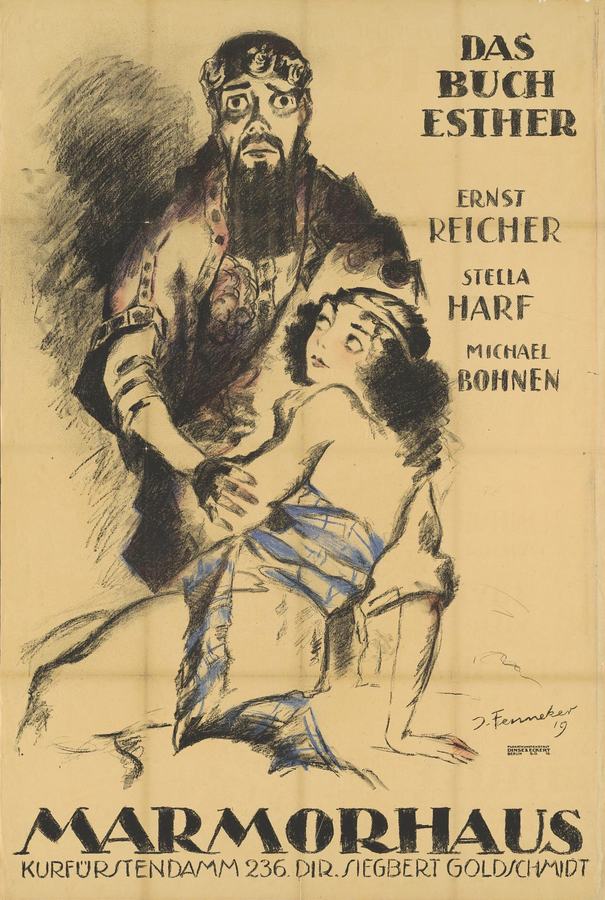
The year 1919 remains a watershed epoch for the German moving image, a period where the burgeoning language of cinema sought to reconcile the theatrical grandiosity of the past with the psychological depth of the nascent Expressionist movement. In this fertile soil, Ernst Reicher—a name often synonymous with the 'Stuart Webbs' detective series—ventured into the realm of the divine and the dynastic with Das Buch Esther. This is not merely a rote recitation of scripture; it is a meticulously choreographed drama of power that utilizes the biblical backdrop as a canvas for a very modern exploration of jealousy and survival.
The film’s divergence from the traditional Megillat Esther is immediate and striking. By positioning Stella Harf’s Queen Vashti not as a rebellious wife but as a proactive antagonist, Reicher creates a dualistic tension that mirrors the narrative complexity seen in contemporary works like The Woman Beneath. This Vashti is a creature of shadows, aligning herself with Haman to orchestrate a coup d'état that feels more Shakespearean than strictly biblical. The inclusion of Michael Bohnen adds a layer of operatic intensity to the ensemble, his presence echoing the gravitas found in his legendary stage career.
Visually, Das Buch Esther is a triumph of set design and lighting. The palatial interiors are rendered with a depth of field that invites the viewer to peer into the dark corners of the Persian court. There is a specific aesthetic at play here that reminds one of the atmospheric density in El beso de la muerte, where the physical environment seems to close in on the characters. The use of shadow to delineate the moral landscape of the film is particularly effective; while the Jewish quarters are bathed in a soft, naturalistic light, the corridors where Haman and Vashti whisper their sedition are shrouded in a menacing gloom.
The sequence involving the presentation of the maidens is handled with a delicate balance of voyeurism and reverence. Unlike the more overtly sensationalist approach one might find in The Wood Nymph, Reicher focuses on the psychological toll of the selection process. Esther, played with a luminous restraint, is not just a beauty to be admired but a symbol of her people’s precarious existence. The cinematography during the banquet scenes utilizes a rhythm of editing that heightens the sense of impending doom, a technique that would later become a staple of German suspense cinema.
The creative and personal partnership between Ernst Reicher and Stella Harf provides the film with its emotional core. There is a palpable chemistry that informs every frame, even when they are positioned as adversaries. Harf’s portrayal of Vashti is a masterclass in silent-era histrionics—not in the sense of overacting, but in the precise use of gesture and gaze to convey a complex interior world. Her performance stands in stark contrast to the more melodramatic tropes found in Syndig Kærlighed, offering instead a nuanced depiction of a woman fighting for her agency in a patriarchal vacuum.
Reicher’s direction is surprisingly modern in its pacing. He avoids the static, tableau-like compositions that plagued many early biblical films, opting instead for a dynamic camera that follows the movement of the plot. This kinetic energy is what separates Das Buch Esther from the more rigid spectacles of the era. The way he integrates the subplot of Haman’s attempted assassination of the King shows a sophisticated understanding of narrative counterpoint, a skill also evident in the structural integrity of The Traffic Cop.
Purists might take umbrage at the liberties taken with the source material, particularly the heightened role of Vashti and the specific mechanics of the King’s decree. However, these choices serve to amplify the stakes. In this version, the threat to the Jewish population is not merely a bureaucratic whim of Haman but a central pillar of a broader political conspiracy. This adds a layer of urgency to Esther’s mission. The film explores themes of identity and assimilation that resonate far beyond its 1919 production date, touching on the same existential anxieties found in Birth, albeit through a vastly different cultural lens.
The portrayal of Mordecai by Willy Kaiser-Heyl provides the necessary moral anchor. His refusal to bow to Haman is framed not as an act of stubbornness, but as a profound statement of theological integrity. This conflict is the catalyst for the entire drama, and Kaiser-Heyl plays it with a quiet dignity that contrasts sharply with the frantic energy of the Persian court. It is a performance of immense gravity, reminiscent of the stoic protagonists in Mellem de yderste Skær.
One cannot discuss Das Buch Esther without acknowledging the sheer scale of its production. The banquet scenes are a feast for the eyes, featuring an array of dancing girls, exotic animals, and overflowing chalices that suggest a decadence bordering on the grotesque. This opulence is not merely for show; it serves to highlight the moral decay at the heart of the empire. The attention to detail in the costumes—from the intricate headpieces of the maidens to the heavy, embroidered robes of the King—reflects a commitment to historical immersion that was rare for its time, surpassing the production values of contemporary films like Blue Grass.
The editing during the film’s final act is particularly noteworthy. As the King discovers the plot against his life, the intercutting between the various factions—the plotting Haman, the desperate Queen Vashti, and the intervening Mordecai—creates a sense of mounting tension that is almost Hitchcockian in its execution. This level of cinematic sophistication suggests that Reicher was looking toward the future of the medium, experimenting with narrative techniques that would later be perfected in the thriller genre, such as in Friday the 13th (the 1916 German version, naturally).
Contextually, the film arrived at a time when Germany was grappling with its own identity in the wake of the Great War. The story of a minority population navigating the whims of a powerful, often capricious government would have had a profound resonance for audiences in 1919. Das Buch Esther acts as a mirror to these societal fears, using the ancient past to comment on the volatile present. It shares this thematic preoccupation with films like The Weakness of Man, which also delves into the fragility of social structures when confronted with individual ambition and moral failure.
The climax, involving the judgment of Haman and Vashti, is executed with a visceral intensity. The film does not shy away from the brutality of their fate, framing it as a necessary cleansing of the body politic. This unflinching approach to justice is a hallmark of the era’s cinema, where the resolution of conflict often required a total and public reckoning. The emotional catharsis provided by the Jews' release from persecution is handled with a sense of genuine triumph, avoiding the saccharine sentimentality that often plagues modern biblical adaptations like The Mite of Love.
In the pantheon of silent biblical epics, Das Buch Esther deserves a prominent place. It is a work of significant artistic ambition that showcases the versatility of Ernst Reicher as both a performer and a filmmaker. By weaving together elements of political thriller, romantic drama, and religious epic, he created a film that transcends its genre. Its influence can be seen in the later, more famous epics of the 1920s, but there is a raw, experimental energy here that is uniquely its own.
The film also serves as a poignant reminder of the vibrant Jewish cultural life in Germany prior to the catastrophes of the later 20th century. To see the story of Esther told with such grandeur and respect in 1919 Berlin is to witness a moment of cultural synthesis that is both beautiful and tragic in hindsight. It stands as a testament to the power of cinema to preserve the stories and the spirits of a time long past, much like the haunting imagery found in A léleklátó sugár.
Ultimately, Das Buch Esther is a film of contrasts: between the sacred and the profane, the public and the private, the ancient and the modern. It is a work that demands to be seen not just as a historical curiosity, but as a vital piece of cinematic art. Whether it is the subtle performance of Stella Harf, the visionary direction of Ernst Reicher, or the timeless power of the narrative itself, there is something in this film that continues to captivate and challenge the viewer. It is a grand banquet of the senses, a cinematic feast that, like the banquet thrown by the King himself, leaves one both satisfied and yearning for more.
For those who appreciate the nuances of silent cinema, this is an essential experience. It avoids the pitfalls of its contemporaries—such as the occasionally sluggish pacing of Pasquale or the narrative thinness of The Thousand-Dollar Husband—and instead offers a dense, rewarding narrative that rewards multiple viewings. It is a shining example of what early cinema could achieve when it dared to look beyond the footlights and into the very soul of humanity.
IMDb 6.2
1930
Community
Log in to comment.