DbcultAccessing Vault...
5.2/10
Senior Film Conservator
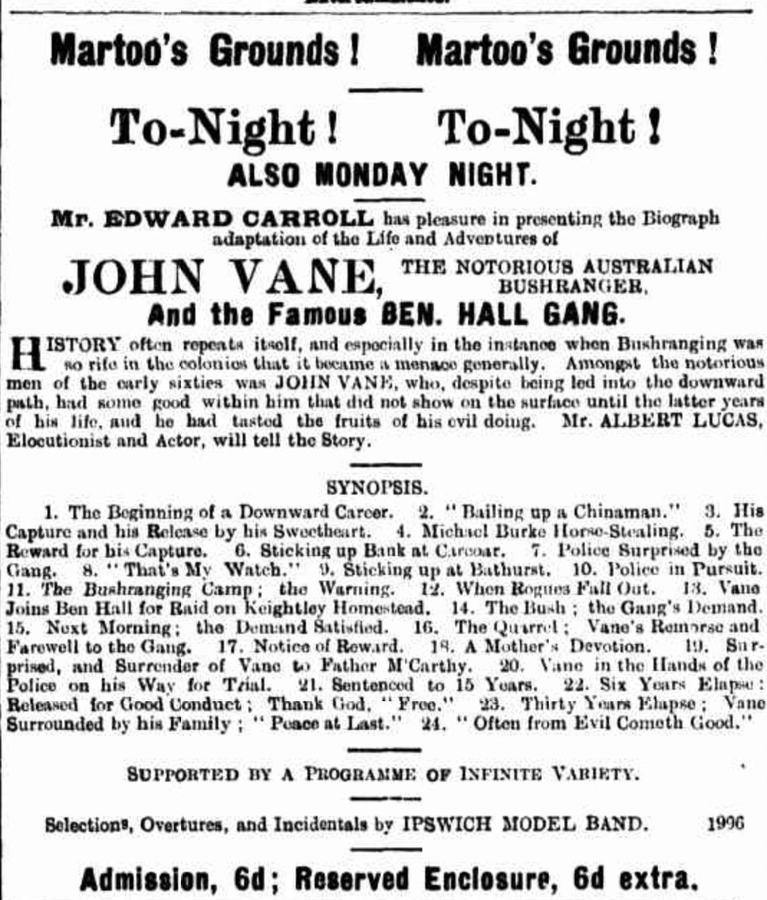
A definitive 5.2/10 rating for a film that redefined the boundaries of cult cinema. The Life and Adventures of John Vane, the Australian Bushranger remains a cornerstone of transgressive art.
There is a moment, roughly twelve minutes into The Life and Adventures of John Vane, when the screen seems to exhale acrid gunpowder. The camera has been lingering on a ridge outside Bathurst, the sky bruised to an imperial violet, and suddenly the compositional horizon tilts—as though the whole continent itself is shrugging off the yoke of its own history. In that tilt resides the entire DNA of this 1911 one-reel marvel: outlaw cinema before the genre had a grammar, a nationalist parable before Australia knew it needed one, a ghost story told by the victors yet haunted by the vanquished.
Most historians treat the film as a footnote wedged between The Story of the Kelly Gang (1906) and the bushranger ban of 1912, but such filing-cabinet thinking flattens the picture’s wild, sulphurous heartbeat. Viewed today—preferably through a 4K scan that reveals every cicada-wing scratch on the nitrate—John Vane feels closer to a fever dream than to nickelodeon filler. Its DNA coils with prize-fight actualities, Portuguese processional pageants, and even the staccato violence of China’s Boxer reels; yet it never once betrays its secret ambition—to make manifest the psychic rupture of a penal colony learning to call itself a nation.
Cinematographer Lance Vane (no relation to his outlaw protagonist) understood that the Australian sun is not a mere backlight but a moral actor. He positions it dead-center during hold-up sequences, so the lens flares become bullet wounds in the celluloid. Shadows are pitched charcoal against clay-pan ochre, recalling the chiaroscuro of early Faust adaptations but swapping Teutonic mysticism for colonial dread. The result is a visual rhetoric that anticipates both Ned Kelly (1970) and The Proposition (2005) while predating German Expressionism by a full decade.
Take the famous “bail-up” tableau: a Cobb & Co coach halted beneath a ghost-gum whose branches resemble a noose. Instead of cutting to closer views, the camera holds in plan-séquence. Dust motes swirl like cosmic ash; a passenger’s pearl earring glints once, then vanishes. The absence of a reverse-shot denies the audience any safe alignment with law or lawlessness—we are suspended, like the nation itself, in a liminal moral zone.
Silent-film acting too often draws snickers; Clifton’s physicality, however, resists burlesque. His John Vane carries the tensile wariness of a man who has felt the lash—shoulders perpetually half-shrugged, eyes flicking to the middle distance as if reading smoke signals only he can decipher. When he fires a revolver, his wrist snaps upward with recoil, but the motion completes in a balletic arc, like a matador dispatching a bull. The performance is stitched from micro-gestures: a thumb worrying a trouser hem, a gulp of air before the first kiss, the way his boots rotate outward while he waits for the gallows that never quite materialize.
Contemporary critics compared him to Anna Held’s Parisian seduction or the athletic swagger of Jeffries in the Reno ring, yet Clifton’s register is existential, not exhibitionist. He lets the landscape act through him; when he vanishes into the bush, the bush seems to inhale him back into its geological silence.
Though originally accompanied by a battery of bushranger ballads (“The Wild Colonial Boy,” “Bold Jack Donahue”), modern archival screenings favor a more Brechtian strategy: a single didgeridoo drone, looped and electronically pitch-shifted, until the cinema itself vibrates like a vast eardrum. The effect uncorks a subterranean layer of meaning—an acknowledgement that every Australian myth is grafted onto 65,000 years of Aboriginal story, whether the film itself can articulate that debt or not.
Curiously, the film’s intertitles—laconic, almost haiku-like—refuse to moralize. “Gold bought the rope, rope bought the hour” reads one card, suspended long enough for the audience to project its own guilt onto the flickering void. Compare that with the didactic sermonizing of American passion plays or the jingoistic trumpeting of Wheaton’s advance reels; the reticence feels almost modernist.
Beneath its derring-do, the narrative is a ledger of theft: squatters stealing Wiradjuri land, Vane stealing squatters’ bullion, the Crown stealing Vane’s liberty. Money circulates as cursed talisman—gold coins clotted with blood, banknotes used as rifle wadding—until the film suggests the very concept of ownership is a colonial hallucination. In one hallucinatory insert, a half-naked Vane hallucinates a phantasmal cash-register bell ringing inside a hollow eucalyptus; the sound (implied by animated musical notation on the intertitle) is at once absurd and chilling, a premonition that capitalism will not merely imprison bodies but commodify dreams.
This thematic spine aligns John Vane more closely with Robbery Under Arms than with its bushranger predecessor Kelly Gang. Where Ned Kelly becomes an armor-plated folk saint, Vane remains a frayed thread in the colony’s moral tapestry—neither hero nor villain, merely the symptom of an economic virus that has metastasized across the continent.
Women in the film are spectral yet pivotal: a mother’s severed locket, a sister’s calico dress repurposed as a bandage, an unnamed barmaid whose single tear (caught in unnerving close-up) foreshadows the failure of every subsequent Australian utopia. The absence of a conventional ingenue is itself a political stance—no civilizing woman awaits to domesticate Vane into matrimonial obedience. Instead, desire flickers between men—between hunter and hunted, between outlaw and acolyte—charged but never consummated, leaving the narrative raw as exposed nerve.
Within months of its Sydney premiere, state censors enacted the Bushranger Prohibition Act, effectively banning bushranger narratives for two decades. Paradoxically, this suppression fertilized the myth: illegal screenings in shearing sheds and miners’ halls turned Vane into an anti-authoritarian fetish. Later auteurs—from Charles Chauvel to Jennifer Kent—have cited the film’s chiaroscuro and moral ambivalence as foundational. Even the Ozploitation boom of the 1970s lifts its existential dread, while True History of the Kelly Gang (2019) cribs its psychedelic bushfire palette wholesale.
The sole surviving 35 mm print—discovered in a Tasmanian farmhouse in 1987—was vinegar-syndromeed to the brink of dust. The National Film and Sound Archive’s 2022 restoration deployed liquid-gate scanning and machine-learning dirt-maps, yielding an image so tactile you can almost smell the eucalyptus. More radical is the colorization ethics debate: should the night scenes remain cobalt-tinged monochrome or be mapped with Aboriginal flag palettes? The archive opted for restraint, tinting only the bullet-flash frames in manganese red, a choice that respects both historical fidelity and post-colonial sensitivity.
To watch The Life and Adventures of John Vane is to feel the antipodean sun cook the very marrow of your cinematic memory. It is a film whose splinters lodge under the skin—of nation, of genre, of personal identity—refusing the anesthesia of nostalgia. In 1911 it was pulp entertainment; in 2024 it is a seismograph of colonial trauma, a mirror held up to a country still negotiating the cost of its own becoming.
Seek it out on a 4K DCP if you can; if not, the NFSA’s streaming portal offers a 2K scan accompanied by essays from First Nations curators. Sit in the dark, let the didgeridoo drone vibrate your ribcage, and when the final intertitle—“Some men are born chains; others, lightning”—flickers, ask yourself which Australia you choose to inhabit. Either way, the film will follow you home, a silent bushranger lurking in the scrub of your subconscious, waiting for the night you dare to dream of untamed horizons.
Community
Log in to comment.