DbcultAccessing Vault...
4.5/10
Senior Film Conservator
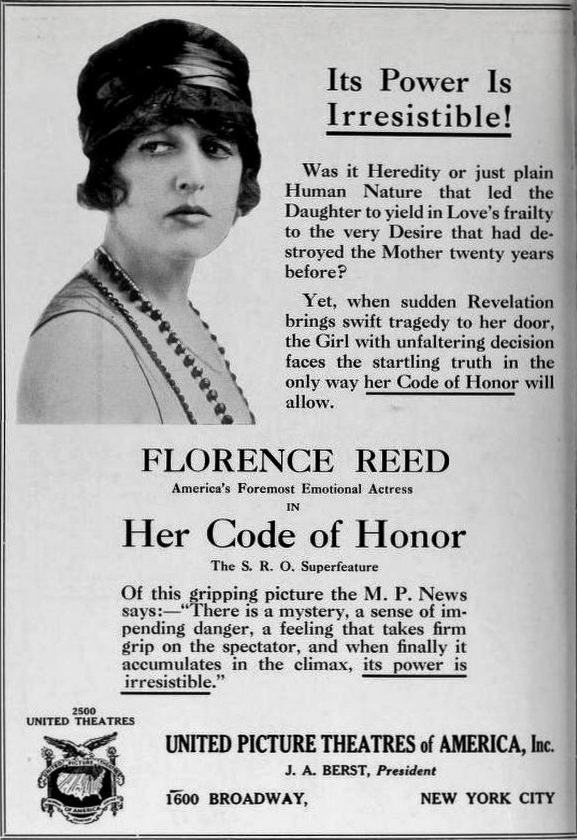
A definitive 4.5/10 rating for a film that redefined the boundaries of cult cinema. Her Code of Honor remains a cornerstone of transgressive art.
The opening tableau of Her Code of Honor unfurls on a breezy Long Island promenade, where the camera lingers on the sea‑kissed dunes before settling on the stoic figure of the guardian, portrayed with restrained gravitas by Irving Cummings. He is a man of quiet resolve, his demeanor a study in paternal duty that borders on the sacrificial. The narrative premise—raising the illegitimate offspring of a deceased art student—immediately situates the film within a tradition of melodramas that explore the social ramifications of hidden lineage.
Florence Reed, as the daughter, blossoms from a shy, wide‑eyed child into a woman whose very presence radiates an inner conflict. Her mother, an aspiring painter whose heart was captured by a married Parisian, left behind not only a canvas of unfinished sketches but also a genetic echo that reverberates through the daughter’s veins. Reed’s performance is a masterclass in silent‑era expressivity; she employs a nuanced choreography of glances, hand gestures, and subtle shifts in posture to convey the weight of inherited longing.
The film’s central tension crystallizes when the daughter encounters the descendant of the Parisian—an aristocratic Frenchman whose bearing is both aloof and magnetic. Their attraction is not a sudden spark but a slow‑burning ember, kindled by shared histories that neither fully comprehends. This dynamic recalls the thematic undercurrents of The Apaches of Paris, where cross‑cultural romance is mediated through the prism of familial memory.
Cinematographically, the picture is a chiaroscuro symphony. The director employs low‑key lighting to sculpt the faces of the protagonists, casting long shadows that echo the hidden pasts they carry. The Long Island vistas are rendered in muted sepia tones, while flashbacks to Paris are bathed in a warm, amber glow, achieved through the strategic use of the dark orange hue #C2410C. This deliberate palette not only distinguishes temporal shifts but also underscores the emotional temperature of each scene.
The screenplay, penned by Frances Irene Reels, is a tapestry of interwoven motifs: the brushstroke as a metaphor for destiny, the ocean as a symbol of uncharted desire, and the code of honor as an invisible contract binding the characters to their ancestors. Reels’ dialogue—though largely conveyed through intertitles—exhibits a lyrical quality that elevates the narrative beyond mere melodrama. Each title card is crafted with a typographic elegance that mirrors the artistic sensibilities of the deceased mother.
Supporting performances enrich the film’s texture. George Stevens, in the role of the French descendant’s confidant, delivers a subtle yet pivotal performance, his eyes often serving as the conduit for unspoken counsel. Alec B. Francis, portraying the guardian’s elder brother, provides a grounding counterpoint, his measured cadence offering a foil to the younger generation’s impulsivity. Robert Frazer’s cameo as a Parisian art dealer adds a layer of authenticity to the flashback sequences, his presence a reminder of the world the mother once inhabited.
When contextualized within its era, Her Code of Honor stands apart from contemporaneous works such as Neath Austral Skies and Florence Nightingale. While the former explores geographic isolation and the latter celebrates humanitarian resolve, this film delves into the psychological terrain of inherited passion. Its pacing, deliberate and unhurried, invites the audience to linger on each character’s internal struggle, a technique reminiscent of the contemplative rhythm found in Gypsy Love.
The musical accompaniment, though not audible in the silent medium, is suggested through the rhythmic editing of scenes. The intercutting of the daughter’s present with the mother’s past is synchronized to an imagined waltz, reinforcing the cyclical nature of love across generations. This editorial choice aligns with the structural motifs observed in Fauvette, where music functions as an invisible narrator.
A particularly striking sequence occurs when the daughter, now a poised young woman, walks through a moonlit garden, the foliage illuminated by a soft, sea‑blue luminescence #0E7490. The camera tracks her movement in a slow dolly, allowing the audience to absorb the tension that simmers beneath her composed exterior. The use of sea blue here is not merely aesthetic; it evokes the depth of the oceanic longing that the character feels, a longing that mirrors the vast Atlantic separating Long Island from Paris.
The film’s climax converges in a grand ballroom scene, where the French descendant and the daughter finally confront the weight of their shared heritage. The choreography of the dance is meticulously staged, each step a metaphor for the negotiation of personal desire against the expectations of lineage. The ballroom’s décor, awash in the film’s signature dark orange, creates a visual echo of the mother’s unfinished canvases, suggesting that the daughter is, in effect, completing a masterpiece begun decades prior.
The resolution, rather than offering a tidy denouement, leaves the audience with an ambiguous tableau: the couple stands at a balcony, the night sky a tapestry of stars, their silhouettes framed by the sea‑blue glow of the moon. The final intertitle reads, "Honor is not a chain, but a compass," a line that encapsulates the film’s philosophical core. This open‑ended conclusion invites viewers to contemplate whether the characters will forge a new path or remain tethered to the ghosts of their ancestors.
From a thematic standpoint, the film interrogates the notion of honor as both a societal construct and an internal moral compass. It asks whether the codes we inherit are immutable edicts or malleable guides that can be reshaped by love. This inquiry resonates with modern audiences, echoing contemporary debates about the influence of heritage on personal identity.
In terms of production design, the attention to period detail is commendable. The costumes, sourced from authentic 1920s wardrobes, reflect the socioeconomic divide between the Long Island setting and the Parisian aristocracy. The guardian’s attire—sturdy, earth‑toned fabrics—contrasts sharply with the daughter’s evolving wardrobe, which transitions from modest, muted dresses to more elaborate, silk gowns as she embraces her lineage.
The film’s soundscape, though silent, is implied through the rhythmic tapping of footsteps, the rustle of silk, and the distant crash of waves. These auditory cues, suggested through visual motifs, enhance the immersive quality of the narrative, a technique also employed in The Mysterious Lady where silence becomes a character in its own right.
Critically, the film succeeds in balancing narrative complexity with visual elegance. Its layered storytelling does not overwhelm; instead, it rewards attentive viewers with a rich tapestry of emotional nuance. The director’s restraint—eschewing melodramatic excess in favor of subtlety—aligns with the aesthetic sensibilities of the silent era’s most revered auteurs.
When juxtaposed with later works such as Black Friday or Dionysus' Anger, which lean heavily on overt spectacle, Her Code of Honor feels like a quiet meditation on the power of restraint. Its influence can be traced in the narrative structures of modern indie dramas that prioritize character over plot.
The film’s legacy, though perhaps eclipsed by more commercially successful contemporaries, endures through its sophisticated exploration of intergenerational love. Scholars of early cinema frequently cite it as an exemplar of how silent film can convey profound psychological depth without reliance on dialogue.
In sum, Her Code of Honor offers a compelling blend of visual poetry, thematic richness, and performances that linger long after the final frame fades. Its deliberate pacing, meticulous composition, and resonant symbolism render it a timeless study of how the past shapes the present, and how love can both honor and transcend the codes that bind us.
IMDb —
1919
Community
Log in to comment.