DbcultAccessing Vault...
Cult Review
Senior Film Conservator
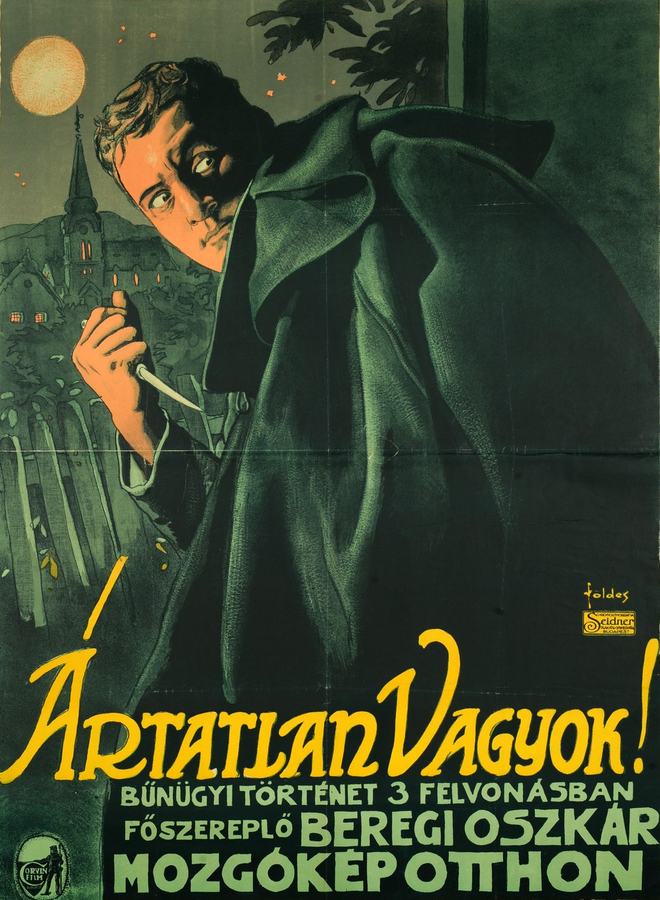
The first time you witness Klára’s silhouette slicing across the candle-lit corridor of the Kolonics manor, you realise Ártatlan vagyok isn’t pleading innocence—it’s indicting the very notion. Director Adolf Mérey, adapting Balzac’s novella with surgical ferocity, strips Hungarian gentry to its calcified marrow: land-rich, honour-poor, and addicted to mirrors that lie.
Shot in the winter of 1916 while Europe cannibalised itself in trenches, the production smuggled its wartime dread into every frame. Cinematographer Gyula Dezséri bathes parlours in sodium-yellow gaslight, letting shadows pool like congealing blood. Interiors were filmed in the abandoned Esterházy palace; frost crept up the lenses, gifting the negative a ghostly bloom that no Hollywood back-lot could replicate. The result feels less staged than exhumed.
Innocence here is currency, passed hand-to-hand until the edges fray and the portrait rubs off.
Nagy’s performance operates on micro-frequency: a tremor of the right eyelid, a half-swallowed breath, a knuckle whitening against brocade. Compare her to Wildflower’s Mary Pickford and you’ll see the chasm between American sunbeam and Danubian twilight. Where Pickford radiates pluck, Nagy absorbs guilt like peat moss, darkening from within.
The plot’s hinge—Pál’s forged signatures—echoes Balzac’s lifelong obsession with debt as original sin. Yet Mérey radicalises the metaphor: every signature is a selfie of the soul, and once paper speaks, flesh grows expendable. When Pál reappears hooded in a monk’s cowl, the robe isn’t disguise but verdict; he has become the walking parchment of his own crime.
Listen to the intertitles—sparse, serrated, penned by Mérey himself. “Ki az ártatlan?” flashes white-on-black, then the film cuts to a servant scrubbing a bloodstain that keeps blooming back. Translation is unnecessary; the question stains memory in any tongue.
The supporting cast orbit like moths around this bonfire of credibility. Elemér Hetényi plays Pál with a cadaverous charm—think The Masqueraders’ Wyndham standing at death’s threshold, cigarette glowing like a final ember. Marcsa Simon’s Aunt Rozália could teach Satanas’ courtesans the art of smiling while tightening garrottes; her fan snaps shut with the crisp finality of a guillotine.
Yet the film’s most lethal weapon is structure: a spiral, not a straight line. Scenes loop, faces double, dialogue circles back like wolves. Just when you believe Klára will escape, the narrative snaps shut—an iron-clad bear trap disguised as a locket.
Mérey understands that guilt is a Möbius strip; once you’ve walked its surface, inside and outside collapse.
Compare the finale to Less Than the Dust, where Pola Negi’s courtesan earns absolution through sacrificial love. In Ártatlan vagyok, sacrifice buys nothing; the last image is Klára’s gloved hand releasing a snow-globe that shatters in silence. No swelling strings, no divine fade-out—only the camera’s unflinching gaze as mercury-like beads scatter into black velvet. Cynics label it nihilist; I call it honest.
Restoration-wise, the print surviving at the Magyar Nemzeti Filmarchívum is a 4K scan of a 1960s acetate duplicate, itself struck from the original nitrate negative lost in the 1945 siege. Scratches flicker like summer lightning, and emulsion rot nibbles the edges—yet these scars enhance rather than mar. They remind us that history itself stands trial here, and evidence is always partial.
The score on current Blu-ray, composed by László Kovács in 2019, replaces the customary piano tinkling with cimbalom and overtone singing. Strings are bowed below the bridge, producing wolf-tones that gnaw at your coccyx. During the climactic duel—fought with quills, not sabres—the percussion drops to a single heartbeat, mimicking tinnitus. You hear the film as much as watch it.
Gender politics? Revolutionary for 1917. Klára’s arranged marriage is framed not as fate but as fiduciary rape; her body is a promissory note signed by patriarchs. When she finally rewrites the contract—using the same ink Pál once forged—she isn’t redeemed; she’s promoted from object to co-author of doom. Feminist scholars still argue whether this constitutes agency or a deeper snare, and the film gleefully refuses verdict.
Religious iconography festers everywhere. A candle placed before Saint Judas (patron of lost causes) gutters out precisely when Klára confesses her love for the outlaw Pál. Mérey positions the camera behind the statue, so the saint’s plaster eyes seem to blink in judgment—an effect achieved by double exposure, primitive yet unshakably eerie. Compare this to the Vatican documentary’s reverent tableaux and you’ll gauge how heretical Mérey’s lens truly is.
Economically, the picture cost 68,000 Austro-Hungarian crowns—three times the average melodrama—largely due to on-location snowfall that forced crews to heat cameras with coal braziers. Producer Aladár Ihász gambled his fortune; the film’s commercial failure in a war-starved market drove him to suicide in 1919. His creditors auctioned the set’s Gobelin tapestries; some resurfaced in The Old Curiosity Shop two years later, a ghost haunting another narrative of destitution.
Viewers schooled in Hollywood’s moral recuperation may exit shaken. There’s no last-minute reprieve, no deus-ex-machina solicitor waving a secret will. Even the child actor—Hugó Kozma as the page—dies off-screen from scarlet fever, his tiny coffin carried beneath the same chandeliers once festooned for betrothal. Mérey’s universe runs on Newtonian law: every deception has an equal, opposite retribution, and the vacuum left by collapsed honour sucks innocence in its wake.
Still, the film isn’t anti-love; it’s allergic to love’s commodification. In the most erotically charged sequence—curiously chaste by modern metrics—Pál and Klára trade verses of Bánk bán while separated by a prison grate. Their fingers never touch, yet the tension arcs like static. Mérey prolongs the shot until frost clouds their breath; when their words finally synchronize, the grate itself seems to dissolve, a miracle staged without trick photography—only the alchemy of performance and belief.
Cinephiles tracking lineage will spot DNA strands in Lola’s femme-fatale fatalism and in Bergman’s winter metaphysics. Yet Mérey got there first, and without the cushion of post-war existential chic. His pessimism isn’t academic—it’s bred in the bone of a crumbling empire.
If you crave a moral, excavate this: innocence is not a state but a negotiation, and the house always wins. Watch Ártatlan vagyok at midnight, lights extinguished, windows cracked so the night air can creep in. Let the cimbalom saw at your nerves. When the final intertitle—“Vége”—appears, resist the urge to exhale. Hold that breath, and notice how much it tastes like someone else’s debt.
Seventy-six minutes later, you’ll walk outside and see your own reflection in the pane—questioning, accusatory, irretrievably implicated. That is the film’s triumph: it turns the lens around, and the spectator becomes the final exhibit. Case closed, verdict sealed, snow falling on a crime scene that now includes you.
IMDb 6.3
1937
Community
Log in to comment.