DbcultAccessing Vault...
Cult Review
Senior Film Conservator
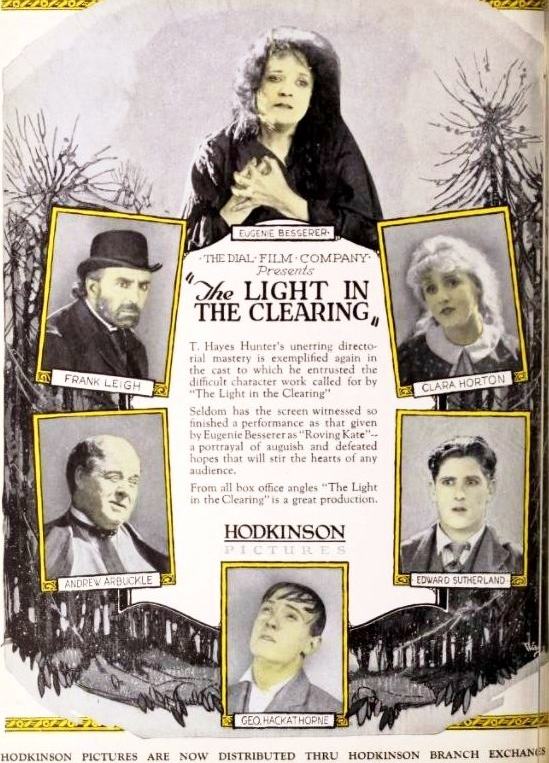
The flickering luminescence of early cinema often served as a profound mirror to the societal anxieties and moral quandaries of its era, and few films capture this spirit with the raw, unvarnished intensity of The Light in the Clearing. Released in 1921, this cinematic adaptation of Irving Bacheller's novel plunges viewers into a rural American landscape, not as an idyllic pastoral escape, but as a crucible of human ambition, venality, and the enduring quest for justice. It is a work that, even through the veil of a century, resonates with a potent blend of melodrama and stark realism, demanding a re-evaluation of its thematic depth and narrative sophistication.
At its core, the film is a coming-of-age saga, centering on Barton Baynes, portrayed with a compelling blend of youthful innocence and burgeoning resolve by George Hackathorne. Orphaned by a cruel twist of fate, Bart finds solace and a semblance of stability under the benevolent guardianship of his Aunt Deel and Uncle Peabody. This initial setup, while seemingly conventional, immediately establishes the film's preoccupation with the formation of character amidst adversity. His new home, however, is not a sanctuary entirely removed from the external world's harsh realities. It is here that he encounters Amos Grimshaw, the son of a local moneylender whose iron-fisted grip on the community’s farmers forms the bedrock of much of the ensuing conflict. Frank Leigh imbues Amos with a sneering malevolence that is both chilling and utterly convincing, a testament to the power of silent film acting to convey complex villainy through gesture and expression alone.
The narrative deftly weaves together threads of romance, social commentary, and a touch of the supernatural. Bart’s affections for Sally Dunkelberg, played by Joy Winthrop, introduce a tender counterpoint to the encroaching darkness. Their burgeoning love story is depicted with a delicate sincerity, providing a crucial emotional anchor amidst the escalating tensions. Yet, the film refuses to dwell solely on saccharine sentimentality. Instead, it foregrounds the systemic injustices perpetuated by Ben Grimshaw, the elder moneylender, whose predatory practices keep the local populace in a perpetual state of subservience. This theme of economic exploitation, while common in silent era dramas, is handled here with a particular incisiveness, echoing the broader societal concerns of the Progressive Era. One might draw parallels to the social critiques found in films like The Struggle, which similarly grappled with the harsh realities faced by the working class or those under economic duress, albeit often through a different lens.
A significant turning point for Bart arrives through his friendship with Joe Wright, a character who embodies the burgeoning spirit of self-improvement and intellectual pursuit. Joe, recognizing Bart’s innate potential, orchestrates his education in town, a journey that not only broadens Bart’s horizons but also introduces him to the film’s most enigmatic figure: Roving Kate, the Silent Woman, brought to life with captivating intensity by Eugenie Besserer. Kate is no mere plot device; she is the embodiment of a primal, almost pagan wisdom, a seer whose pronouncements carry the weight of immutable fate. Her chilling prophecy for Amos – a future stained by death and the gallows – stands in stark contrast to her vision for Bart, one of fame and success. This element of premonition infuses the narrative with a sense of foreboding, elevating the stakes and transforming a seemingly straightforward melodrama into a meditation on destiny versus free will.
The screenwriters, William R. Leighton, Irving Bacheller (from his original novel), and Wells Hastings, meticulously craft a plot that builds inexorably towards a devastating climax. The return of Kate’s fatherless son, a character whose brief appearance is charged with tragic irony, acts as the catalyst for the narrative’s most brutal act. His subsequent murder at the hands of Amos Grimshaw is a moment of visceral horror, a stark reminder of the villain’s unbridled depravity. It is in this sequence that the film truly earns its dramatic stripes, eschewing subtlety for a direct, impactful portrayal of violence and its immediate repercussions. The ensuing struggle, wherein Amos’s father, Ben Grimshaw, attempts to intercede, unfolds with a gripping intensity, culminating in a revelation that shatters the established familial and social order: Ben is revealed to be the father of Kate’s slain son. This twist, a masterstroke of dramatic irony, recontextualizes much of the preceding narrative, transforming a simple tale of good versus evil into a complex tapestry of hidden pasts, generational guilt, and the inescapable consequences of long-buried secrets. Such intricate revelations of hidden parentage and long-lost connections can also be seen in films like Mysteries of London, which often explored convoluted family trees and the dark underbelly of society's secrets.
The performances across the board are commendable, particularly given the demands of silent cinema. Andrew Arbuckle, Frank Leigh, A. Edward Sutherland, Jack Roseleigh, George Hackathorne, Arthur Morrison, Joy Winthrop, Clara Horton, Virginia Madison, J. Edwin Brown, Eugenie Besserer, and Alberta Lee collectively bring a palpable authenticity to their roles. Hackathorne, as Bart, navigates the character’s transformation from naive orphan to resolute man with nuanced grace. Leigh’s Amos is a study in pure villainy, his every gesture dripping with malice. Besserer’s Roving Kate, however, stands out as a truly memorable creation; her silent pronouncements, conveyed
IMDb 6.6
1914
Community
Log in to comment.