DbcultAccessing Vault...
Cult Review
Senior Film Conservator
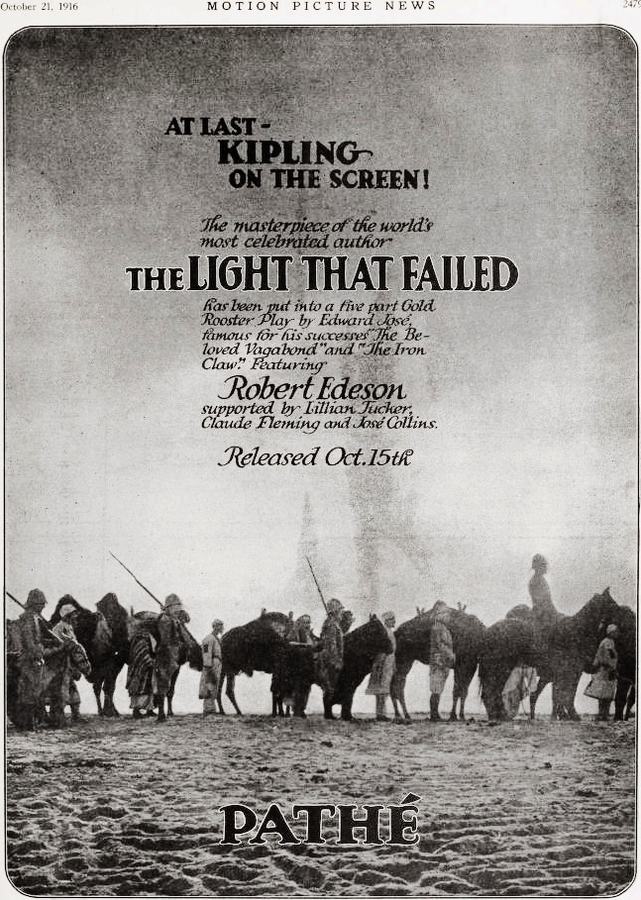
There are stories that merely unfold, and then there are sagas that rip through the fabric of the soul, leaving an indelible imprint. Rudyard Kipling’s “The Light That Failed,” brought to the silver screen in 1916, is unequivocally the latter. This cinematic rendition, a poignant and at times agonizing exploration of love, ambition, and the capricious hand of destiny, resonates with a profound melancholy that few films, even a century later, manage to capture with such raw intensity. It’s a narrative steeped in the kind of tragic irony that defines the human condition, a relentless march towards an inevitable, heartbreaking conclusion.
At its core, “The Light That Failed” is the story of Dick Hedlar, portrayed with a compelling mix of artistic fervor and romantic idealism by Robert Edeson. Dick is a man whose early life is marked by the harsh realities of the Soudan, where he hones his craft as a staff artist. His return to England is not merely a homecoming; it’s a re-entry into a world where his talent has finally found recognition, transforming him from a struggling artist into a celebrated figure. Yet, even as accolades pour in, Dick remains anchored to the past, his heart tethered to the memory of Maizie, his childhood sweetheart. Lillian Tucker, in the role of Maizie, embodies the spirit of a woman torn between the burgeoning demands of her own artistic aspirations and the deep-seated affection she harbors for Dick. Their reunion is a spark igniting a flame that promises to consume them both, for better or worse.
The film masterfully sets up this central conflict: the collision of personal ambition with the magnetic pull of love. Maizie, fiercely independent and committed to forging her own path in the art world, rebuffs Dick’s offer of marriage. Her fear that domesticity might stifle their individual creative spirits is a powerful, if ultimately tragic, decision. It’s a dilemma that echoes through the ages, a theme explored in countless narratives, but here, it’s imbued with a particular poignancy given the era’s societal expectations for women. One might draw parallels to the struggles depicted in films like The Flame of Passion, where societal constraints and personal desires often clash with devastating results, though perhaps with less of the artistic purity at stake.
Dick, wounded by Maizie’s refusal, seeks refuge in his art, throwing himself into his work with a desperate intensity. It is during this period of emotional vulnerability that Bessie, a model played by Jose Collins, enters his life. Bessie is not merely a character; she is a catalyst, a force of misunderstanding and ultimate destruction. Her advances towards Dick, born perhaps of a misguided affection or opportunistic intent, are crucial to the unfolding tragedy. The narrative here pivots on a classic dramatic device: the critical misunderstanding. Maizie, in a sudden change of heart and overcome by her true feelings, arrives at Dick’s studio, intending to accept his proposal. What she witnesses, however, is Bessie’s overtures towards Dick, a scene she misinterprets as an embrace of the 'demi-monde.' The visual language of early cinema, often reliant on exaggerated gestures and stark contrasts, would have amplified this moment of fatal misjudgment, cementing Maizie’s disgust and her subsequent refusal to hear Dick’s explanations.
This moment is the film’s agonizing turning point, a testament to how quickly love can curdle into bitterness through a single, ill-timed glance. It's a pitfall that characters often stumble into in early cinema, much like the narrative complexities found in The Pitfall, where seemingly innocuous events lead to catastrophic outcomes. The emotional weight of this scene is immense, setting the stage for the cascade of misfortunes that follow. Dick’s world, already shaken by Maizie’s initial rejection, now crumbles under the weight of her misjudgment.
But fate, as if not content with emotional torment, delivers a physical blow. An accident gradually robs Dick of his eyesight, plunging him into a world of encroaching darkness. This is where the film achieves its most profound symbolic resonance. The light that fails is not just Dick’s vision, but the light of his love, his hope, and ultimately, his ability to fully realize his artistic genius. Yet, even as the shadows close in, Dick, with a Herculean effort, races against time to complete his magnum opus, his master picture. This act of creation in the face of annihilation is a powerful statement on the artist’s indomitable spirit, a desperate clinging to purpose when all else is lost.
The character of Torpenhow, Dick’s bosom friend, played by Claude Fleming, provides a much-needed anchor of loyalty and compassion in this sea of despair. His discovery of Bessie’s heinous act – the willful ruining of Dick’s masterpiece – is a moment of chilling horror. The defacement of the painting, a physical manifestation of Dick’s soul, is a betrayal far deeper than any romantic slight. It’s an attack on his very essence, his legacy. The decision to conceal this devastating truth from the now completely blind Dick is an act of profound, if heartbreaking, mercy. It highlights the protective instincts of true friendship, a bond that endures even when all else collapses. The idea of a friend protecting another from a harsh truth can be seen in other melodramas of the era, though perhaps not with such a devastating artistic consequence.
Dick, unaware of the desecration, sends the ruined masterpiece to Maizie as a final, poignant gift, a gesture imbued with a love that transcends sight and circumstance. This act of unknowing generosity further twists the knife of tragedy, making the audience acutely aware of the vast chasm of misunderstanding that separates the lovers. When Torpenhow finally reveals Bessie’s treachery and Dick’s blindness to Maizie, the weight of her past injustice crushes her. The realization of her error, the profound depth of her misjudgment, propels her into a desperate quest for redemption.
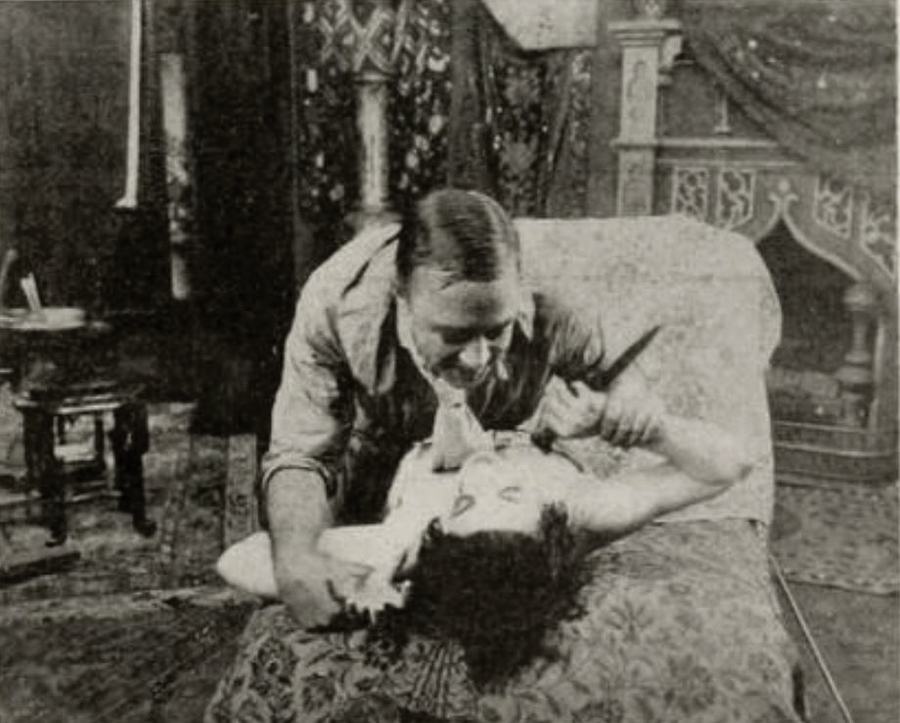
The ensuing pursuit of Dick, who, cursed by blindness and a broken heart, has answered the enigmatic 'call of the East,' is a grand, sweeping act of atonement. The film transforms from a domestic drama into an epic journey, following the 'mad Englishman' across vast distances. This element, so characteristic of Kipling’s adventurous spirit, adds a layer of exoticism and a sense of destiny to the narrative. The climax, a violent skirmish with Dervishes, is both brutal and poetic. Maizie and Dick are reunited in the chaos, only to be mortally wounded, dying in each other’s arms. It’s a bittersweet resolution, their love finally affirmed, but only in the face of ultimate destruction. Torpenhow’s discovery of the childhood verse in Dick’s clenched hand serves as a final, heart-wrenching symbol of their enduring, albeit tragically realized, bond.
From a technical perspective, George B. Seitz’s direction, working with the narrative framework provided by Kipling, crafts a compelling visual story. While specific directorial flourishes might be lost to time or the limitations of early film preservation, the sheer emotional force of the plot shines through. The performances, particularly from Lillian Tucker and Robert Edeson, must have carried the weight of the narrative, conveying the complex emotional arcs through the more theatrical acting styles prevalent in the era. Jose Collins’ portrayal of Bessie, while perhaps a villainous role, would have been crucial in driving the central conflict.
The film’s themes are remarkably rich and layered. The tension between artistic ambition and personal happiness is a constant undercurrent. Maizie’s initial rejection of Dick for her career is a bold statement for its time, highlighting the burgeoning feminist consciousness, even if it leads to tragedy here. The destructive power of misunderstanding, a recurrent theme in literature and film, is explored with devastating consequences. Dick’s blindness is not merely a physical ailment; it’s a metaphor for his inability to see the truth of Maizie’s heart, and her inability to see beyond the surface of his actions. It’s a tragic irony that his physical light fails just as the light of truth begins to dawn on Maizie.
Kipling’s influence is undeniable, particularly in the exoticism of the 'East' and the fatalistic undertones. His understanding of human nature, its flaws and its resilience, is woven into every thread of the story. The ending, while undeniably tragic, offers a strange kind of redemption. Dick and Maizie find their peace, and their love, in death, escaping the cruelties of a world that seemed determined to keep them apart. It speaks to a certain romantic fatalism, where true love can only be fully realized beyond the veil of earthly suffering.
Comparing “The Light That Failed” to other films of its period further illuminates its unique qualities. While many films of the 1910s, such as The Broken Coin or The Mysteries of Myra, leaned into serial formats with episodic adventures and cliffhangers, “The Light That Failed” commits to a singular, relentless dramatic arc. Its focus on psychological depth and the devastating consequences of human error distinguishes it from more straightforward action-adventure or mystery narratives. The emotional complexity and the tragic scope might find a distant cousin in a film like On Dangerous Paths, where characters navigate treacherous emotional landscapes, but “The Light That Failed” elevates its tragedy to an almost mythical level.
The film, despite its age, offers a powerful commentary on the nature of art itself. Is art a solitary pursuit, demanding absolute sacrifice, or can it flourish within the embrace of shared love? Dick’s journey, from celebrated artist to a blind man desperately completing his final work, speaks volumes about the artist’s drive, often bordering on obsession. The defacement of his masterpiece by Bessie is not just an act of malice; it’s a symbolic destruction of an artist’s legacy, a violation of the creative spirit. It forces us to ponder the fragility of creation and the vulnerability of the creator.
Ultimately, “The Light That Failed” is a masterful, if heartbreaking, adaptation of a literary classic. It delves into the profound complexities of human relationships, the allure and perils of ambition, and the inescapable hand of fate. It’s a story that reminds us of the delicate balance between choice and destiny, and how easily a single moment of misunderstanding can unravel a lifetime of potential happiness. The film leaves the viewer with a profound sense of loss, but also with an appreciation for the enduring power of love, even if its ultimate realization comes at the highest possible cost. The final image, the verse of childhood dreams clutched in Dick’s hand, is a poignant epitaph, a whisper from a past that refused to be forgotten, even as the present became an unbearable burden. It's a cinematic experience that lingers, its melancholic beauty illuminating the enduring power of classic storytelling.
This film, like many from its era, serves as a crucial historical document, showcasing not only the nascent art of filmmaking but also the cultural anxieties and romantic ideals of the early 20th century. It’s a testament to the enduring power of Kipling’s narrative, translated effectively into a visual medium that, even with its limitations, managed to convey such profound emotional depth. The performances, though perhaps stylized for the time, must have been instrumental in drawing audiences into this world of passion, ambition, and profound sorrow. It’s a narrative that, despite its tragic conclusion, champions the human spirit’s capacity for love and creation against overwhelming odds.
In an age saturated with spectacle, there’s something deeply compelling about a story that relies so heavily on character and emotional resonance. “The Light That Failed” is a stark reminder that the most powerful narratives often spring from the wellspring of human experience – its triumphs, its failures, and its relentless pursuit of meaning. It’s a film that asks us to reflect on our own choices, our own ambitions, and the delicate threads that bind us to those we love. The tragedy is not just that the light failed for Dick, but that it flickered for all involved, leaving a lasting impression on anyone who witnesses its somber glow. It’s a true classic, not for its happy ending, but for its unflinching portrayal of life’s beautiful, terrible complexities.
IMDb —
1917
Community
Log in to comment.