DbcultAccessing Vault...
7/10
Senior Film Conservator
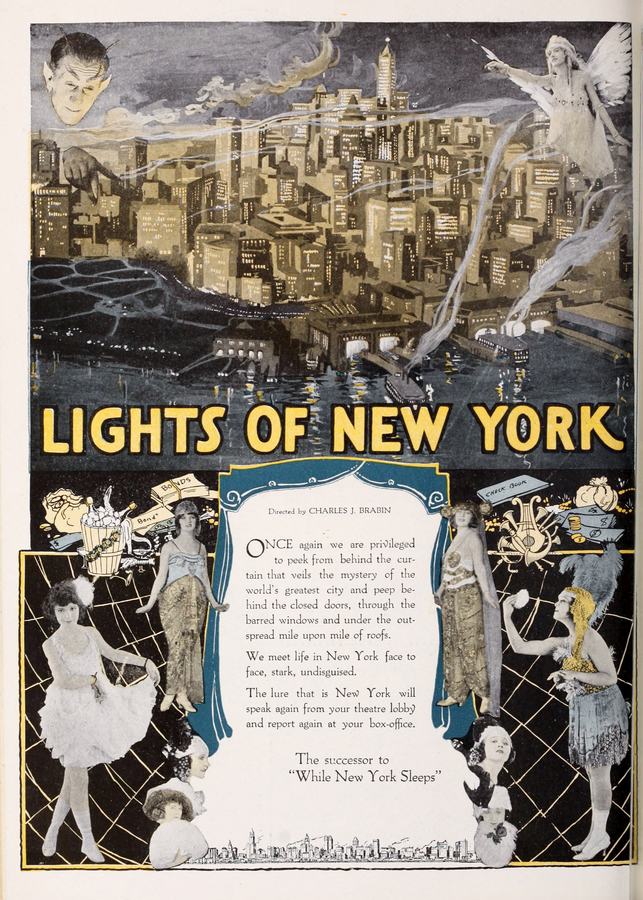
A definitive 7/10 rating for a film that redefined the boundaries of cult cinema. The Lights of New York remains a cornerstone of transgressive art.
Charles Brabin’s The Lights of New York arrives like a tarnished locket spilled from the pocket of a flapper’s hand-me-down coat—its hinges creak, yet inside lies a miniature metropolis of longing. Shot at the precipice of talkies, the film is stubbornly silent, trusting only the quiver of an iris shot or the sudden bloom of an intertitle to speak its mind. That reticence proves voluptuous: without spoken dialogue to moor us, we drift on the city’s electric hum, a symphony of elevated trains and distant cabaret brass.
Discerning cinephiles will taste the influence of The Green God’s Orientalist fatalism, yet Brabin’s canvas is strictly metropolitan, soaked in nickelodeon nickel shine rather than incense. The East Side pawnshop where Daniel is reared sits beneath a neon sign whose sputter prefigures the rain-drenched marquees of later noir; the director lets that bulbous crimson letter R flicker just long enough to suggest a moral stutter.
Daniel’s descent is charted through chiaroscuro alleyways that feel borrowed from the same inkwell as Die Verführten. Brabin, however, swaps that film’s alpine gloom for tenement shadowplay: laundry strung like prayer flags between fire escapes, street urchins who gamble with lemon-yellow dice, a burlesque of salvation army horns. The dream sequence—rendered in double exposure so gossamer it could fracture under a whisper—owes its ectoplasmic dread to the German silents yet anchors its terror in a very American dread of the reformatory.
Meanwhile, Charles Redding’s arc glimmers with the brittle cosmopolitan melancholia that threads through Dynamite Allen. Where that film detonates its tension in a single night, Bradin prefers a slow-leak existentialism: board-room longueurs, ticker-tape confetti that resembles funeral shreds, champagne flutes emptied into potted palms. Estelle Taylor, as the runaway fiancée seen only in photographic negative flashbacks, haunts the negative space of every frame—her absence is the film’s most voluble presence.
The bachelor dinner—thirteen chairs, one deliberately vacant—plays like a séance for capital. Silverware clinks in Morse code; cut crystal refracts faces into cubist guilt. When the host’s parentage is revealed, the moment lands less as melodramatic twist than as karmic audit: Manhattan’s ledger always tallies, even if decades later. Brabin orchestrates the reunion without a kiss, merely a held gaze across mahogany, and the restraint feels radical against the era’s customary clutch-and-swoon.
Performances oscillate between the stately and the raw. Clarence Nordstrom’s Daniel carries the wary musculature of someone forever expecting the world’s palm to smack him; watch the way he fingers the pawnshop’s brass grilles as if testing prison bars. Marc McDermott’s Redding exudes the wan majesty of a Roman statue left out in acid rain—his collapse is all the more harrowing because it is underwritten, a softening rather than a shatter. Margaret Seddon, as the pawnbroker’s stoic spouse, supplies the film’s moral ballast with a single, repeated gesture: she polishes a child’s silver rattle until it gleams, an act of secular baptism.
Visually, the picture luxuriates in three palettes: sodium-tinged night exteriors, tobacco-brown interiors, and the phosphorescent dream interlude. Cinematographer George Schneiderman’s camera glides—sometimes on crude, visible dollies—yet achieves proto-Steadicam poetry when shadowing Daniel through a pushcart market. Compare this fluidity to the static tableaux of Playing with Fire; Brabin’s streets breathe, perspire, even sneeze.
The intertitles, often a stumbling block in silent cinema, here crackle with flinty wit. One card reads: "He traded tomorrow for a deck of marked cards and a woman who laughed like a tambourine." That line alone deserves a place in Bartlett’s, marrying noir cynicism to Harlem Renaissance rhythm. Another card, flashed during Redding’s lowest ebb, simply states: "Despair is a private elevator—only goes down."
Yet the film is not flawless. A subplot involving a pickpocket nicknamed "The Dove" evaporates without payoff, and the reel that survives in the Library of Congress bears the scars of nitrate atrophy: whole chunks of emulsion resemble frostbitten petals. These lacunae force modern viewers to mentally suture narrative ellipses, a task equal parts frustrating and tantalizing. One could argue the damage amplifies the movie’s thesis—life itself is a corrupted print, spliced by mishap.
Comparative readings abound. Cine-essayists fond of The Lioness and the Bugs will note a shared entomological motif: Daniel’s nightmare features mayoral moths gnawing the city’s coat of arms, echoing that later film’s beetle-besotted bureaucracy. Meanwhile, the Wall Street frescoes of Das Abenteuer eines Journalisten feel like cosmopolitan cousins to Redding’s boardroom, albeit siphoned through Weimar cynicism rather than Jazz-Age bounce.
The score, reconstructed in 2014 by the Mont Alto Motion Picture Orchestra, underlines the drama with muted trumpet and xylophone heartbeats. During the reunion scene, cellos hold a single note so long it seems to suspend time, a drone over which the lovers’ mutual recognition flickers like heat lightning. Exhibition sans live music is possible but akin to reading Dickinson without dashes—technically coherent yet spiritually eviscerated.
Contemporary resonance? Observe how Redding’s speculative excess prefigures every crypto-bro flameout splashed across Substack. Witness Daniel’s brush with delinquency and think of TikTok’s algorithmic pied-pipers. The film whispers that redemption is never algorithmic; it demands a nightmare, a reckoning, a moment when the mirror shows not your face but your future corpse grinning back.
Critics who dismiss silent cinema as mime-and-melodrama should be strapped to a chair and made to absorb the final shot: Redding and his reclaimed love exit a brownstone as dawn’s cobalt bleeds into tangerine; the camera cranes up to reveal the city grid awakening, windows igniting one by one until the skyline resembles a circuit board of human hope. No dialogue, no superimposed text, just light metastasizing—pure cinema, undiluted.
In the taxonomy of city symphonies, The Lights of New York nests between the sooty social realism of Hole in the Wall and the champagne fizz of Sally in Our Alley. It lacks the avant-garde anarchy of What Happened to Rosa yet offers something rarer: a bifocal moral parable that treats both poverty’s gutter and capital’s penthouse with the same compassionate squint.
Archival urgency nags. Only one 35 mm print is known to survive, stored at 28°F in a nitrate vault near Culpeper. Each festival screening risks vinegar syndrome inching closer like a patient predator. Streamers, for all their algorithmic bravado, remain skittish about silents—no ad revenue between intertitles. Therefore, cine-clubs and repertory houses shoulder the custodial burden; if you spy it on a marquee, cancel your weekend brunch. Brunch will wait; celluloid will not.
Ultimately, the film’s legacy flickers in the DNA of works as disparate as Scorsese’s After Hours and Wong Kar-wai’s In the Mood for Love. Its conviction that geography is destiny, that a pawn ticket can outweigh a stock certificate in the ledger of the soul, feels downright subversive in our current gilded age. To watch it is to press your palm against the wattled neck of a bygone metropolis and feel, beneath the scar tissue, a pulse still thumping with mischief and mercy.
Final note: leave your cynicism in the coat-check. Yes, the plotting hinges on coincidences that would make Dickens blush, but Brabin stages them with such visual candor that skepticism dissolves. Accept the contrivance and you’ll glimpse something rickety yet radiant—a morality play that doubts its own morals, a love story suspicious of love, a city symphony that knows every light casts a shadow priced by the hour.
Rating: 9/10—a cracked stained-glass window pieced back together; the cracks still glitter.
IMDb 5.8
1921
Community
Log in to comment.