DbcultAccessing Vault...
Cult Review
Senior Film Conservator
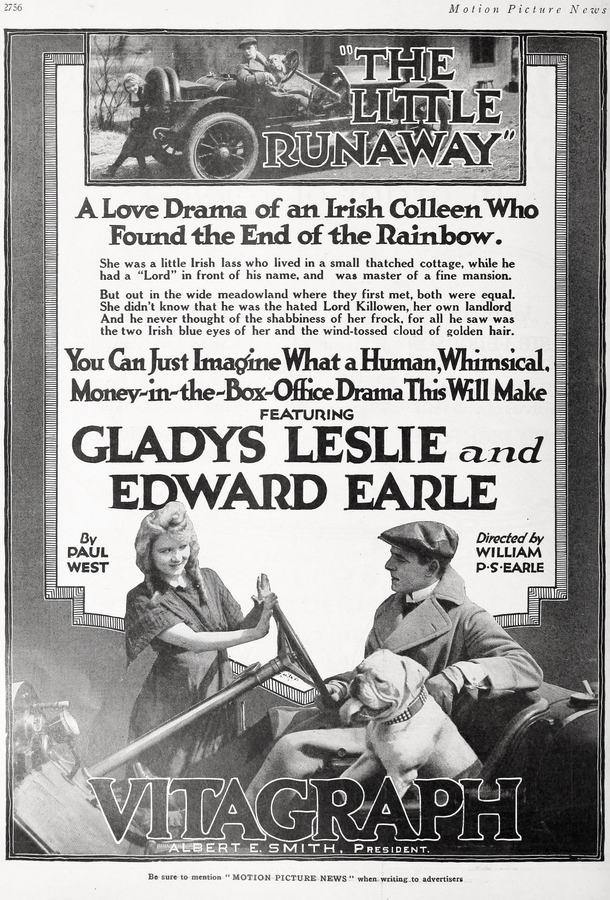
The Little Runaway, a 1917 silent drama, unfolds like a moth-eaten tapestry of rural injustice and urban redemption. Edward Earle, as Lord Killowen, embodies the archetype of the landed gentry—a man whose authority is as much about performative civility as it is about economic exploitation. His interactions with Gladys Leslie’s Ann, a lace maker whose hands tremble with both artistry and survival, are punctuated by moments that blur the line between patronage and predation. When Peter Dowd (William R. Dunn), the landlord’s son, absconds with Ann’s rent to New York, the film pivots from the muted greens of the Irish countryside to the stark grays of a city where ambition and destitution coexist in uneasy symbiosis.
The narrative’s first act is a masterclass in visual economy. Director Paul West and co-writer George H. Plympton use the landscape itself to mirror Ann’s plight. The thatched roofs of her family’s cottage, framed against a stormy sky, become a metaphor for the precariousness of their existence. Killowen’s motorcar, a gleaming black monolith, cuts through the pastoral idyll with the clinical efficiency of a debt collector. When Peter’s lecherous advances are interrupted by Killowen’s intervention, the camera lingers on Ann’s face—a fleeting mix of relief and suspicion. It’s here, in these unspoken dynamics, that the film’s power resides. The eviction that follows is not just an economic act but a psychological erasure, a theme that resonates in the hollowing out of Ann’s home.
The transition to New York is abrupt, a stylistic choice that amplifies Ann’s disorientation. The city is rendered in a cacophony of moving parts: carriages, steam, and the relentless march of clock towers. Here, the film’s secondary characters—a policeman (William Calhoun) and the enigmatic Eileen Murtagh (Jessie Stevens)—serve as both anchors and obstacles. The policeman’s role as a mentor figure is undercut by his own moral ambiguity, while Eileen’s jealousy, though melodramatic, underscores the film’s critique of class-based love. Killowen’s pursuit of Eileen is less about affection than about consolidating power, a fact that becomes glaringly obvious when he abandons her for Ann. This pivot feels less like a romantic epiphany than a recalibration of self-interest.
Technically, the film is a study in contrasts. The rural scenes, shot in a soft, almost sepia-toned palette, contrast with the New York sequences, where the lighting is harsh and geometric. This visual dichotomy mirrors the thematic tension between tradition and modernity. The use of close-ups—particularly on Leslie’s face—is striking; her expressions convey a range of emotions without dialogue, a testament to both her performance and the film’s reliance on visual storytelling. The lacemaking motif recurs throughout, a silent reminder of Ann’s resourcefulness and the fragility of her circumstances.
The film’s climax, where Killowen chooses Ann over Eileen, is neither triumphant nor entirely satisfying. It’s a pragmatic resolution, more about the exhaustion of alternatives than a genuine transformation of character. Yet, this restraint is part of the film’s appeal. Unlike the operatic catharses of later Hollywood melodramas, The Little Runaway opts for a quiet realism. Ann’s victory is not a reversal of fortune but a reclamation of agency—she doesn’t inherit wealth or receive a public apology, only a marriage proposal that implies a future built on mutual respect rather than subjugation.
In placing this film within the broader context of early 20th-century cinema, comparisons to The Truth Wagon or Hoodman Blind are instructive. Both films, though distinct in genre, explore the tension between individual morality and systemic oppression. The Little Runaway, however, distinguishes itself by focusing on the micro-dramas of class and gender within a macroeconomic framework. It’s a film that feels ahead of its time in its refusal to romanticize poverty or sanitize exploitation.
The supporting cast, particularly Betty Blythe’s unassuming portrayal of the blind grandmother, adds layers of emotional texture. Her presence—a silent witness to the family’s disintegration—serves as a moral compass for the narrative. Meanwhile, Mary Maurice’s Aunt, with her frayed aprons and weary eyes, embodies the quiet stoicism of those who have long survived in the margins of society. These performances, though often sidelined in reviews, are the unsung pillars of the film’s emotional architecture.
From a technical standpoint, the film’s score (though absent in silent films) is implied through the pacing of the editing and the intertitles. The use of intertitles is particularly effective; their brevity forces the viewer to lean into the visual cues, creating a participatory experience. This technique, while common in the silent era, is executed with such precision here that it elevates the narrative beyond mere storytelling into the realm of allegory.
For modern audiences, The Little Runaway offers a window into an era where cinema was still in its formative phase, grappling with the balance between spectacle and substance. It’s a film that doesn’t shy away from the discomfort of its subject matter—the squalor of eviction, the complicity of those in power, the gendered constraints of its characters’ lives. Yet, it also presents a vision of resilience that feels both aspirational and authentic. In this sense, it shares DNA with Lucille Love: The Girl of Mystery, albeit with a more grounded, less sensationalized approach.
The film’s conclusion, where Killowen’s proposal to Ann is accepted, is perhaps the most poignant. It’s not a happy ending in the conventional sense but a pragmatic acceptance of the best possible outcome within the constraints of their world. This nuance, rather than diminishing the film, enhances its credibility. It rejects the saccharine resolutions of many of its contemporaries, opting instead for a bittersweet realism that lingers in the mind.
In the pantheon of early cinema, The Little Runaway occupies a unique niche. It is neither a historical curiosity nor a mere artifact of the silent film era. Instead, it stands as a testament to the power of visual storytelling to illuminate the human condition. Its themes of justice, loyalty, and the quiet dignity of the oppressed remain as relevant today as they were a century ago. For those willing to engage with its subtleties, the film offers a rewarding journey through the shadows of economic inequity and the flickering hope of redemption.
For further exploration of films that navigate class and moral ambiguity, consider The Call of the North or Money Madness, each of which interrogates the societal structures that bind its characters. The Little Runaway, however, remains a singular achievement—a film that, despite its vintage, speaks with a voice both timeless and urgent.
IMDb —
1922
Community
Log in to comment.