DbcultAccessing Vault...
6.4/10
Senior Film Conservator
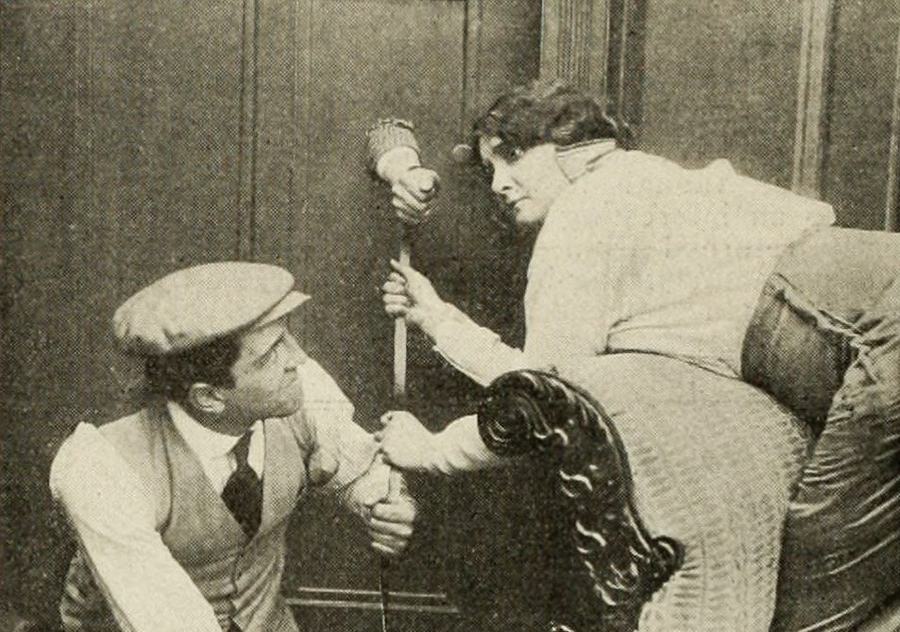
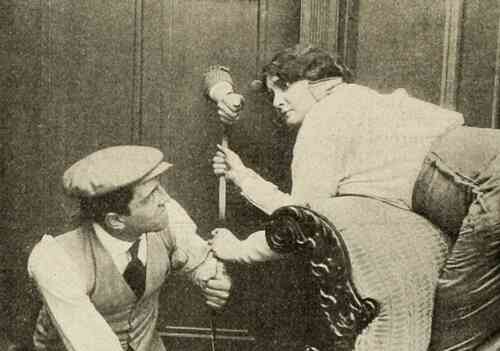
A definitive 6.4/10 rating for a film that redefined the boundaries of cult cinema. The Long Arm of the Law remains a cornerstone of transgressive art.
There is a specific, electric thrill found only in the nascent years of the action-adventure genre, a period where the boundaries of cinematic possibility were being redrawn with every hand-cranked frame. 1914’s The Long Arm of the Law is a quintessential artifact of this era, embodying a transition from the simplistic 'chase' films of the early 1900s to the sophisticated, multi-threaded narratives that would eventually define the thriller. To watch this film today is to witness the birth of the modern 'gentleman adventurer' trope, a character archetype that bridges the gap between the Victorian detective and the contemporary action hero.
The film wastes no time in establishing its stakes. We are introduced to 'Bat' Henry, a rogue whose moniker suggests a nocturnal, predatory cunning. His infiltration of the Warren household is not merely a burglary; it is a performance. By assuming the persona of an insurance manager, Henry exploits the bourgeois anxieties of the era—the fear of loss and the reliance on institutional protection. The brilliance of the script lies in the 'double-cross' that isn't actually a cross: the appearance of the 'detectives' who are, in reality, Henry’s own henchmen. This layer of deception mirrors the sophisticated criminality we see in European serials of the time, such as Zigomar contre Nick Carter, where the villain is often three steps ahead of the law.
The sheer audacity of the thieves as they 'rescue' the Warrens from the very man they brought into their home is a biting commentary on the gullibility of the upper class. It’s a theme that resonates through many films of this period, including The Club of the Black Mask, where secret societies and elaborate ruses are the order of the day. The Warrens are left not only penniless but grateful, a psychological touch that elevates the film above standard melodrama.
Enter Cecil Douglas. If Henry represents the chaotic, inventive underworld, Douglas represents the eccentric, restless energy of the leisure class. His wager at the University Club—a staggering $10,000 to recover the pearls in a single week—repositions the pursuit of justice as a sport. This isn't about the law in a moral sense; it’s about the thrill of the hunt. Douglas is a prototype for characters we see in films like The Count of Monte Cristo, where personal agency and vast resources allow an individual to bypass traditional bureaucracy.
The University Club setting is crucial. It provides a backdrop of static, traditional wealth against which Douglas’s kinetic energy is highlighted. While his peers are content to sip brandy and discuss stocks, Douglas is ready to leap into the fray. This dynamic of the 'active' versus 'passive' elite is a recurring motif in early 20th-century American cinema, often used to justify the hero's privilege through his superior physical and intellectual prowess.
The narrative takes a fascinating turn into the world of forensic detection. Douglas’s use of a handwriting comparison to identify Henry is a nod to the burgeoning public interest in criminology. By hiring an accomplice to pose as 'Countess Le May,' Douglas creates a honeypot that appeals to Henry’s predatory instincts. The tension in the scene where Douglas compares the slips of paper is palpable, a quiet moment of deduction that balances the film’s more explosive sequences. It reminds me of the psychological depth found in Der Andere, where the internal workings of the criminal mind are as important as the external action.
However, Henry is no amateur. His 'scenting' of danger and subsequent escape through a secret exit demonstrates a parity between hero and villain that is essential for a compelling chase. The film avoids making its antagonist a caricature; Henry is a worthy opponent, possessing a survival instinct that rivals Douglas’s own determination.
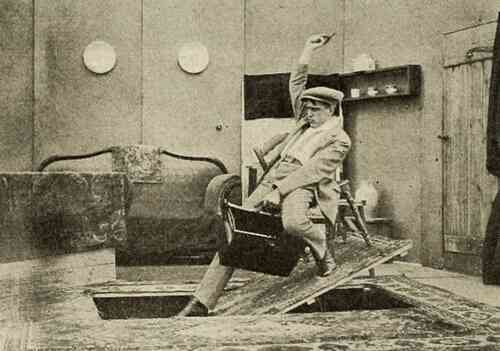
When the chase truly begins, The Long Arm of the Law shifts into a higher gear of cinematic spectacle. The sequence involving the tilting floor and the pit is a marvel of early practical effects. It’s a moment of genuine peril that forces Douglas to rely on external help—the firemen—breaking the 'lone hero' trope for a moment of communal effort. This rescue isn't just a plot point; it’s a visual feast of ladders, hoses, and smoke that must have enthralled 1914 audiences.
Then, we have the aeroplane. In 1914, aviation was still a miracle, a symbol of the future. By having Douglas use a plane to overtake an automobile, the film is making a bold statement about the triumph of modern technology. This isn't just a chase; it’s an evolution of movement. The logistics of filming an aerial pursuit in the mid-1910s were immense, and the results are surprisingly visceral. We see similar attempts at high-octane stunts in Dødsklippen, but there is a uniquely American 'can-do' spirit to Douglas’s aerial intervention here.
The final act of the film is a relentless sequence of pursuit and capture. The imagery of the woman accomplice collapsing from exhaustion is a stark reminder of the physical toll of this 'game.' Unlike the hero and villain, who seem fueled by an almost supernatural drive, she represents the human limit. But the film doesn't linger on her; the focus remains squarely on the confrontation between Douglas and Henry.
The barrel sequence is perhaps the most iconic moment of the film. Henry, cornered and desperate, chooses a chaotic, gravitational escape—rolling down a steep hill in a barrel and plunging into the water. It’s a move of pure desperation that highlights the 'Bat' Henry character’s willingness to risk everything. Douglas’s immediate dive into the water to subdue him is the final proof of his superiority; he is willing to follow his prey into the elements, into the mud, and into the dark.
This water-bound struggle is reminiscent of the gritty realism found in The Lure of New York, where the city's underbelly is often portrayed through its literal depths. The capture of the 'bedraggled crook' by a passing policeman brings the story full circle. The law, which was initially mocked and manipulated by Henry, finally reasserts itself, but only through the intervention of the private individual.
The Long Arm of the Law is more than just a period piece; it is a blueprint for the action cinema that followed. Its use of multi-modal transportation, forensic clues, and high-stakes wagers would become staples of the genre. While it lacks the operatic scale of The Destruction of Carthage, it makes up for it with a lean, muscular narrative that never loses its momentum.
The film also touches on themes of class and duty that are explored in more somber works like Loyalty or Urteil des Arztes, but it does so through the lens of entertainment. It doesn't lecture; it thrills. Even the minor characters, like the 'startled servant' or the club members, feel part of a lived-in world, a testament to the film's solid construction. Whether it's the three shots that pierce the strap or the circular hole sawed through a door, the film is packed with tactile, inventive details that reward the attentive viewer.
In the end, Douglas wins his wager, but the audience wins something more: a glimpse into the boundless creativity of early filmmakers who were discovering, in real-time, how to tell a story that moves as fast as a bullet. It stands alongside On the Fighting Line and The Lost Chord as a vital piece of the 1914 cinematic puzzle, proving that even over a century later, the long arm of quality filmmaking still reaches out to grab us.
Final Verdict: A high-octane relic that still manages to surprise with its mechanical ingenuity and relentless pacing.
IMDb 4.8
1911
Community
Log in to comment.