DbcultAccessing Vault...
Cult Review
Senior Film Conservator
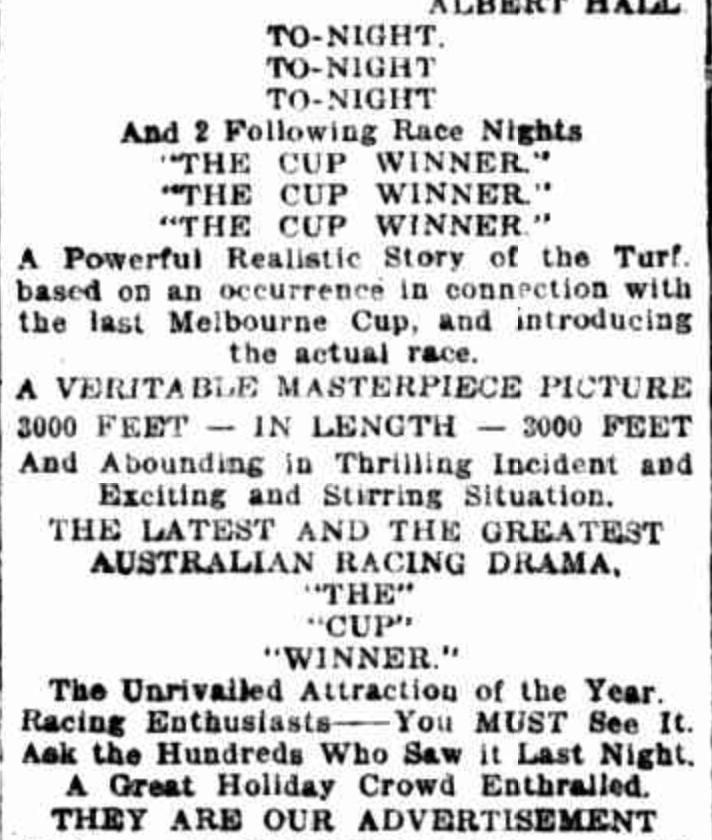
To witness The Cup Winner (1911) in the contemporary era is to embark upon a temporal voyage into the very crucible of narrative sports cinema. While the medium was still grappling with its own identity—oscillating between the voyeuristic documentation of actuality and the structured artifice of the stage—this film emerged as a sophisticated synthesis of both. It does not merely record a race; it dramatizes the existential weight of the outcome. In the early 1900s, the horse race was the ultimate cinematic subject, offering a natural crescendo of action that perfectly suited the limitations of the hand-cranked camera and the absence of synchronized sound.
The film occupies a unique niche when compared to earlier sporting iterations. If we look back at The Corbett-Fitzsimmons Fight, the focus was purely pugilistic and documentary-focused. By 1911, however, the audience's appetite had evolved. They no longer sought just the event; they craved the stakes. Charles Villiers, an actor whose presence often bridged the gap between the theatrical and the cinematic, provides the emotional anchor here. His performance lacks the frantic gesticulation common in lesser silents of the period, favoring instead a grounded intensity that mirrors the mounting anxiety of the betting ring.
The casting of Villiers was a masterstroke of the era. He possessed a visage that could convey a myriad of social anxieties—the fear of ruin, the hunger for status, and the quiet dignity of the sportsman. In The Cup Winner, he represents the quintessential Edwardian man caught in the gears of a changing world. Unlike the more exuberant athleticism seen in Harry the Footballer, Villiers’ role is one of internal conflict. The "cup" of the title is a multifaceted metaphor: it is at once a physical trophy, a vessel for financial redemption, and a symbol of social acceptance.
The narrative structure of the film is deceptively simple, yet its execution reveals a burgeoning understanding of cross-cutting and suspense. We see the preparation, the shadowy deals in the stables, and the final, breathless surge toward the finish line. This rhythmic pacing was a significant leap forward from the static observations of A Football Tackle or the somewhat repetitive nature of early fight reproductions like Reproduction of the Corbett and Fitzsimmons Fight. Here, the camera begins to take on a more subjective role, inviting the viewer to participate in the protagonist's desperation.
When analyzing The Cup Winner, one must consider its contemporaries to appreciate its sophistication. Films like A Ticket in Tatts also explored the intersection of gambling and luck, but The Cup Winner leans more heavily into the melodrama of the individual. It shares a certain DNA with The Double Event, yet it feels more intimate, focusing on the psychic toll of the race rather than just the pageantry. The film’s ability to weave a coherent emotional arc within the constraints of a short runtime is a testament to the maturing craft of its unnamed writers and directors.
The cinematography, though primitive by modern standards, utilizes the natural light of the racecourse to create a sense of verisimilitude. There is a gritty texture to the frames, a layer of Edwardian dust that adds a sense of historical weight to the proceedings. The crowd scenes, likely filmed at a real event, provide a documentary-style realism that contrasts sharply with the staged drama of the protagonist’s personal life. This blending of genres—actuality and fiction—was a hallmark of the 1910s, but rarely was it used as effectively as it is here to heighten the tension of the climax.
Technically, the film’s crowning achievement is its depiction of the race itself. Unlike the stationary cameras used in Jeffries-Johnson World's Championship Boxing Contest, which relied on the raw brutality of the subjects to sustain interest, The Cup Winner employs a rudimentary form of montage. The intercutting between the jockeys' faces, the pounding hooves, and the anxious spectators in the grandstand creates a visceral experience that prefigures the modern action sequence. It is an early example of how cinema could manipulate time and space to generate adrenaline.
The use of depth in the frame is also noteworthy. Characters often move from the background into the foreground, a technique that breaks the "proscenium arch" feel of earlier films like The Life and Passion of Jesus Christ. In The Cup Winner, the world feels three-dimensional and lived-in. When Villiers’ character walks through the paddock, the environment feels expansive, stretching beyond the edges of the celluloid. This sense of a wider world was crucial for the audience's immersion, making the stakes of the race feel globally significant rather than merely a local skirmish.
Beyond the technical and the performative, The Cup Winner serves as a mirror to the societal preoccupations of 1911. This was a time of immense class anxiety and shifting economic fortunes. The horse race was one of the few places where the classes mingled, albeit in strictly demarcated zones. The film captures this social friction. We see the opulence of the owners' boxes and the desperate grit of the betting ring, a dichotomy that was also explored in films like The Squatter's Daughter, though through a different lens.
The obsession with the "winner" reflects a burgeoning meritocratic ideal—the notion that through skill, luck, and determination, one could transcend their circumstances. This theme is universal, but in the context of 1911, it was particularly potent. The film doesn't shy away from the darker side of this pursuit; the threat of the "loser's" fate hangs heavy over the first two acts. It is this shadow that gives the final victory its light. In many ways, The Cup Winner is a precursor to the modern underdog story, a narrative archetype that would go on to dominate the sports genre for the next century.
Today, The Cup Winner stands as a vital piece of the cinematic puzzle. It is easy to dismiss these early silents as mere curiosities, but to do so is to ignore the foundational work they did in establishing the language of film. Every slow-motion replay and every dramatic sports score we enjoy today has its roots in the experimental editing and narrative pacing of films like this. It shares a spirit with the frantic energy of At Break-Neck Speed, yet it possesses a narrative maturity that many of its contemporaries lacked.
The performance of Charles Villiers deserves a modern reassessment. He was an actor who understood the power of the close-up before it was a standard tool in the director's kit. His ability to hold the screen with a look of quiet contemplation or sudden resolve is what makes the film more than just a historical document. It makes it a human story. While much of the film’s specific production history has been swallowed by time, the flickering images that remain speak volumes about the ingenuity of these early pioneers.
In the grand tapestry of 1911 cinema—a year that gave us everything from Dante's Inferno to Anna Karenina—The Cup Winner holds its own as a work of focused, high-stakes drama. It is a reminder that the thrill of the chase and the agony of the gamble are timeless human experiences, perfectly suited for the silver screen. Whether you are a scholar of silent film or a casual fan of sporting history, this film offers a fascinating glimpse into the moment when cinema found its pulse.
Reviewer's Note: The Cup Winner is a significant artifact for those interested in the evolution of the British film industry and the early career of Charles Villiers. Its preservation is a victory for film historians everywhere.
IMDb 5.1
1923
Community
Log in to comment.