DbcultAccessing Vault...
Cult Review
Senior Film Conservator
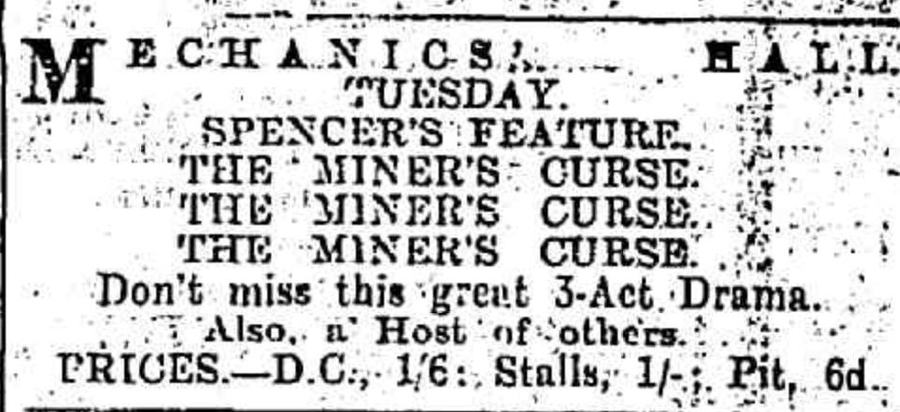
The flickering shadows of 1912 offer more than mere nostalgia; they provide a visceral window into the nascent soul of Australian narrative ambition.
In the pantheon of early silent cinema, Alfred Rolfe remains a figure of staggering importance, yet one frequently overshadowed by the more sensational headlines of his contemporaries. With The Miner's Curse, Rolfe didn't merely document a story; he sculpted an atmosphere. Unlike the documentary-style realism of Birmingham or the raw athletic captures seen in The Corbett-Fitzsimmons Fight, Rolfe infused the Australian landscape with a proto-Expressionist dread. The film functions as a bridge between the simplistic morality plays of the Victorian stage and the complex visual storytelling that would eventually define the medium.
The narrative thrust involves the harrowing psychological disintegration of a gold-seeker. This isn't the romanticized frontier found in The Story of the Kelly Gang, but rather a more intimate, claustrophobic exploration of human frailty. Rolfe utilizes the mine as a literal and metaphorical abyss. The protagonist’s descent into the earth mirrors a descent into the darker recesses of the id, where the promise of wealth becomes a corrosive influence that dissolves familial bonds and sanity alike.
What strikes the modern viewer most forcefully is the use of depth. While many films of the era, such as 69th Regiment Passing in Review, were content with flat, proscenium-style framing, Rolfe experiments with the verticality of the mine shafts. The play of light—harsh, unforgiving Australian sun contrasted with the impenetrable ink of the subterranean pits—creates a visual binary between the known world and the cursed domain. It is a technique that predates the more celebrated shadows of German Expressionism by nearly a decade.
The "curse" itself is handled with a restraint that is surprising for 1912. Rather than relying on the heavy-handed theatricality often found in The Life and Passion of Jesus Christ, Rolfe embeds the supernatural within the mundane. The rustle of dry leaves, the shifting of loose gravel, and the haunted gaze of the lead performers suggest a malevolent presence that is woven into the very fabric of the earth. This is a land that does not want to be pillaged, a sentiment that resonates with a haunting ecological prescience.
To understand the magnitude of The Miner's Curse, one must look at the cinematic landscape of the time. While European directors were focusing on grand historical pageants like Les funérailles de S.M. Marie-Henriette or religious epics such as S. Lubin's Passion Play, Australian filmmakers were carving out a unique identity centered on the "Bush" and the "Mine."
Rolfe’s work here is a fascinating counterpoint to The Miner's Daughter. Where the latter leans into the sentimental tropes of the era, The Miner's Curse embraces a darker, more nihilistic tone. It shares a thematic DNA with the bushranger epics like Robbery Under Arms, yet it strips away the folk-hero glamour to reveal the raw, jagged edges of survival. The film questions the cost of the "Australian Dream" long before that term was even codified.
The acting in The Miner's Curse represents a pivotal shift away from the exaggerated pantomime of early shorts like Solser en Hesse. There is a burgeoning interiority here. The protagonist's face, often captured in medium close-ups that were revolutionary for the period, conveys a spectrum of emotion—from the feverish intensity of the initial discovery to the hollowed-out despair of the final act. It is a performance of quiet devastation, far removed from the broad strokes of Un portero modelo.
The supporting cast, too, avoids the pitfalls of caricature. The depiction of the mining community feels lived-in and authentic, reminiscent of the gritty realism found in Saída dos Operários do Arsenal da Marinha, but with a narrative purpose that drives the tragedy forward. Every gesture, every glance toward the mine entrance, is laden with the weight of communal anxiety. This is a collective tragedy, not just an individual one.
Technically, the film is a marvel of resourcefulness. Working with limited equipment in the harsh Australian interior, Rolfe and his cinematographer managed to capture images of startling clarity and power. The use of natural light to create high-contrast silhouettes against the horizon is a precursor to the aesthetic of the Western, yet it is used here to evoke a sense of spiritual isolation rather than heroic grandeur.
The editing, while rudimentary by modern standards, shows a sophisticated understanding of pacing. The intercutting between the domestic sphere and the subterranean world creates a rhythmic tension that builds toward the inevitable collapse. It lacks the frenetic energy of At Break-Neck Speed, opting instead for a slow, agonizing burn that mirrors the slow accumulation of the curse's power.
It is a tragedy of film history that so much of this era has been lost to nitrate decay. Viewing The Miner's Curse today is like examining a fragment of a larger, grander mosaic. It belongs to a period of intense creative fertility in Australia, where filmmakers were experimenting with long-form storytelling well before it became the global standard. This was the era of The Squatter's Daughter and The Life and Adventures of John Vane, a time when the screen was a frontier as untamed as the land it depicted.
The film also serves as a fascinating sociological document. It reflects the anxieties of a nation transitioning from a colonial outpost to a modern industrial state. The miner is the quintessential figure of this transition—a man seeking to extract a future from the ancient past of the earth. The curse is the price of that extraction, a reminder that progress often comes at the cost of the soul.
Ultimately, The Miner's Curse is a triumph of mood over plot. While the story follows the familiar beats of Edwardian melodrama, the execution is purely cinematic. It is a film that understands the power of the image to convey the unspeakable. In its best moments, it achieves a kind of spectral beauty, where the flickering grain of the film stock itself seems to represent the ghosts of the miners who perished in search of a dream.
As we look back from a century's distance, Rolfe’s achievement remains undiminished. He took the raw materials of his environment—the dust, the light, the heat, and the greed—and forged them into a narrative of enduring power. It is a foundational text of Australian cinema, a dark jewel unearthed from the depths of the silent era. For anyone interested in the evolution of the moving image, this is not merely a curiosity; it is an essential encounter with the ghosts of our cinematic past.
Recommended for fans of:
Australian Gothic, Early Silent Melodrama, and the works of Alfred Rolfe. If you enjoyed the gritty realism of The Story of the Kelly Gang, this psychological descent is your next logical stop.
IMDb 5.4
1918
Community
Log in to comment.