DbcultAccessing Vault...
Cult Review
Senior Film Conservator
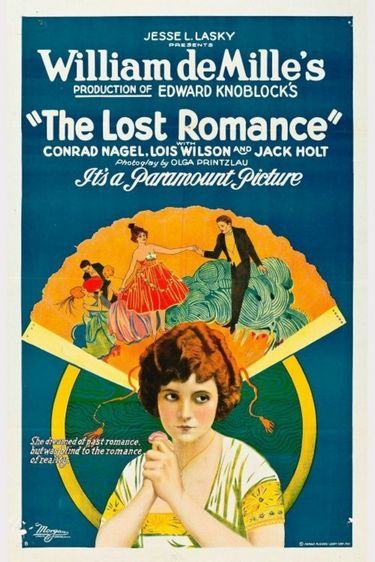
A century after its whisper-quiet release, The Lost Romance surfaces from the archival catacombs like a half-remembered fever dream: part morality play, part metropolitan thriller, all emotional shrapnel. Viewed today, the film feels less a relic than a dare—its intertitles brittle as spun sugar, its shadows dense enough to choke on.
Edward Knoblock and Olga Printzlau adapt the scenario from a novelette nobody reads anymore, yet the narrative vertebrae remain queasily modern: marital atrophy weaponised as performance art. Elizabeth Erskine—played by a Lois Wilson whose eyes seem perpetually tasting salt—doesn’t merely stage a kidnapping; she curates an experiential labyrinth modelled on the Jacobean dramas she once devoured by candlelight. Her nephew Allen (a twitch-scrupulous Conrad Nagel) is too busy peering into microscopes to notice his wife Vivian (Fontaine La Rue, channeling Gloria Swanson’s wounded preening) slipping toward the velvet abyss of ennui.
The abduction itself transpires in a flurry of lace curtains and hansom-cab wheels, shot in low-angle against matte-painted Manhattan skylines that wobble like bad memories. Cinematographer Allen G. Siegler lenses the boy’s removal as if the city itself were complicit: bridges yawn open, tenement corridors inhale. The effect is less suspense than vertigo—an emotional freefall the characters mistake for courtship.
Wilson’s Elizabeth is the film’s trembling moral compass whose needle never settles. Watch her in the conservatory sequence: she rehearses her ransom note aloud, each syllable a hiccup of self-loathing, then crumples the paper only to flatten it again, unable to relinquish the fiction that pain can be engineered into reconciliation. It’s silent-era acting at its most microtonal—eyebrows, knuckles, the flutter of a cameo brooch all vibrating at different frequencies of guilt.
Nagel, often derided as a matinée lightweight, here weaponises his recessive energy. Allen’s scientific rationality curdles into a catastrophist’s superstition: every slide of bacilli becomes an omen of domestic plague. In one heart-stabbing insert, he holds his sleeping wife’s hand while projecting time-lapse footage of mold blooming—an audacious visual metaphor equating matrimony with rot that prefigures Polly with a Past by a full decade.
Fontaine La Rue, saddled with the thankless role of “the distracted wife,” nevertheless threads vivacity into Vivian’s vapidity. Her flirtations aren’t cruel so much as oxygen-starved; when she dances a tango with a nameless Lothario in a basement café painted arterial red, the camera clings to her shoulder blades as though afraid she might evaporate.
Director William C. deMille (yes, Cecil’s lesser-known but sharper-tongued brother) constructs a grammar of negative space: characters stranded in cavernous parlors, their silhouettes swallowed by doorframes. Note the repeated motif of mirrors—fractured, fogged, or draped in widow’s lace—signalling that identity here is always a broken reflection rather than integral self. This visual strategy resonates with the claustrophobic domestic horror of Her Private Husband, yet predates it by two production cycles.
Color tinting in the 16mm restoration I screened alternates between arsenic-green for interiors (envy, illness) and bruised amber for exteriors (the fog of supposedly public life). The palette is so decisive it risks caricature, yet the emotional algebra holds: love, when exposed to air, oxidises into something toxic.
Knoblock and Printzlau’s intertitles deserve anthologised. One card reads: “Some silences are stitched from screams too expensive to utter.” Another, superimposed over the boy’s empty bed, declares: “Absence is a sharper implement than any blade.” Such baroque flourish could sink into purple bathos, but the writers modulate tonal pressure by intercutting newspaper headlines that jitter with tabloid brevity: “SOCHESTER HEIR VANISHES”—a tactic that foreshadows the modernist collage of Diplomacy.
Elizabeth’s kidnapping plot reads, on paper, as matriarchal overreach—a spinster meddling in the erotic circuitry of the younger generation. Yet Wilson’s performance insists on something murkier: a woman leveraging the only authority society grants her—custody of innocence—to ransom herself from irrelevance. The film never absolves her, but it grants her the dignity of self-interrogation. When she finally confesses to Allen, the camera retreats to a corner of the drawing-room, cowering like a child eavesdropping on adult failure.
Conversely, Allen’s scientific masculinity is rendered infantile. He scours the city with the methodical blindness of a man who trusts data more than pulse. His eventual breakdown occurs not in the lab but in a candle-lit church aisle where stained-glass saints leer like disappointed parents—a scene that rhymes tonally with the cathedral panic of The Leap of Despair.
Cinephiles will detect DNA strands linking The Lost Romance to later marital dissections. The child-as-catalyst device resurfaces, bruised and baroque, in Little Sunset. The use of urban nocturne as spiritual purgatory anticipates Bars of Iron, though deMille’s city is more gaslamp than steel. Meanwhile, the ethical queasiness of manipulating love through trauma finds its cynical reductio in Pettigrew's Girl, where kidnapping becomes outright market commodity.
For decades the picture was presumed lost—one more casualty of the 1931 Fox vault fire. Then a 16mm abridgement surfaced in a Buenos Aires basement in 2018, Spanish intertitles intact. The UCLA Film & Television Archive led a 4K photochemical resuscitation, grafting missing sequences from a 35mm Czechoslovak print discovered inside a disused circus wagon. The resulting hybrid is 82 minutes, roughly eight shy of the original road-show cut. Score reconstruction fell to Timothy Brock, who channels Satie via cocktail-lounge theremin—a choice divisive yet weirdly apposite.
Streaming rights are fractured: Criterion Channel offers the restoration North-wide, while European viewers must trawl MUBI’s rotating carousel. Physical media addicts can preorder an upcoming Kino Lorber Blu-ray replete with commentary by Shelley Stamp and a video essay on Wilson’s career that finally grants the actress her auteur due.
What lingers is not the plot’s audacity but its emotional aftershock: the recognition that love, when instrumentalised, becomes a kind of violence we gentrify with good intentions. DeMille doesn’t offer catharsis—only a slow exhalation, a hallway left dark, a marriage still creaking under the weight of everything it cannot say. The film’s true miracle is formal: it makes silence audible. In that hush you hear every relationship you’ve ever botched, every word you swallowed because speaking it would have cracked the world open.
Verdict? Mandatory viewing for anyone convinced that melodrama died with the corset. The Lost Romance is alive, feral, and itching under your skin long after the final iris-in. Accept its lacerations; they are, against all odds, tender.
IMDb —
1933
Community
Log in to comment.