DbcultAccessing Vault...
Cult Review
Senior Film Conservator
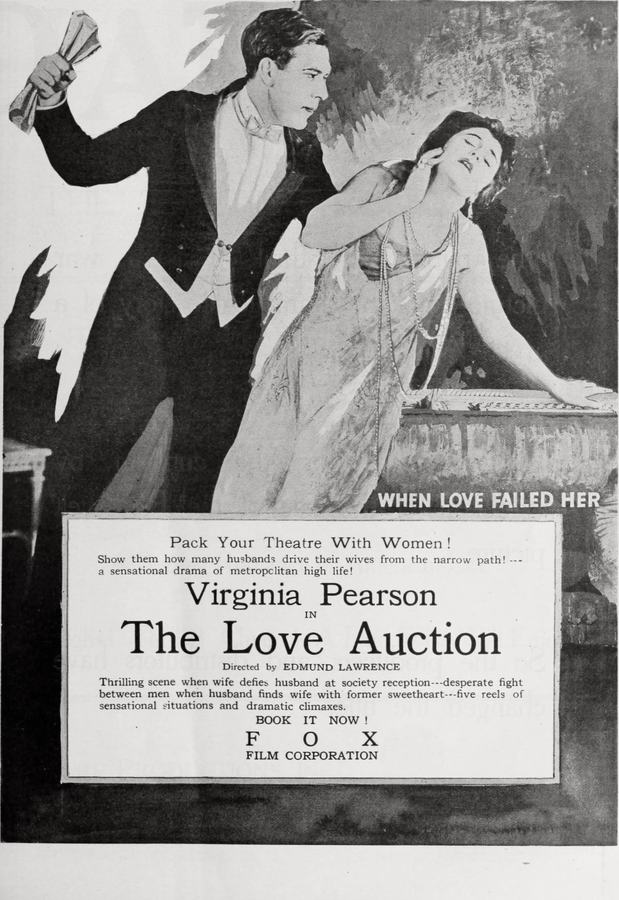
The flickering shadows of early cinema often held up a mirror to society's deepest anxieties, and few films captured the raw, unvarnished torment of the human spirit quite like The Love Auction. This 1919 silent drama, a veritable maelstrom of moral decay and fleeting redemption, doesn't merely tell a story; it unravels a profound tragedy with an almost surgical precision, leaving its audience to grapple with the harrowing consequences of addiction, manipulation, and the desperate yearning for an elusive peace.
At its core, the film is a searing character study of Lea Montrose, brought to life with an arresting vulnerability by Virginia Pearson. We meet Lea as she embarks on what she hopes will be a blissful union with Dorian Vandeveer, portrayed with a compelling, tormented intensity by Hugh Thompson. Yet, the foundations of their marriage are almost immediately undermined by Dorian’s relentless battle with the bottle. His addiction isn't depicted as a mere character flaw but as a ravenous beast, devouring his promises, his dignity, and ultimately, Lea’s very hope. The film doesn't shy away from the brutal honesty of this struggle, illustrating Dorian’s sincere, yet ultimately futile, attempts at reform. Each relapse isn't just a plot point; it's a crushing blow, eroding Lea’s spirit until the vibrant promise of their love is reduced to a desolate wasteland.
In her profound disillusionment, Lea seeks solace, or perhaps an escape from the relentless despair of her home life. This quest for meaning leads her into the orbit of Dr. Studholm Charters, a charismatic yet utterly sinister figure embodied by Thurlow Bergen. Charters’ cult is not presented as a fringe oddity but as a psychological trap, preying on vulnerability and offering a counterfeit sense of belonging and spiritual enlightenment. His influence over Lea is insidious, a slow-burning erosion of her autonomy under the guise of guidance. It's a chilling portrayal of how easily desperation can be exploited, a theme that, regrettably, remains as potent today as it was a century ago. One might draw parallels to the psychological manipulation seen in films like The Soul's Cycle, where characters grapple with moral quandaries under external pressures, though The Love Auction takes a decidedly darker turn into outright villainy.
Just as Lea seems irrevocably lost to Charters' machinations, fate, or perhaps the writers May Edginton, Raymond L. Schrock, Julia Burnham, and Edmund Lawrence, introduce a glimmer of alternative possibility. Jack Harley, a former flame, returns to town, now a man of considerable wealth and stature, played with a quiet strength by Edwin Stanley. His reappearance is a bittersweet echo of a path not taken, a stark contrast to the grim reality of Lea’s marriage. Their rekindled relationship is handled with a delicate touch, hinting at a genuine connection that transcends the societal confines of her existing union. It’s a moment of illicit, yet understandable, solace for Lea, a brief reprieve from the suffocating despair.
The birth of Lea’s baby introduces a complex layer of hope and renewed tragedy. For Dorian, the child acts as a powerful catalyst, igniting within him a fresh resolve to conquer his demons. Thompson's portrayal of this renewed struggle is particularly poignant; we see the flicker of a man desperate for redemption, for a chance to be a worthy father. It’s a cruel twist of fate that this fragile hope is immediately imperiled by Charters. The cult leader, a master of observation and manipulation, quickly suspects Jack’s paternity, transforming this innocent life into a weapon. His demand that Lea submit to him in return for his silence is a horrifying act of blackmail, a stark demonstration of his avarice and lust for power. This particular brand of moral depravity and exploitation of vulnerability is a recurring motif in cinema, often explored in films depicting the Sins of Ambition or the insidious nature of L'avarizia (greed), where characters leverage secrets for personal gain.
The film’s climax is a brutal, unyielding descent into the abyss. When Dorian, on the cusp of true reform, learns of Charters’ monstrous demand, his fragile sobriety shatters. The beast of addiction, momentarily subdued, roars back with a vengeance, driving him to a desperate, violent act. He kills Charters, an act of perceived justice that is immediately overshadowed by its own tragic consequences. The film doesn’t allow for any easy catharsis; Dorian’s subsequent suicide is a devastating punctuation mark on a life consumed by self-destruction and external malevolence. It’s a stark reminder that even acts born of desperation and protection can lead to an inescapable doom.
From a technical perspective, The Love Auction, even in its silent era constraints, showcases a masterful understanding of visual storytelling and emotional conveyance. The actors, particularly Pearson and Thompson, rely heavily on exaggerated yet effective facial expressions and body language to communicate the complex emotional landscape of their characters. Pearson’s journey from wide-eyed optimism to profound despair is a masterclass in silent acting, her every gesture speaking volumes. Thompson’s portrayal of Dorian’s inner battle, his moments of fleeting hope followed by crushing defeat, is equally compelling. Bergen’s Charters is a truly memorable villain, his subtle smirks and piercing gaze conveying a chilling intelligence behind the façade of spiritual guidance.
The writing, credited to May Edginton, Raymond L. Schrock, Julia Burnham, and Edmund Lawrence, and notably with ghostwriting input from Vera Casparay for Charles Donald Fox, constructs a narrative that, while melodramatic by modern standards, possesses an undeniable psychological depth. It explores themes that remain eternally relevant: the corrosive power of addiction, the seductive dangers of cults, the societal pressures on women, and the tragic consequences of moral compromise. The film doesn't offer easy answers or saccharine resolutions; instead, it presents a stark, unflinching look at the darker corners of human experience. It forces the audience to confront uncomfortable truths about choice, fate, and the often-destructive interplay between personal weakness and external malice.
The pacing, typical of the era, allows for moments of quiet contemplation alongside bursts of intense drama. The intertitles, carefully crafted, serve not just to advance the plot but to deepen the emotional resonance, guiding the audience through the characters' inner turmoil. One can appreciate how the narrative builds tension, allowing Charters' villainy to simmer before erupting into outright blackmail, and how Dorian's descent is portrayed not as a sudden fall but as a gradual erosion of his will, punctuated by desperate, almost heroic, attempts at recovery.
In its depiction of marital strife and the yearning for alternative relationships, The Love Auction touches upon the complexities of human desire and societal expectation, much like films exploring the intricate dynamics in The Way of a Man with a Maid. However, this film pushes those boundaries into much darker, more tragic territory, demonstrating the destructive potential when these desires clash with deeply entrenched problems like addiction and the predatory nature of figures like Charters. The story serves as a cautionary tale, a stark reminder of the fragile nature of happiness and the ever-present shadow of despair.
Ultimately, The Love Auction stands as a powerful testament to the enduring appeal of silent cinema's dramatic prowess. It’s a film that demands empathy, yet offers little comfort, instead delivering a potent, unforgettable punch. It’s a vital piece of cinematic history, not just for its narrative daring but for its compelling performances and its unflinching examination of the human condition, proving that even without spoken words, a story can resonate with profound emotional weight, leaving an indelible mark on the viewer long after the final frame flickers into darkness. A true gem for anyone interested in the foundational narratives of early Hollywood and the timeless struggles they so vividly portrayed. Don't let its age deter you; this is a film that speaks volumes without uttering a single sound.
IMDb —
1928
Community
Log in to comment.