DbcultAccessing Vault...
Cult Review
Senior Film Conservator
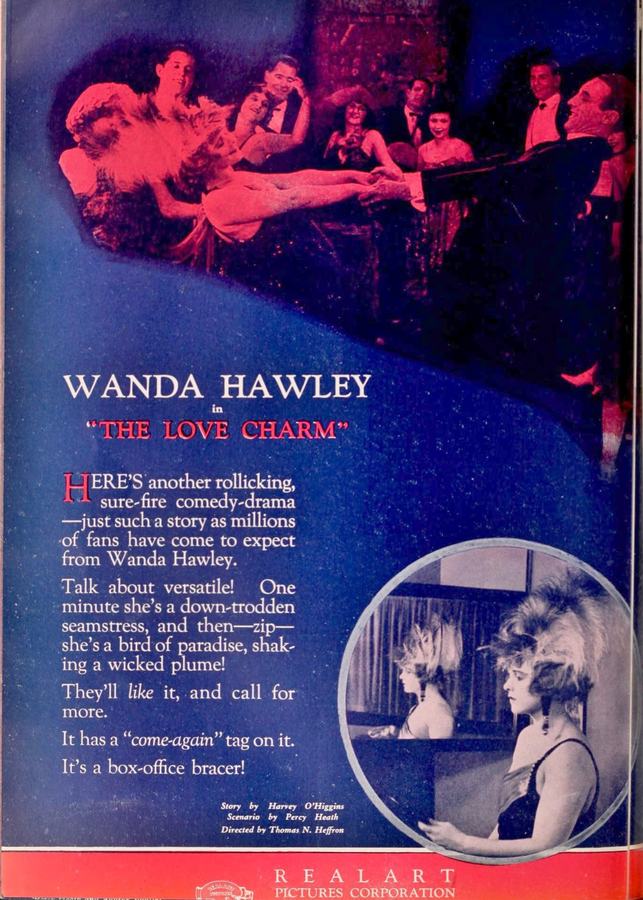
A nickel’s worth of newsprint propels a Dickensian waif into a drawing-room chess match where hearts are the pieces and every move leaves fingerprints on the soul.
The Love Charm is not merely a curio exhumed from Paramount’s moth-proof vaults; it is a time capsule of twenties sexual economics, stitched with enough catgut tension to make a Stradivarius weep. Director John Francis Dillon shoots the opening train sequence like a criminal line-up: windows become celluloid frames, each passenger a flicker of proto-cinema, while Ruth’s magazine flutters like a semaphore flag signaling the plot’s central con: that affection can be conjured as easily as a coin trick. The film’s first miracle is its refusal to let the era’s standard flappers hijack the narrative. Instead, Ruth’s rebellion is internal, a slow-motion mutiny against the Cinderella contract that silent cinema had Xeroxed ad nauseam.
Molly McGowan’s face—round, earnest, capable of folding into grief so subtle it feels like humidity—operates as the film’s silent narrator. Notice how she lets the camera come to her: when Ruth first spots the love-charm article, McGowan’s pupils dilate not with hope but with the calculation of a gambler reading the track. Later, forced to play the vamp, she over-enunciates each smoke ring as if it were a Cyrano couplet, and the effect is comedic yet spiritually lacerating; we witness labor in every pretend laugh, the way we sense the seams in a cheap sequined dress.
Cut to Warner Baxter’s Thomas Morgan. Hollywood would soon typecast Baxter as the suave leading man (he won the first Oscar for a sound picture), but here he is all elbows and financial ledgers, a banker whose liquidity is in his gaze rather than his vault. Watch the dinner-party scene: while Hattie serves bon-mots like hors d’oeuvres, Thomas’s eyes keep swiveling to Ruth’s downcast profile, tracing her as if she were an algebraic proof he must solve. The blocking is exquisite—every time Hattie thrusts herself into his sightline, Dillon racks focus so that Ruth’s blurred silhouette burnishes the background like a reprimand.
Enter Mae Busch as Hattie, a harpy wrapped in lamé. Busch, who later traded barbs with Laurel & Hardy, gives Hattie a velociraptor vitality: her laughter arrives on three beats, the last one always a half-step flat, suggesting a phonograph needle scraping the label. She is the film’s capitalist id, convinced that marriage is a merger and virginity a negotiable debenture. When she hisses at Ruth, “Cousin, some of us are born to serve and others to be served,” the intertitle card might as well drip venom onto our laps.
But the true engine of dramatic irony is Michael D. Moore’s Harry Morgan—world-weary, nasal, possessing the ethical flexibility of a pocketknife. Moore plays him like a stock-exchange Iago; his revelation of Ruth’s charade is delivered not with malice but with the bored efficiency of a man double-parking conscience. Once Harry inherits, notice how his posture straightens as if the money itself were a chiropractic adjustment. The switcheroo—Hattie’s instantaneous transfer of affections—should feel contrived, yet Busch sells it by letting her pupils perform a quick cost-benefit analysis mid-close-up.
Visually, the picture toggles between chiaroscuro servants’ corridors and over-exposed parlors where chandeliers throw sunspots like gambling disks. Cinematographer James Van Trees achieves a proto-noir tinge: hallways seep with umbra pools, while the dining room blares white, implying that visibility itself is a class privilege. The moment Ruth, now togged as vamp, descends the staircase, her silhouette eats the frame from the inside—a blot of moral ink on the pristine stationery of respectability.
Scholars often overlook how economically the screenplay (by Harvey J. O’Higgins and Percy Heath) weaponizes labor. Every act of drudgery—stitching a hem, basting a roast—occurs on-camera, grounding the romantic scaffolding in sweat equity. When Ruth finally confesses her deception, she does so while folding laundry, her fingers never ceasing their origami of domesticity; love may be ethereal, but absolution is still measured in creases per minute.
Compare this to the contemporaneous Good Gracious, Annabelle where class tension is a mere screwball afterthought, or Garden of Lies which aestheticizes poverty into garden-party pastels. The Love Charm refuses such velvet revolutions; its emotional Marxism insists that hearts cannot merge until bank accounts and broom handles are equally weighed.
Yet the film is no socialist pamphlet. Its final reel restores order with a speed that suggests the studio legal department wielded a stopwatch. Once Hattie’s gold-digging latches onto Harry, Ruth’s scrubs fall away, revealing the same demure ingénue who arrived on the 8:05. Some modern viewers will call this capitulation; I read it as the film’s sly admission that all identity is performance, that the ‘real’ Ruth is as provisional as the vamp. The love charm itself—never shown, only alluded—functions like Chekhov’s missing gun: its power derives from belief, not ballistics.
Listen to the score, reconstructed by the UCLA ensemble: violins saw a minor-key lullaby whenever Ruth scans the magazine, then switch to ragtime brass during her faux-vamp escapades. The discord is intentional, reminding us that twenties womanhood was itself a medley of Victorian residues and jazz syncopations. At the climactic porch proposal, the soundtrack drops to solo piano, its pauses so cavernous you can almost hear nitrate crackling—a ghost in the sonic machine.
Performances aside, the film’s meta-drama is its near-death and resurrection. Thought lost until a 1989 Buenos Aires print surfaced, The Love Charm arrived back to us like a passenger from the Titanic, water-streaked but breathing. The restoration team opted to retain occasional scratches; in night scenes they resemble comet tails, as though the universe itself were underwriting Ruth’s fortunes.
For cinephiles tracking silent-era trajectory, place this feature at the crossroads between Mary Pickford’s spunky martyrs and Clara Bow’s libidinous firecrackers. Ruth Sheldon is the missing link: neither child-woman nor libertine, but a subject negotiating modernity’s shoals with nothing save a magazine clipping and a conscience that won’t stay folded.
If Nelly Raintseva externalized revolution through expressionist shadow, and Die Faust des Schicksals fetishized fate as a carnival strongman, then The Love Charm domesticates destiny into drawing-room algebra: add affection, subtract envy, multiply by liquidity, solve for x. That the equation balances is less a testament to narrative ingenuity than to the era’s need for moral bookkeeping.
Contemporary relevance? Look no further than influencer culture, where curated personas rake followers like confetti, only to monetize authenticity once the algorithm sniffs blood. Ruth’s vamp act is the 1924 equivalent of ring-light narcissism, and Harry’s windfall mirrors crypto-millionaires minted overnight. The more the medium updates its pixels, the more its human circuitry stays soldered to the same resistors.
My quibbles are few: an inserted comic-relief sequence involving a tipsy butler should have stayed on the cutting-room floor, and the climactic kiss is shot at such distance that modern viewers may mistake it for a handshake. Yet these are relics of studio nervousness, not directorial apathy.
Bottom line: The Love Charm is a pocket-watch narrative—compact, intricate, its tick louder than cathedral bells. It will not shift tectonic plates, but it might realign your faith in silent cinema’s capacity for psychological X-rays beneath its pancake makeup. Stream it during a thunderstorm; let the lightning stutter through the window so the on-screen flickers feel like dialogue between centuries.
Verdict: 4.5 out of 5 stars. A buoyant masterclass in how to spin romantic straw into golden commentary without ever uttering a word—proof that the most potent charm is celluloid itself, forever developing in the dark.
IMDb 8.2
1932
Community
Log in to comment.