DbcultAccessing Vault...
Cult Review
Senior Film Conservator
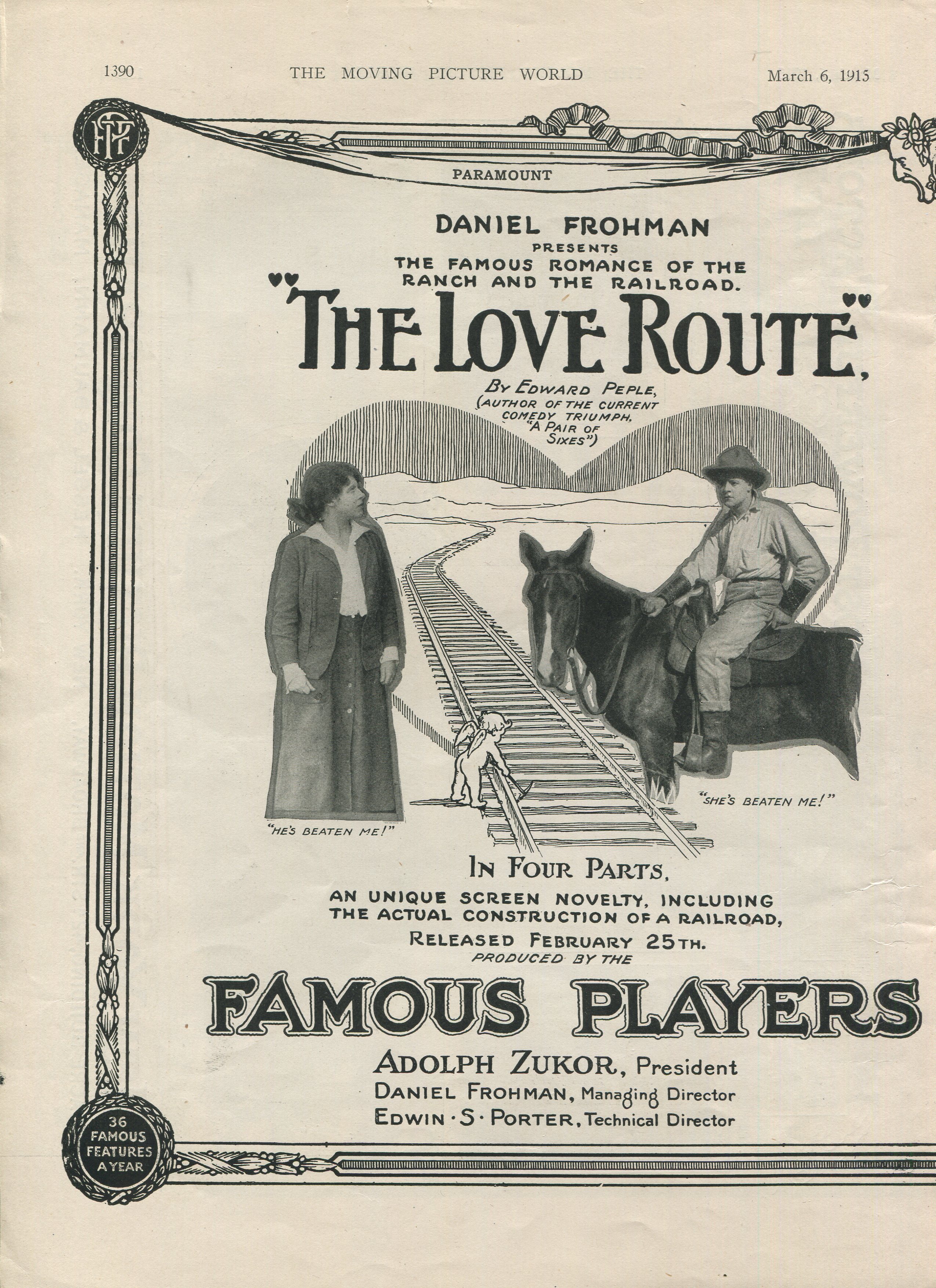
Allan Dwan’s The Love Route arrives like a brittle love letter scrawled on butcher paper, its edges singed by the very locomotive whose path it interrogates. The film—little more than a whisper in the cathedral of silent-era mythos—nonetheless detonates with a ferocity that belies its 42-minute sprint.
Shot in the sere hush of California’s Irvine ranchlands during the autumn of 1914, the picture wields landscape as both chorus and character. Each mesquite trunk is etched in chiaroscuro; each cloud of dust seems choreographed by Fate herself. Dwan, ever the mathematician of motion, composes frames where barbed wire slices the horizon like a surgeon’s stitch, prefiguring the psychic lacerations to come.
Winifred Kingston’s Allene is no frills-free ingénue; she is a kinetic contradiction—spine of ramrod, gaze of unshed monsoon. Watch the micro-tremor in her gloved fingers as she signs the injunction against the railroad: the quill quivers yet the jaw is granite. Opposite her, Harold Lockwood’s John Ashby smolders with a matinee-idle handsomeness that Dwan repeatedly undercuts—placing him ankle-deep in hoof-slogged muck or backlit by the funereal orange of a dying sunset.
Donald Crisp, doubling as scheming foreman Harry Marshall, exudes reptilian affability; his smile unfurls like a pocketknife—slow, deliberate, dangerous.
Juanita Hansen, in a bite-sized role as Allene’s confidante, supplies the film’s sole filament of comic oxygen, fluttering through saloon doors with a feathered hat that resembles a startled egret.
Cinematographer William E. Fildew shoots the iron horses with reverent dread, granting them serpentine agency: rails glisten like twin blades, sleeper-ties resemble coffin lids. In one hallucinatory insert, the camera tilts vertiginously from a surveyor’s transit to the blank, pitiless sky, implying that even the heavens have been subpoenaed by commerce.
Intertitles—rendered in an ornate font reminiscent of funeral announcements—bleed onto the screen, then evaporate like ghost ink, an effect that anticipates The Bells‘ later experiments with textual hauntology.
The plot’s Oedipal scaffolding is as old as pasture sod: patriarchs slain, heirs shackled to vendetta. Yet screenwriter Edward Peple injects a septic irony—Progress itself becomes the MacGuffin. The railroad is neither salvation nor damnation, merely the mirror in which generational lunacy is magnified.
Compare this to the marital charade in My Official Wife, where romantic duplicity unfolds within velvet parlors; here, love is dragged across gravel and cactus spine, its finery shredded until only sinew and pulse remain.
Allene’s climactic decision to lay the final rail herself constitutes a radical prise de conscience. She weaponizes the very instrument of patriarchal dominion—a 200-pound timber imbued with capitalist divinity—to re-stitch the amputated artery of her love. The gesture is both self-immolation and apotheosis; she becomes Antigone wielding a sledgehammer.
Contemporary exhibitors were instructed to accompany the final reel with “La Paloma” played moderato e misterioso. The juxtaposition of Spanish melancholy against Anglo expansionism creates a temporal vertigo—an aural palimpsest that lingers like cigar smoke inside the viewer’s cranium.
Where The Chechako externalizes cruelty through frostbitten landscape, The Love Route internalizes it within muscle memory; where Az utolsó bohém romanticizes bohemian dissolution, this film insists that romance sans frontier is mere perfume. Even Zudora’s occult seriality feels glib besides the moral quicksand Dwan excavates here.
A 4K photochemical resurrection premiered at Pordenone 2019, revealing heretofore invisible details: the brand on a steer reading “H—” for Houston, the micro-stitching on John’s bandolier. The tinting scheme—amber for day, cobalt for dusk—restores the film’s original chromatic grammar, rescuing it from the ashen monochrome of public-domain dupes.
In an era where infrastructure battles (pipelines, 5G, hyperloops) still cleave communities, The Love Route resonates as a cautionary fossil. It whispers that every mile of track is paid for not merely in soil but in psyche, that love cannot be quarantined from the larger circuitry of power.
Yet the film refuses nihilism: by letting Allene hammer the final spike, Dwan proffers a utopian filament—progress and passion need not be antipodes if guided by conscience rather than conquest.
At forty-two minutes, The Love Route is less a feature than a fever—one that irradiates the retina long after the magnesium glow of the closing shot. It is imperfect (a comic-relief stable boy verges on minstrelsy; a day-for-night shot collapses into murk), yet its imperfections are the cracks through which its humanity steams.
Rating: 8.8/10 — Essential for devotees of silent myth-making, gendered frontier politics, and the ongoing dialectic between love and locomotion.
For further context, pair this viewing with A Florida Enchantment’s gender subversion or the Balkan nationalism of Karadjordje to map how 1914 cinema wrestled with modernity across divergent geographies.
IMDb 5.8
1936
Community
Log in to comment.