DbcultAccessing Vault...
6.4/10
Senior Film Conservator
A definitive 6.4/10 rating for a film that redefined the boundaries of cult cinema. The Man from Home remains a cornerstone of transgressive art.
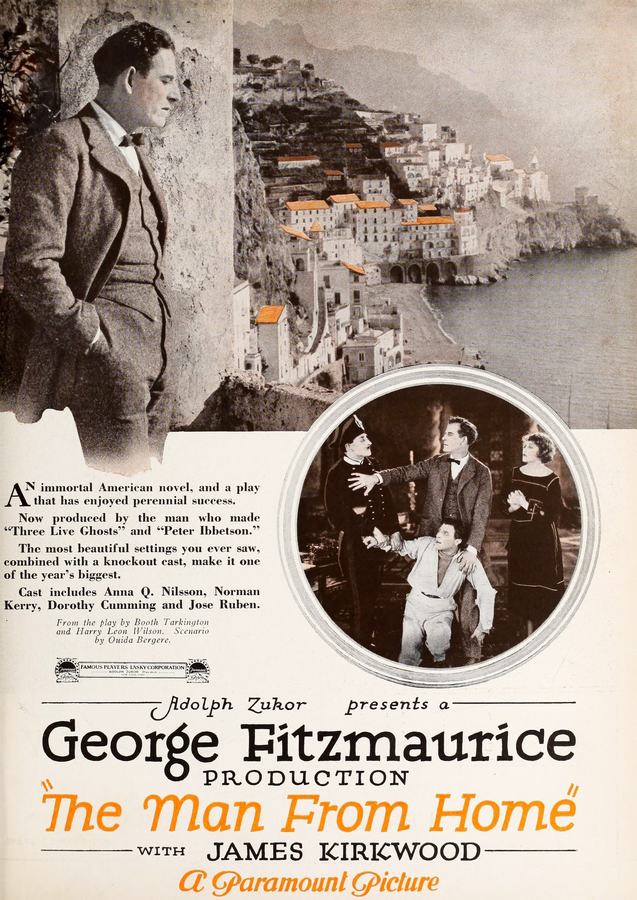
In the pantheon of early 1920s cinema, few works attempt to bridge the chasm between American idealism and European cynicism with as much vigor as The Man from Home (1922). Directed by the visually astute George Fitzmaurice, this adaptation of the Booth Tarkington and Harry Leon Wilson play serves as a fascinating specimen of the transitional period in film history. It is a time when the medium began to shed its stage-bound origins in favor of a more expansive, cinematic vocabulary, yet it retained the high-stakes melodrama that defined the era's narrative sensibilities.
The plot, while deceptively straightforward on the surface, functions as a complex machinery of social commentary. An American heiress, played with a delicate yet palpable anxiety by Annette Benson, finds herself at the center of a moral maelstrom. Her fiancé, portrayed by the dashing Norman Kerry, is not merely a romantic lead but a personification of the 'New World' ethics. When he chooses to defend a fisherman accused of a heinous crime—the stabbing of his wife—the film pivots from a romance into a gritty procedural that challenges the audience's perceptions of guilt and innocence. This thematic depth is reminiscent of the social friction explored in The Week-End (1921), though Fitzmaurice opts for a more atmospheric, almost noir-adjacent aesthetic.
The fisherman, a character often relegated to the background in lesser films, becomes the fulcrum upon which the entire drama turns. His plight represents the vulnerability of the proletariat when confronted by the rigid, unyielding structures of the law. The stabbing itself is handled with a restraint that, paradoxically, heightens its impact. In an era where histrionics were the norm, the quiet desperation of the accused man offers a stark contrast to the opulent surroundings of the heiress and her social circle. This juxtaposition is a hallmark of the film's visual strategy, utilizing shadows and light to delineate the moral boundaries of its characters.
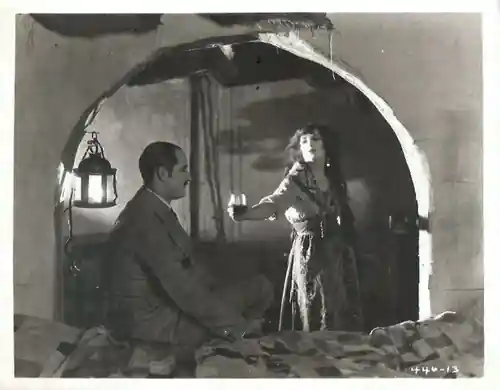
Norman Kerry delivers a performance of remarkable restraint. Unlike the exaggerated gestures seen in Anton the Terrible, Kerry moves through the frame with a grounded authority. He is the 'Man from Home'—a figure of rustic integrity who remains unswayed by the meretricious allure of the European elite. His chemistry with Annette Benson is palpable, yet it is often overshadowed by the larger ethical questions the film poses. Benson, for her part, captures the internal conflict of a woman caught between her loyalty to her class and her growing realization of the truth.
The supporting cast, including James Kirkwood and Anna Q. Nilsson, provides a rich tapestry of archetypes that feel lived-in rather than merely functional. Nilsson, in particular, brings a level of sophistication that was often lacking in early silent dramas. The interplay between these characters creates a sense of a larger world existing beyond the edges of the frame—a world where the echoes of the Great War still resonate in the cynical attitudes of the aristocracy.
One cannot discuss The Man from Home without acknowledging its visual prowess. The cinematography captures the rugged beauty of the coastal setting, using the natural elements to mirror the internal tempests of the characters. The waves crashing against the cliffs serve as a rhythmic accompaniment to the rising tension in the courtroom and the drawing room alike. This use of nature as a narrative device is far more sophisticated than the static compositions found in The Purple Lily.
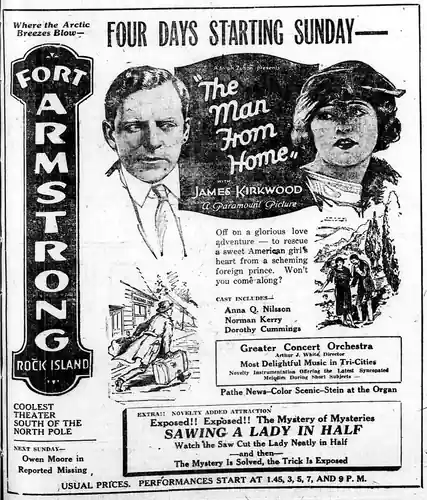
The lighting, particularly in the scenes involving the fisherman’s cottage and the subsequent investigation, utilizes a proto-noir sensibility. Deep blacks and piercing whites create a visual tension that reflects the binary of the 'innocent vs. guilty' struggle. It is here that Fitzmaurice shows his mastery of the medium, using the camera not just to record the action, but to interpret it. The way the camera lingers on the fisherman's hands—calloused and trembling—tells a story of labor and loss that dialogue could never fully encapsulate.
The pedigree of the writing team—Booth Tarkington, Harry Leon Wilson, and Ouida Bergère—is evident in every scene. Tarkington’s influence is most visible in the sharp observations of American character, while Bergère’s touch ensures the narrative remains tightly paced and emotionally resonant. The dialogue titles are pithy and devoid of the flowery sentimentality that often plagued silent films of the late teens. Instead, they possess a modern edge, focusing on the subtext of the interactions.
The film’s exploration of the legal system is particularly fascinating. It doesn't present the law as an infallible arbiter of truth but as a weapon that can be wielded by those with the power to manipulate it. This cynical view of institutional justice is a recurring theme in the writers' collective works, and here it is given a visceral punch by the life-or-death stakes of the stabbing case. The fiancé’s role as an amateur investigator allows the audience to navigate this world of deception alongside him, making the eventual revelation of the truth all the more satisfying.
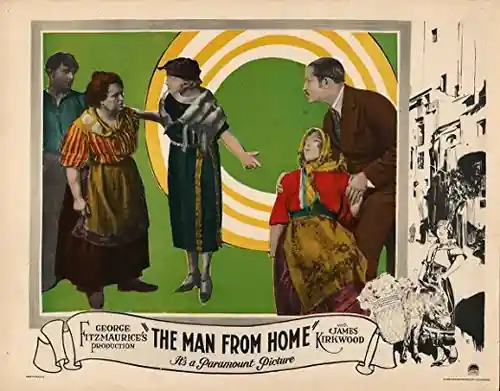
While many films from 1922 have faded into obscurity, The Man from Home remains a compelling watch due to its refusal to offer easy answers. It suggests that true nobility is found not in one's birthright but in one's willingness to stand for the truth, even when it is inconvenient or dangerous. This is a far cry from the more simplistic moralizing seen in The Quitter or the theatrical grandiosity of Thais (1917).
The resolution of the film is both a triumph of justice and a bittersweet acknowledgement of the cost of that justice. The heiress is changed by the experience, her naive worldview shattered by the reality of human cruelty and the courage required to confront it. It is a coming-of-age story wrapped in a mystery, set against a backdrop of international intrigue. The Man from Home himself, having served his purpose as the catalyst for change, remains a steadfast figure, a reminder that integrity is the only currency that truly matters in a world obsessed with wealth and status.
In the grand tapestry of silent cinema, The Man from Home stands out as a work of significant intellectual and emotional weight. It manages to be both a crowd-pleasing melodrama and a thoughtful critique of class dynamics. George Fitzmaurice’s direction, combined with the stellar performances of Norman Kerry and Annette Benson, ensures that the film transcends its era. It is a testament to the power of storytelling that nearly a century later, the plight of a wrongly accused fisherman and the man who risked everything to save him can still resonate with such clarity.
For those interested in the evolution of the legal drama and the American 'hero' archetype, this film is essential viewing. It lacks the frenetic energy of later talkies but compensates with a deliberate, atmospheric pacing that allows the themes to breathe. It is a reminder that cinema, even in its infancy, was capable of tackling the most profound questions of the human condition with grace and intelligence. Whether compared to the historical sweep of The Battle of Trafalgar or the intimate domesticity of The House Built Upon Sand, The Man from Home carves out its own unique space in the annals of film history.
Technical Note: The restoration of this 1922 classic allows modern viewers to appreciate the intricate set designs and the subtle nuances of the cast's expressions, proving that great art is truly timeless.
IMDb —
1925
Community
Log in to comment.