DbcultAccessing Vault...
Cult Review
Senior Film Conservator
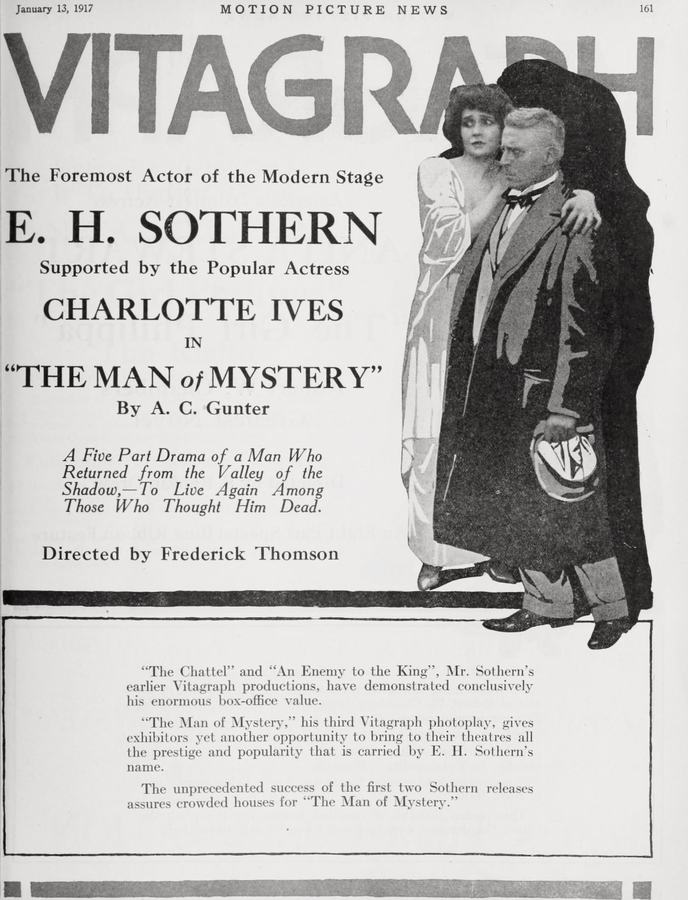
A corpse walks out of a volcano and into his own ballroom. That sentence alone should secure The Man of Mystery immortality, yet the film has languished in the catacombs of cinema history, exhumed only by nitrate archaeologists and the incurably curious.
Helmer Walton Bergman’s 1917 curio is part resurrection fable, part ledger-sheet noir, part marital masquerade. It marries the morbid fatalism of Italian verismo to the clockwork coincidences of Victorian melodrama, then spritzes the concoction with sulphur from Vesuvius. The result is a narrative that feels perpetually on the verge of combustion—appropriate for a film whose pivotal set-piece is a volcanic belch that literally remakes a man.
Cinematographer Rudolph J. Bergner treats Rome as a chiaroscuro fever dream: cobblestones glisten like obsidian, palazzi loom like mausoleums, and candlelight carves caverns into powdered faces. When David—stooped, liver-spotted—first shuffles across the marble atrium, the camera tilts downward, forcing us to share Clara’s revulsion. Later, after the ash baptism, the same camera cranes upward, drinking in the new David’s perpendicular posture; the lens itself seems to genuflect.
Color tinting amplifies the duality. Naples sequences drip in sulphuric yellow, suggesting both opulence and infection. Rome’s salons are drenched in cerulean, the hue of cold contracts and colder hearts. Intertitles—lettered in crimson—flash like wounds across the screen.
Gilda Varesi Archibald essays Clara with a porcelain fragility that fractures, revealing steel. Watch her pupils in the moment she first spies the reborn David: a tremor of erotic recognition, swiftly shuttered by suspicion. It is silent-film acting at its most syllabic; every eyebrow arch is a stanza.
E.H. Sothern’s pre-transformation David is a study in vertebral surrender—shoulders folded like broken wings, voice (via intertitles) a murmur of perpetual apology. Post-Vesuvius, Sothern magnetizes the frame: spine elongated, gait predatory, smile a scalpel. The performance is so bifurcated one suspects twin brothers rather than a single actor.
Charlotte Ives, as Mrs. Brunschaut, swans through parlors like a galleon in full sail, eyes flicking ledgers of vice behind her fan. She never twirls a mustache—she doesn’t need to; the feathered hat alone is sinister enough.
Vesuvius here functions less as natural disaster than as cosmic cosmetic surgeon. Its eruption is staged with miniatures, double-exposures, and what looks suspiciously like a salt-shaker of flour dumped over a cardboard diorama. Yet the crudity is oddly effective: the lava glows hand-tinted orange, frame edges blister, and the eye willingly suspends disbelief. In 1917, audiences had not yet been numbed by photorealistic CGI; suggestion still scalded.
The physician’s laboratory—white tiles, Tesla coils, a chaise lounge that anticipates Frankenstein’s slab—offers the film’s most surreal flourish. David’s rejuvenation is conveyed via a dissolve: wrinkled profile melts into marble bust, a visual haiku on vanity and capital. One expects Edison to wander in, brandishing a lightbulb like Hamlet’s Yorick.
Beneath the volcanic bombast lies a fetish for ledgers. Characters speak less of love than of liquidity. When David entrusts his fortune to Stroggi, the camera lingers on the iron safe as though it were a dowry chest. Later, Clara’s conspiracy hinges on bearer bonds—those paper phantoms that can vaporize a marriage quicker than adultery.
The film grasps something Hitchcock would monetize decades later: money is the most erotic prop on screen. Coins clink like champagne flutes, banknotes flutter like lingerie. When David foils the theft, he does so by reciting interest rates—dialogue that should bore, yet Sothern delivers it like a love sonnet.
Clara begins as chattel—her body bartered for luxury, her agency outsourced to mother and banker. Yet the narrative sneaks in a subversive twist: her desire awakens only when confronted by a stranger who is, paradoxically, her husband. The film thus stages female consent as a Möbius strip: she must not know she is choosing her own spouse in order to freely choose him.
Mrs. Brunschaut, meanwhile, is the unrepentant she-wolf of capital, orchestrating forgery from her boudoir. Cinema in 1917 rarely granted older women such Machiavellian real estate; her mere existence feels like a protest against the sentimental grandmothers populating contemporaneous fare.
Place The Man of Mystery beside Vendetta (1914) and you see two Mediterranean tales of assumed death and reputational rebirth—yet where Vendetta wallows in vendetta, Bergman’s film flirts with redemption. Pair it with The Crown Prince's Double and note the doppelgänger motif: both exploit physiognomic confusion for suspense, though only Mystery literalizes the makeover via geology.
Against Every Girl's Dream, a film where marriage crowns the heroine, Mystery cynically suggests wedlock is a merger to be audited annually. The tonal whiplash between these releases reveals an industry wrestling with modernity, unsure whether to romanticize or eviscerate the social contract.
Let us not pretend the plot obeys Newtonian physics. David’s resurrection relies on a physician who never reappears; the banker’s signature is somehow accepted by notaries despite his declared death; Vesuvius obligingly erupts on cue like a trained dog. Yet fidelity to logic would cauterize the film’s dream-prowling potency. In the silent era, narrative incoherence was the price of mythic resonance—a bargain audiences struck nightly.
Still, one itch remains: Clara never questions why her anonymous suitor possesses intimate knowledge of her trousseau. The film hurries past the query, fearful that scrutiny might collapse the house of cards. Hitchcock, later, would turn such gaps into vertiginous suspense; Bergman merely hopes we are too dazzled to notice.
Surviving prints lack original scoring, inviting curators to improvise. Imagine a Neapolitan mandolin plucking through the courtship, replaced by atonal strings in the lab; imagine tympani mimicking the volcano’s guttural growl. The silence becomes a canyon into which modern accompaniment can echo, making each screening a séance rather than a relic.
There is no Criterion spine for The Man of Mystery; Tarantino has never riffed it on a podcast. Yet its DNA drifts through later tales of reinvention—Sommersby, Vertigo, even Batman Begins with its playboy presumed dead while training abroad. The fantasy that catastrophe might chisel us into purer forms haunts Western culture like a half-remembered hymn.
Archivists at Bologna’s Cineteca recently unearthed a 35mm nitrate reel mislabeled Il Mistero. Rumor whispers of an alternate ending in which David, unmasked, strides back into the ash cloud, weary of the very identity he fought to salvage. Whether apocryphal or prophetic, the rumor proves the film still breaths, still steams.
The Man of Mystery is neither masterpiece nor footnote; it is a lava-encrusted timepiece whose hands still spin. It asks the oldest of questions—can we escape ourselves?—then answers with a volcano, a ledger, and a kiss in candle-dark. For 78 minutes, the film peels back the epidermis of marriage, capital, and identity, revealing the raw, twitching wants beneath.
Watch it for the resurrection fantasy we all secretly crave: that some force—geologic, surgical, cinematic—might shear away our debts, our hunches, our unloved faces, and usher us back into the ballroom, unrecognizable, undeniable, finally desired. Then walk home wary: ash, after all, has a habit of clinging to patent leather.
— 35mm dreams, nitrate nightmares, and the persistent hiss of the projector lamp.
IMDb —
1935
Community
Log in to comment.