DbcultAccessing Vault...
6.5/10
Senior Film Conservator
A definitive 6.5/10 rating for a film that redefined the boundaries of cult cinema. The Man Tamer remains a cornerstone of transgressive art.
The first time you see Gladys Walton crack that twelve-foot whip, the sound arrives like a slap across the face of silence itself—a white crack that splits the monochrome forever.
Silent-era aficionados speak of lost films the way sailors speak of lost ships: with salt-stung longing and a superstitious hush. The Man Tamer—five reels once projected in 1921, now presumed ash—survives only in the amber of lobby cards, a handful of brittle reviews, and the collective memory of centenarians who once clutched bags of roasted peanuts while seated on bleachers that smelled of rain-soaked canvas. Yet its phantom roars louder than half the talkies cluttering today’s algorithmic trough. Why? Because it understood, decades ahead of its time, that spectacle is only as intoxicating as the bruise it leaves on the psyche.
Director John Barton Oxford and scenarist Andrew Percival Younger conspired to invert the Pygmalian cliché: instead of sculpting a docile Galatea, they chisel a woman who sculpts men into spectators of her audacity.
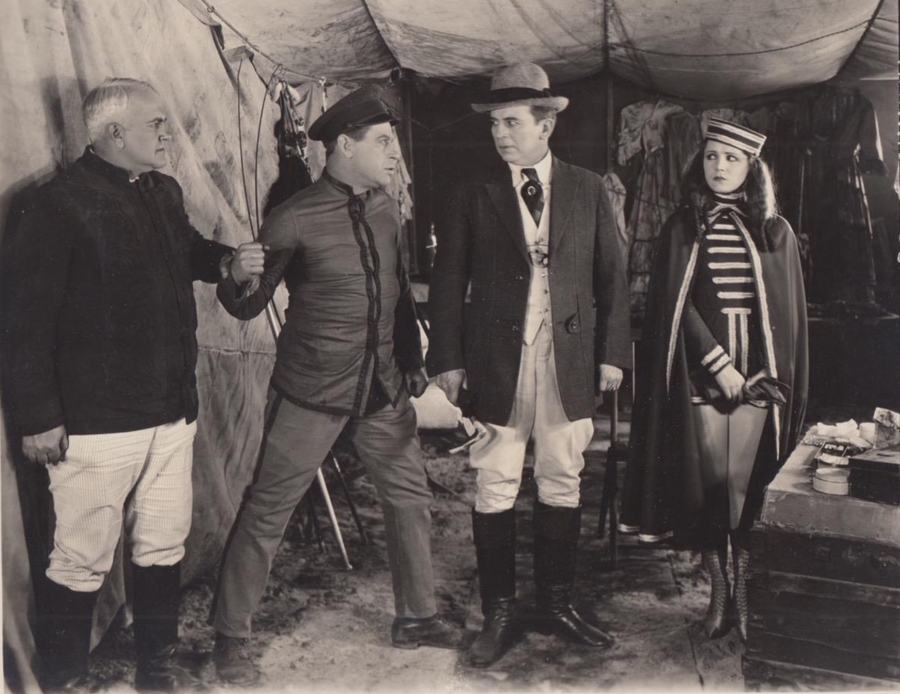
The plot, pieced together from extant trade-paper synopses and the 1972 reminiscences of prop boy turned centenarian Charles ‘Binky’ Murphy, is deceptively archetypal. Naomi Valéry (Walton) is the orphaned daughter of a French animal trainer, bequeathed only his leather gauntlets and a prowling menagerie of debt. She bargains with Colonel Obadiah Spike (a cigar-chomping J. Parker McConnell), proprietor of the trans-continental Spike & Schelli Mammoth Combined Shows, offering her whip-craft in exchange for board and a percentage of ticket sales. The Colonel—half P. T. Barnum, half Captain Ahab—agrees, sensing box-office alchemy in the spectacle of feminine flesh daring the jaws of death.
Enter Basil Thurlow (Rex De Rosselli), the millionaire’s scapegrace son, slumming incognito beneath a Panama hat and a smile sharp enough to slice prosciutto. Basil’s libido is a firework: bright, brief, leaving scorched earth and ooh-aah gasps. He wagers fellow swells that he can coax the “lion girl” into a penthouse pet. Meanwhile, Jimmy ‘Spurs’ O’Malley (Roscoe Karns), the circus manager and former rodeo star, nurses a slow-burn devotion potent as bourbon in oak. Spurs’ idea of courtship is replacing the worn buckles on Naomi’s cage door under the moonlight, never announcing the deed, merely tipping his hat when she finds the work done.
Oxford stages these emotional cross-currents amid set-pieces that foreshadow later circus classics—from The Devilish Romeo to Cecil B. DeMille’s Greatest Show on Earth—yet he refuses to aestheticize peril into mere pageantry. When Naomi steps into the iron-barred circle, the camera (manned by future noir maestro Charles ‘Murph’ Murphy) drops to a low angle so the lion looms like a thunderhead. Close-ups of her pulse flickering at the collarbone alternate with the beast’s amber irises—two apex predators acknowledging the razor’s edge between choreography and carnage.
What distinguishes The Man Tamer from contemporaries such as Alias Mrs. Jessop or Pearls and Girls is its refusal to treat the heroine’s prowess as novelty garnish. Naomi’s authority is not a gimmick to be corrected by matrimony; it is the film’s moral polestar. When Basil, convinced that money domesticates all things, buys her a chiffon gown so diaphanous it could double for morning mist, she thanks him, then promptly rips a strip from the hem to bind a bleeding stable boy’s wrist. The garment—worth more than the boy’s annual wage—becomes bandage, not bridal veil. Oxford lingers on the torn silk fluttering against the boy’s grime, a visual manifesto: utility over ornament, solidarity over seduction.
This is silent cinema at its most proto-feminist, predating the flapper comeuppance comedies by a full year.
Yet the film is no pamphlet. Its sexual politics vibrate with ambiguity. Naomi enjoys the playboy’s attentions—the stolen kisses behind the big-top, the champagne fizz on her tongue. Walton, a former Mack Sennett bathing beauty, plays those scenes with a carnal candor that made censors squirm in their starched collars. She tilts her head, half-smile half-snarl, eyes telegraphing: I know I’m your prey, but remember who sports the claws.
Only fragments of the third and fourth reels were archived by George Eastman House in a 1952 mislabeled tin marked “Lion Act—Test.” What survives is a 7-minute nitrate roll: a montage of Naomi rehearsing under a carousel of klieg lights, Jimmy Spurs watching from shadows, his Stetson brim trembling like a leaf resisting gravity. Even in decay, the emulsion exudes musk: you can almost taste iron in the air, as if the lion’s breath corroded the celluloid. Film historians liken the experience to paging through a scorched diary—edges curled, handwriting vanishing, yet certain phrases seared into memory.
Contemporary critics, notably Louella Parsons, praised Walton’s “feral sincerity,” while Variety carped that the narrative “meanders like a camel on a bender.” Both verdicts ring partly true. The screenplay’s middle act pivots on a contrived extortion subplot—Basil’s father threatens to pull insurance unless the lion act is canceled, yada yada—but the digression gifts us a hypnotic set-piece: Naomi riding a midnight train boxcar beside her pacing cat, moonlight slicing stripes across both their hides, a chiaroscuro love-letter to symbiosis.
Gladys Walton—often dismissed as a decorative comedienne—reveals sinew here. She studied Mabel Stark, the legendary tiger trainer, for weeks, learning to read the cadence of a carnivore’s tail. You sense that homework in the micro-gestures: the way she flexes her knee just before the lion lunges, the fractional pause that tells the animal I’m still sovereign. Her body becomes text, a palimpsest of courage and calculation.
Rex De Rosselli essays Basil with matinee-idle glamour but threads a worm of self-loathing beneath the grin. Watch his pupils when Naomi rejects his proposal: they implode like collapsing tents, all swagger evacuated. In a medium that equated villainy with mustache-twirling, Rosselli opts for the tragedy of triviality—a man undone because the only empire he rules is a stack of poker chips.
As for Roscoe Karns—later beloved as the snarky sidekick in It Happened One Night—here he is stillness incarnate. He utters no intertitles yet speaks volumes through the slump of shoulders when he thinks no one watches. His chemistry with Walton smolders in negative space: a hand half-extended then retracted, a hat brim tipped to hide the bruise of longing.
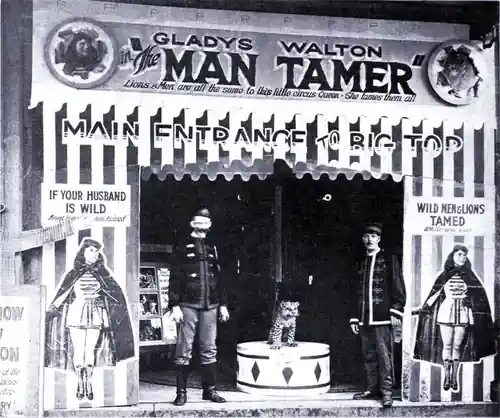
Though filmed in black-and-white, the original prints carried tinting codes: amber for interiors, cerulean for night exteriors, rose for romantic interludes. These chromatic cues—standard in early ’20s features—functioned like emotional hashtags. Imagine the rose shot of Basil brushing Naomi’s neck suddenly cross-cut to cobalt-hued Jimmy Spurs alone amid empty bleachers, the palette shift punching you in the solar plexus with the ache of triangular asymmetry.
Oxford’s compositional signature is the vanishing diagonal: characters enter the frame from extreme lower corners, exit upper opposite, as though the world itself tilts toward destiny. The motif culminates in the climax when Naomi, having loosed her lion into the wilderness, strides up a dune at dawn, her silhouette bisecting the horizon. The camera cranes back until she becomes a hyphen between earth and sky—no longer tamer, no longer tame.
Some cinephiles ask: why mourn a film we cannot screen? Because absence can teach what presence obscures. In the vacant space where The Man Tamer once flickered, we project our modern anxieties—about women’s bodies policed by legislation, about predatory capital masquerading as courtship, about the circus of social media where we nightly stick our heads into digital jaws for likes. The lost reel becomes mirror rather than void.
Moreover, the film’s DNA persists in strands you can splice if you know where to look. The gendered power games anticipate Madame la Presidente; the circus-as-metaphor for class circus resurfaces in Germania; the eroticization of peril prefigures Hitchcock’s Notorious rope of diamonds and danger. Cine-history is less linear tapestry than Möbius strip—touch any point and you feel the vibration of its antipode.
Rumors swirl that an 8-mm abridgment languishes in a São Paulo basement, next to reels of Carnaval 1932. Whether or not providence delivers, the legend suffices to keep conversation alive. And perhaps that is the fate of certain artworks: to exist most potently in the imagination, where every frame is pristine, every lion’s roar syncs with your heartbeat, every whip-crack writes a fresh signature across the sky.
For filmmakers scavenging inspiration, the takeaway is tonal audacity: let the woman lead, let the predator preach, let love be the sideshow—not the marquee. For viewers, the mandate is simpler: champion archives, petition rights holders, digitize grandma’s attic. Somewhere, amid vinegar syndrome and basement floods, a canister labeled “Man Tamer—Reel 2” might yet breathe.
Until then, we circle the ring, lit by the after-image of a woman who refused to choose between safety and sovereignty, between the cage of expectation and the wilderness of self. She cracks her whip; we flinch, we cheer, we change.
—and the lions of history keep pacing, waiting for the next daredevil to meet their gaze.

IMDb 5.8
1934
Community
Log in to comment.