Summary
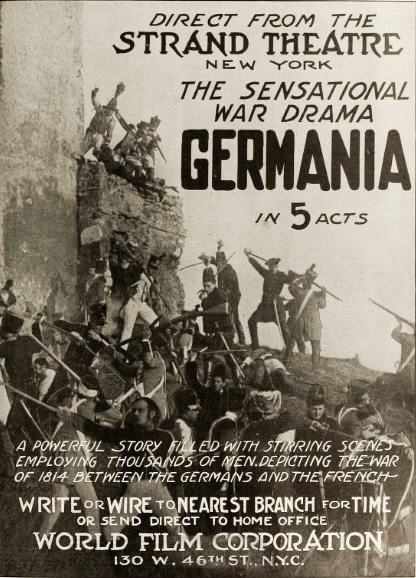
Ink, gunpowder and forbidden love swirl through this 1913 Italian fresco that reimagines the War of Liberation as a chiaroscuro fever-dream. In Nuremberg’s half-timbered shadows, Johann Palm’s clandestine press spews incendiary pamphlets that flutter like burning angels across a continent shackled by Napoleon’s velvet glove. Two student couriers—idealistic Frederick and loyal George—smuggle seditious broadsheets inside flour sacks, while George’s sister Riecke keeps the hearth of resistance glowing. Betrayal festers when Karl Worms, a comrade nursing unvoiced hungers, violates Riecke beneath autumn birches, seeding a private war that will germinate on the corpse-strewn plains of Leipzig. Years of campaigning scar Frederick’s soul; he returns to marry his tarnished muse, only to find her vanished on the eve of vows, chased by shame and the specter of her assailant. Honor, vengeance and nationhood collide in a midnight duel interrupted by the epiphany of Queen Louise: swords must point outward, toward the French oppressor. Come October 1813, amid cannonades that split Saxon skies, the estranged lovers reconverge amid windmills of cadavers—drummer-boy traitor expiating guilt with blood, remorseful Worms embracing death as absolution, Frederick dying in Riecke’s arms just as the word “Germany” is minted on history’s anvil. The film ends on a horizon of retreating Grande Armée silhouettes, dawn igniting a nation reborn from sacrificial grief.
Synopsis
It is the history of the German Revolution and the coalition of the powers of Europe which caused the first rout of Napoleon during the battle of Leipzig on October 10, 1813. Napoleon scoured the whole of Europe and, overwhelmed by his victories, followed the course of his destiny toward a tragic setting. The allied armies had been conquered many times over, but were still undaunted. The protectorate of Napoleon weighed like a yoke over the kingdoms of the Confederation of the Rhine, but the poets, philosophers, and thinkers of the whole of Germany were united in thought, that of relieving their Fatherland from the humiliation which the Emperor with his glory had imposed upon them. The German youth associated in the famous "League of Courage," the Tugendbund, disciplined their minds and their muscles at the sacred fire of an unquenchable thirst for independence. In the printing office of Stein in Nuremburg burns the sacred fire of German patriotism. The news of the defeat of Austerlitz and of the signing of the treaty of Presburgh which puts Bavaria into the hand of Napoleon, casts despair into the minds of all the students who assemble round the printer, John P. Palm. The latter exhorts them not to lose heart and reads to them a page of the fiery pamphlet he is printing and which bears as title, "The Deep Debasement of Germany." The youths become enthusiastic and offer themselves as volunteers to spread the work of Palm throughout Germany. But the pamphlet falls into the hands of Napoleon, who orders the arrest of Palm. By the aid of the students, Karl Worms and Chrysogonus, Palm succeeds in making his escape from Nuremburg and in taking refuge in a mill near the shores of the Pegnitz. This mill is at once transformed into a secret printing office from which are still hurled throughout all Germany proclamations of fire hidden in bags of flour. Such diffusions were specially in charge of two youths. Frederick Loewe and George, the brother of Riecke and Jane, two girls not yet twenty. Frederick loves Riecke. who reciprocates his love. But the grandeur of the work of redemption which is being prepared for the oppressed Fatherland, inspires so much enthusiasm that he decided to start, persuading George to do the same. While they are far off, Worms falls hopelessly in love with Riecke and betrays Frederick, who has placed blind confidence in him. One day, in a wood near the river, he abuses her, and from that day eternal remorse and grief tears his heart and the girl's. Meanwhile Frederick and George in their patriotic pilgrimage are one day provoked by some French officers. George is killed, but Frederick succeeds in making his escape and goes towards his native village, happy at the idea of seeing his Riecke again. At the mill they know already the news of his approaching arrival; Riecke trembles. Frederick arrives, accompanied by other students. Festivities are made at the mill, when all of a sudden they are startled by a cry of alarm. Some French soldiers break into the house and arrest Palm, dragging him away amid the cries and lamentations of all the bystanders. A boy named Jehbel, in order to save his old grandmother who is dying of starvation, tempted by the offered reward, reveals the hiding place of Palm who a few days after ended his noble life, shot by the soldiers of the garrison of Brunau. The campaigns of 1806 and 1807 are over. Frederick has returned to his cottage where his old mother has long been expecting him. He decides to marry sweet Riecke. The day fixed for the marriage has arrived. While all are merry, Karl Worms arrives unexpectedly. The poor Riecke. at seeing again that hated man feels as if in her heart a horrible wound were breaking out afresh. She feels incapable either of making a confession or of telling a lie, and she flees, leaving a short note for Frederick. It is the hour of the betrothal. Riecke , is to be found nowhere, but Frederick sees on the table among the flowers the short note, which tells him of her flight and that she can see him no more. Frederick like a man out of his mind calls her and looks for her, but to no purpose, and finally hears from Jane the sad truth. He looks for Worms to demand an explanation and to vindicate the wrong, but Worms also has fled. Can they have made their escape together? The thirst for revenge increases. He discovers the friend who has betrayed him at a meeting of patriots and he, the dumb statue of revenge, throws at the feet of Worms a sword whilst he, himself, sword in hand stands before him. One of them must die. But while the two adversaries are beginning to fight, a sweet vision stops them. The charming figure of a woman appears to them in a ray of light, the Queen herself. Those swords henceforth will never be raised again but against the enemies of their common country. Frederick has quenched his thirst for revenge in the holy name of his beloved Germany. We are at the days of the great trial, at that gigantic battle which history has called, "the battle of nations." On the funeral plain of Leipzig, the characters of our story are still found near each other. Jehbel, the boy who had betrayed Palm, is now a drummer-boy and washes out by his own blood the shame of his treason. Karl Worms purifies the atrocious remorse in his heart by falling in defense of his flag. Frederick also has fallen near Karl. Riecke wanders like a mad-stricken figure amid the corpses. She discovers the hated Worms and flees in terror, but when she catches sight of Frederick, who is dying, she rushes near him, bends over him and kisses him. "Who has conquered?" asks Frederick with his last breath. "Germany," replies Riecke. She holds his head in her lap, the head of the dearly beloved one who is no more. But the grief of that poor girl lost among the confused crowd of bleeding corpses rising like a sad and lofty symbol; it is the great sacrifice which all the tenderest and greatest of loves must undergo before the shrine of the Fatherland. Poor Riecke no longer cries. Far, far away on the horizon of fire, pass the remainder of the defeated army of Napoleon. And over Germany now dawns the ray of a long expected freedom.
Review Excerpt
"
A nation’s heartbeat, measured in shattered betrothal rings and printers’ ink.
There is a moment—silent yet thunderous—when the camera in Germania lingers on a meandering Pegnitz river at dusk, the water mirroring both the amber mill-windows and the iron-grey uniforms stalking them. That single shot distills the film’s alchemical formula: pastoral lyricism spiked with cordite. Released in the same year Victoriano Huerta seized Mexico City and the Balkans began to smolder, this Italian spectacl..."