DbcultAccessing Vault...
Cult Review
Senior Film Conservator
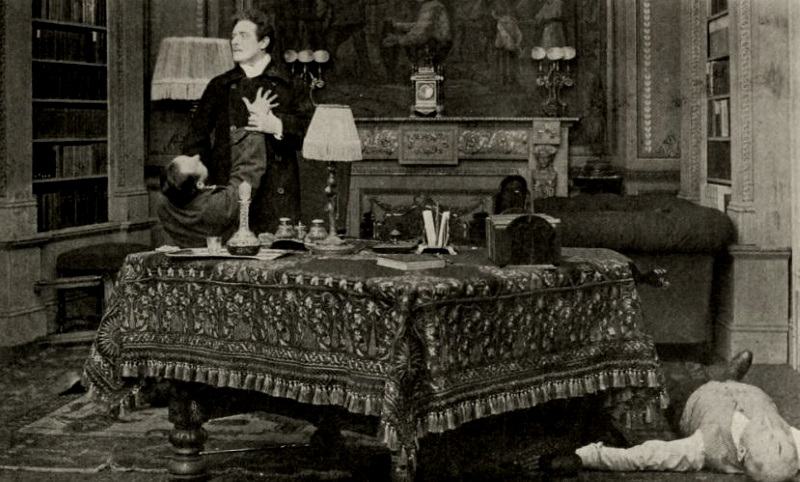
There are films that entertain, and then there are films that seem to inhale the zeitgeist so deeply they leave you light-headed. The Man Who Disappeared—Richard Washburn Child’s ten-part 1914 cliff-hanger—belongs to the second tribe: a pre-Code morality play that races like a runaway express across class anxiety, political graft, and the queer chemistry of self-annihilating love.
Child opens on a ballroom so opulent it could be lit by Gatsby’s future dreams. John Perriton—played with rakish magnetism by W.A. Whitecar—glides through the fox-trot of the idle rich, a man whose charisma is measured in champagne bubbles per minute. Yet the script immediately weaponizes that charm: a forged check, a weakling brother-in-law, and a butler who picks the wrong midnight to polish the silver. In the time it takes for a Strauss record to finish, Perriton’s tuxedo becomes a hairshirt; the black domino mask he dons to shield Nelson Wales is the same mask that will brand him statewide as a remorseless killer.
Notice how cinematographer Harry Linson keeps the camera low during the assault—our eye-line tilts up toward the safe as though it were a communion rail. The murder is not shown; we see only the chandelier’s trembling prisms, a visual shorthand for the moral universe wobbling off its axis. It’s a proto-expressionist flourish that prefigures German silents like Fantômas, yet Child refuses the continental impulse to romanticize crime. The butler’s death is squalid, transactional, a ledger entry written in arterial red.
Episode two flings us onto Long Island Sound, and here the serial finds its maritime soul. Perriton rows with the desperation of a man trying to out-row his own reflection; the oarlocks glisten like manacles in moonlight. When the detective’s bullet splinters wood, the film jump-cuts to a water-level shot—the world reduced to black waves and the huff of two dying breaths. It’s a moment that rivals the open-air authenticity of Dr. Mawson in the Antarctic, only here the ice is moral, not meteorological.
The episode’s cliff-hanger—Perriton handcuffed, marching ahead of his captor up a cliff—becomes a Stations-of-the-Cross in which every footstep loosens more scree into the void. When he purposely slips, sending McWade tumbling, the gesture is both self-preservation and self-flagellation: hurt me, just don’t hurt my name in Mary’s mouth tomorrow.
Episode three’s opium den—populated by T. Tamamoto’s inscrutable drug lord—threatens to drift into Yellow Peril caricature, yet Child complicates the tableau. The den is less a den than a limited-liability corporation: ledger books, stock certificates pinned to silk screens, a lawyer named Lipmann who speaks in quarterly dividends. When Perriton is coerced into impersonating a country heiress’s fictive brother, the film stages identity as commodity, something to be underwritten, bundled, and sold. The con’s beauty lies in its recursive irony: our hero must perform legitimacy to fleece a man who believes legitimacy can be purchased.
Margaret McWade’s Jennie—equal parts moll and proto-feminist—walks away with this reel. Watch her pupils in the two-shot where she first sees the mark: the iris contracts, not with avarice but with the recognition that desire itself is a rigged market. When she confesses the scam to Harry Horn, the close-up lingers on her unpainted lips; the film refuses to leer at penitence, a restraint that feels almost modern.
Episode four gifts us the serial’s most lyrical set-piece: a rooftop hostage scene in which Perriton, bound with electrical cord, angles Jennie’s handbag mirror to flash Morse-like dashes of sunlight into a tailor’s eyes across the alley. The gag is pure Meliès whimsy grafted onto urban realism—an early admission that cinema itself is a mirror redirected against darkness. When the tailor climbs the fire escape to free them, the camera assumes his POV: the city becomes a tessellation of windows, any one of which might hide a witness or an accomplice. It’s a visual metaphor for the serial’s central anxiety: in modernity, every wall is permeable, every self can be refracted into data or rumor.
Episodes five and six swap the underworld for the industrial one. Perriton, now "John Pottle," swings a 14-pound hammer on a half-built skyscraper—frames echoing the sweat-slicked documentaries of John Barleycorn and the labor-versus-capital tension of The Man from Home. Child stages the workplace as a panopticon: time-clocks, time-cards, the implacable eye of the boss who buys bone and sinew by the hour.
The dynamite-in-lunch-pail gambit feels lifted from tomorrow’s headlines—an IWW cautionary tale rendered in nitrate. Yet the film refuses agitprop. When Carter’s goon strong-arms Perriton onto the high girder, the wide shot reveals Manhattan’s infant skyline glinting like a mouthful of new teeth. The void below is not socialist rhetoric; it is the existential gap into which every worker stares when the safety net is gossip and the only pension is a quick death.
Episode six’s draw-bridge sequence is the serial’s most Eisensteinian flourish. Perriton bribes a tug captain to whistle for passage, knowing the bridge must yawn open and throttle Carter’s 12:45 express. The editing alternates between the steam gauge, the bridge gears, Jennie’s anxious profile, and the locomotive’s oncoming eye—montage as civic sabotage. When the train screeches to a halt, the film seems to exhale in collective relief: democracy, momentarily, is a brake shoe.
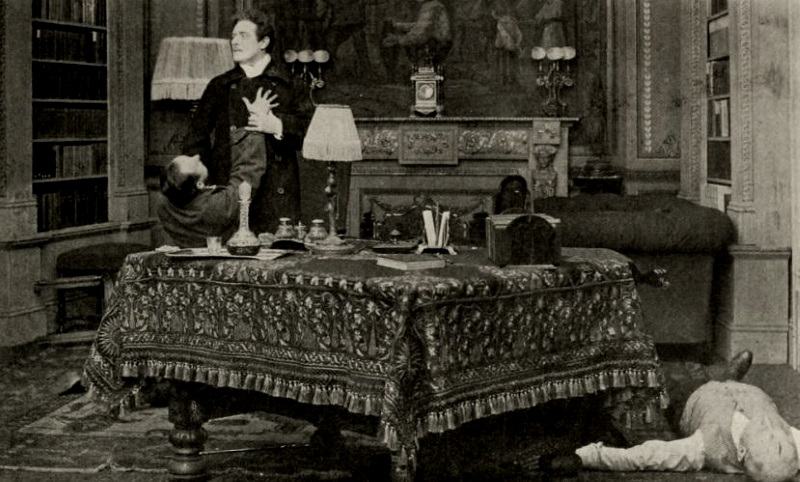
Episode seven stages the lovers’ reunion as a crucible of split-second ethics. Mary, coerced by Carter into ferrying bribe money, stands in the gaslight of a country-house parlor just as Perriton—telescope evidence in pocket—bursts in with detectives at his heels. The two-shot is heart-stopping: their eyes lock, wordlessly calculating cost, betrayal, salvation. When Perriton slams the door on his allies and lowers Mary out the window, the gesture is less rescue than secular absolution: he will not let the law write her story in mug-shot type.
Episode eight’s climax—biplane versus steam train—feels like Griffith hitch-hiking on the wings of Futurism. The intercutting is so kinetic you can almost smell castor oil and soot. When the plane skids onto Vernontown field just as Mary steps onto the platform, the film achieves the temporal coincidence that only railroads and cinema can conjure: two vectors of yearning intersecting by the thinnest margin of seconds.
Episode nine’s overboard escape is staged in a moonlit studio tank, waves sloshing against the hull like liquid noir. Mary’s fake faint—an old melodramatic trick—becomes a Brechtian wink: we see the artifice, yet we bite our nails anyway. When Perriton drags himself onto shore, the camera tilts up to reveal the Hudson Palisades, indifferent geological spectators. Nature, the film suggests, is the only jury not on the take.
Episode ten’s filmed re-enactment is a meta-stroke worthy of Pirandello. Mary hires a motion-picture unit to recreate the butler’s murder, then locks Nelson in a darkened drawing room with the reel as sole company. As the images flicker, the camera records not the screen but Nelson’s face: sweat beads become projector grain, guilt itself pixelates. When he lunges at the luminous phantoms, the chair he wields smashes through the fourth wall and into the arms of waiting police. His heart gives out—not from bullet but from the simpler trauma of seeing his psyche externalized, commodified, replayed ad infinitum. In 1914, this is as close as cinema comes to saying: we are what can be projected of us.
W.A. Whitecar must act through a prism of aliases—Perriton, Pottle, the Man in the Black Mask—and still thread a single moral filament. He does it with body language: shoulders thrown back in society rooms, gradually leveling to the resigned stoop of the perpetual outsider. Watch how he removes his hat in episode five’s hospital scene: the brim covers his eyes for an extra beat, as though even sunlight were an interrogation.
Marjorie Ellison’s Mary journeys from trust to betrayal to mature solidarity without ever calcifying into plaster saint. In the train-station farewell she communicates a lifetime of conflict with a single hand—half-raised to wave, then clenched into a pocket. It is the gesture of a woman who has learned that love is sustained not by promise but by shared complicity against the world’s corruption.
Though shot without tinting, the film’s lighting design evokes a chromatic psyche: ballroom chandeliers burn with the orange of dying suns; river nights are steeped in bruise-blue; the courthouse ledger where bribes are tallied is lit with the sickly yellow of old parchment. These hues exist only in our mind’s eye, yet they feel as present as the intertitles’ ornate scrollwork.
Contemporary exhibitors would have accompanied the serial with everything from pit orchestras to solo pianists thumping out "Hearts and Flowers." Yet the film’s internal rhythm—measured in slamming doors, train whistles, hammer clangs—creates its own percussive score. The most chilling motif is the click of handcuffs, heard only in our imagination, recurring like a leitmotif every time Perriton’s anonymity slips.
Histories often segregate European crime serials (Fantômas) from American rural melodramas (Mrs. Wiggs), but The Man Who Disappeared fuses both lineages. Its cliff-hanger structure, urban conspiracies, and fascination with disguise align with Feuillade; its moral absolutes, last-minute rescues, and faith in love’s redemptive calculus echo Griffith. Yet Child refuses either director’s fatalism: his universe is morally plastic, able to be bent by courage, ingenuity, and the occasional well-aimed handbag mirror.
Surviving prints are spotty; the Library of Congress holds a 35 mm partial, and MoMA has preserved episode ten with Dutch intertitles. A 2018 restoration by EYE Filmmuseum added a synth score that, while anachronistic, underscores the serial’s proto-cyberpunk dread. If you can snag a screening, sprint. If not, scour special-interest Blu-ray labels; the disc will be worth its weight in gold for the final reel alone.
Bottom line: The Man Who Disappeared is a cathedral erected to the idea that identity is negotiable, that love can be laundered through ten different aliases, and that cinema itself is the final mirror in which guilt shall see its true face—and perish.
IMDb —
1924
Community
Log in to comment.