DbcultAccessing Vault...
Cult Review
Senior Film Conservator
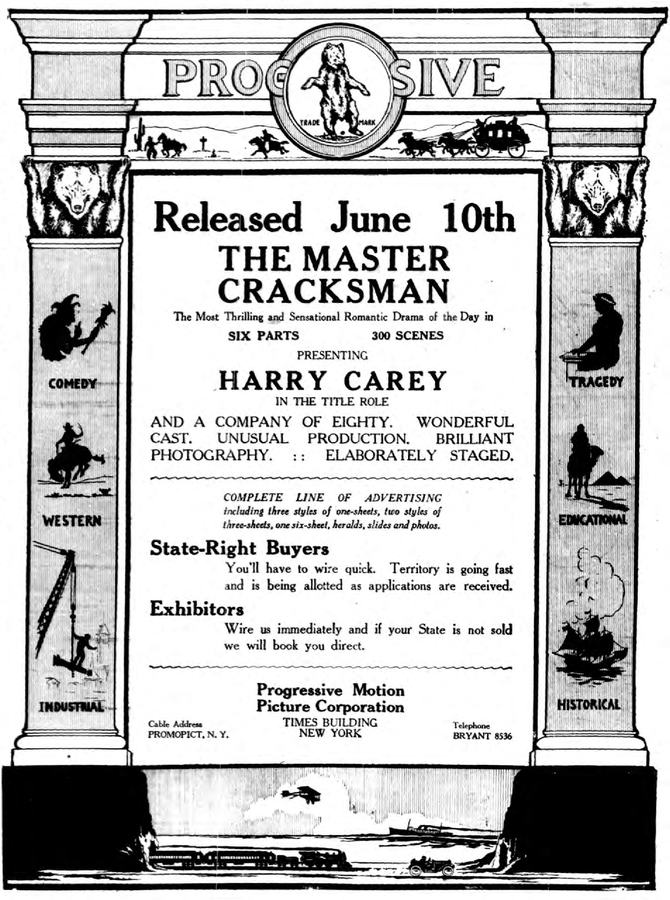
A diamond is only carbon until desire squeezes it into light.
In 1914, while Europe rehearsed the choreography of trenches, American cameras were already pirouetting around another war—class warfare wearing white gloves. The Master Cracksman survives only in shards: a cracked tintyped reel here, a lobby card there, a synopsis typed on onion-skin now freckled like a century-old décolleté. Yet from those crumbs a myth flares, hotter than any carbon crystal, because Harry Carey—part cowboy, part urban fox—knew that the most seductive crimes are the ones that let the audience taste the adrenaline without ever touching the blood.
Begin with the gem merchant’s parlour, wallpapered in burgundy damask the colour of dried blood. Peter J. Martin—mutton-chopped Midas—has summoned a private watchdog, Detective Dan McRae, to babysit a stone that outweighs conscience. The birthday girl, Ruth, drifts through in chiffon so diaphanous it seems carved from the very concept of purity. Enter Gentleman Joe: top-hat tilted like a wink, cane tapping Morse code on parquet, a smile that promises larceny and breakfast in bed. One chloroformed hankie later McRae is gagged in a coal cellar while Joe glides upstairs, a wolf in evening dress, sipping champagne with the lambs.
Parallel to this masquerade, nephew Robert Kendall—chin scarred by creditors’ threats—scripts a second heist. He recruits cousin Harold, a trembling boy who still smells of university chalk, to jimmy the safe. Their alliance is a duet of desperation: the older man’s whisper coils like smoke around the younger’s ideals until Harold believes theft is merely a loan from the future. When Peter discovers the conspiracy, the confrontation combusts: a gun barks, the old man crumples, velvet curtains absorb the echo. Harold bursts in to find his sire splayed across Persian silk, blood freckling the diamond like pomegranate seeds. Kendall vanishes; the police swarm; Harold, bullied by klieg-light interrogation, signs a confession that will later read like a suicide note written by another man.
Here the film pivots on its most vertiginous moral hinge: the jewel thief, hearing that an innocent now shoulders both theft and patricide, decides conscience is the one bauble worth stealing back. Joe stalks Kendall along moonlit wharves where steamers grunt like dying minotaurs. He offers a .32 calibre choice: courtroom circus or solitary curtain call. Kendall pens a confession that drips with self-loathing, then swallows the gun barrel as if tasting his own marrow. Harold is freed; Joe returns to his garret, uncorks a jar of Virginia leaf, and tips the diamond into McRae’s palm with a grin that says ownership is merely a longer con.
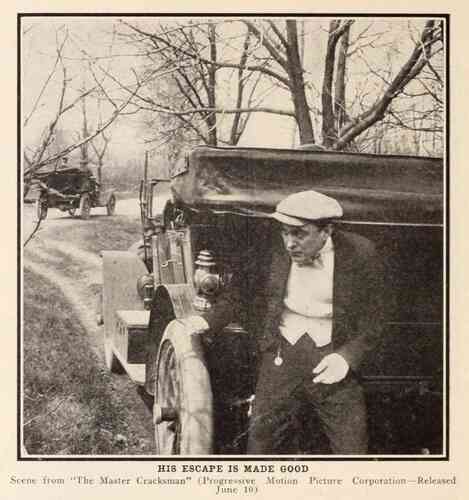
Surviving stills reveal cinematographer Rexford Burnett’s chiaroscuro fetish: faces halved by darkness, eyes glinting like nail-heads in mahogany. Joe’s silhouette dissolving into velvet drapes anticipates the later geometries of German expressionism; the diamond, cupped in a woman’s palm, becomes a miniature sun casting razor spokes across men’s appetites. Intertitles—hand-lettered with copperplate swagger—deliver lines such as “A gentleman may break commandments but never his poise.” The phrase ricochets through the narrative like a bullet that refuses to land.
Harry Carey’s Joe predates even the amoral rogues of European serials. He saunters rather than walks; every crease in his coat is a line of playful poetry. When he doffs his hat to Ruth, the gesture contains both courtly reverence and the unspoken promise that, under different moons, he would steal her heartbeat without breaking stride. Opposite him, Roland De Castro’s Kendall sweats desperation through celluloid; his pupils are black holes swallowing solvency, honour, finally life itself. Harold—played by Herbert Russell—transmutes from ivy-league naïf to scapegoat with such fragile credibility that the audience feels each interrogation room slap land on their own cheek.
American melodrama of the 1910s usually preferred last-minute rescues, railroad tracks, and virtue triumphant. The Master Cracksman instead kneels at the altar of self-slaughter, offering Kendall’s suicide as both restitution and narrative full-stop. The camera does not cut away; we witness the tremor of barrel against teeth, the ink of confession still wet, the soundless bang that seems to suck all oxygen from the frame. Censors of later decades would have excised such candour, yet here it stands—a bleak covenant suggesting that some crimes can only be balanced by forfeiting the soul’s tenancy in flesh.
Ruth and the maidservant characters orbit the action like porcelain moons: admired, coveted, ultimately powerless. The diamond, gendered female by both name and destiny, becomes a surrogate bride passed from father to thief to fiancé. When Joe slips it into the tobacco jar, he performs a mock-marriage, wedding stone to leaf, luxury to labour, masculine appetite to masculine ritual. Juliette Day’s Ruth never quite transcends objet d’art status—yet even within that confinement her glances betray an awareness that the true gem is autonomy, forever just beyond her gloved fingertips.
At roughly 38 minutes, the film hurtles like a hansom cab whose horse has tasted absinthe. Scenes pivot on irises, wipes, and diagonal split-screens that prefigure 1960s capers. Compare its velocity to the languid domestic martyrdom of East Lynne or the colonial meanderings of The Bushman’s Bride; Cracksman feels caffeinated, a locomotive whose coal is human culpability. Contemporary Variety squibs praised its “nerve-jangling compression,” proof that even pre-Griffith audiences could savour brisk sin.
No negative survives with its original cue sheets, yet the action begs for music that alternates parlour-room waltz with tango noir. Picture a solo violin sliding into klezmer clarinet as Joe cracks the safe; a heartbeat drum when Harold spies his father’s corpse; a single muted trumpet holding the note as Kendall squeezes the trigger. The absence of audio forces modern viewers to conjure their own orchestra, making each screening a collaboration across a century of quiet.
Strip away the spats and cravats and you find the ancestral chromosome of Asphalt Jungle, Rififi, even Ocean’s Eleven: the gentleman thief whose code outshines civic law, the inside-man subplot, the double-cross blooming like nightshade. Carey’s Joe is spiritual grandfather to Lucille Love’s enigmatic ally, a bridge between nickelodeon villainy and the glamour-soaked anti-heroes that Depression audiences would later embrace as avatars of stick-it-to-the-rich fantasy.
Only two 35mm nitrate prints are known: one deteriorating in the Library of Congress paper-print vault, the other rumored in a private Melbourne collection whose owner screens it only under the influence of absinthe and nostalgia. Digital transfers circulate among silent-film fora as 480p files flecked with emulsion boils. Yet even in tatters, the movie pulses—proof that narrative sinew can outlive its skin.
We stream capers in 4K where pixels outnumber the stars, yet rarely do we feel the chill of ethical freefall that Carey achieved with candlelight and nerve. The Master Cracksman endures because it asks the question every subsequent jewel-heist film dodges: if society’s ledger is already rigged, does the outlaw become the last honest broker? Joe’s parting gift—hiding the diamond inside mundane tobacco—winks at the ultimate con: value itself is a sleight of hand, a collective hallucination we agree to chase until the lights come up and the vault of history clangs shut.
VERDICT: 9/10 – A cracked yet coruscating relic whose moral aftershock still glitters in the dark.
IMDb 5.4
1918
Community
Log in to comment.