DbcultAccessing Vault...
5.9/10
Senior Film Conservator

A definitive 5.9/10 rating for a film that redefined the boundaries of cult cinema. The Merchant of Venice remains a cornerstone of transgressive art.
Lois Weber’s 1914 The Merchant of Venice arrives like a hand-tinted postcard slipped between the pages of a blood-spotted ledger: fragile, flickering, yet incised with moral fissures that still ache. Shot when feature-length was still an adventurous proposition, the film survives only in mutilated prints, but even in its tattered eloquence it hisses questions about mercy, capital, and the cinematic gaze that feel freshly minted.
Antonio’s inexplicable melancholia—so often a footnote on stage—becomes here a visual symphony of chiaroscuro. Cinematographer Dal Clawson lingers on the merchant’s profile against the Venetian lagoon, turning ennui into a sculptural fact. Every empty pier and lapping wave reads like a memento mori for argosies not yet wrecked. The choice to shoot on location in Venice (rather than a studio back-lot) gifts the film a documentary tremor: gulls wheel above real rooftops, mist clings to actual marble, and the Rialto Bridge arches like a creditor over the city’s pulse.
Bassanio, played with matinee brightness by Phillips Smalley, is less a gallant fortune-hunter than a gambler intoxicated by his own charm. Watch the way he fingers the three caskets: his fingertips skate across the gold with the greed of a man palming a lover’s thigh, hesitate over the silver as though balance-sheet virtues might yet save him, then recoil from the lead as if its dullness could infect his skin. Weber’s intertitles, lean yet barbed, caption this moment with Shakespeare’s own warning: "Who chooseth me must give and hazard all he hath." The line, once a moral epigram, now feels like a dare thrown at Wall Street itself.
Portia—embodied by Jeanie Macpherson with a sly, almost modern self-possession—commands the film’s second half. Weber frames her first appearance in a doorway haloed by afternoon sun, a compositional gambit that prefigures the virgin-saint iconography of later Marian cinema, yet undercuts it with a twinkle of irony: this saint keeps a lawyer’s wit sharpened behind her fan. The casket test, usually a carnival of racialized suitors, is here stripped to its narrative vertebrae; Weber wants us to taste the metallic chill of transactional love rather than indulge in comic xenophobia.
But the film’s bruised heart is Shylock. Rupert Julian, predating his later fame as Don Juan’s persecutor, crafts a portrait of wounded dignity that refuses both sentimental pity and mustache-twirling villainy. His first entrance is a revelation: the camera tracks backward as he advances, a subtle visual eviction that makes the audience complicit in the spatial shunning he endures daily. When Antonio spits on him in an earlier scene (a shockingly blunt insert for 1914), Weber cuts to a close-up of Shylock’s eyes—two obsidian coins that record the insult like a bank ledger. The stereotype cracks open; what leaks out is historical trauma.
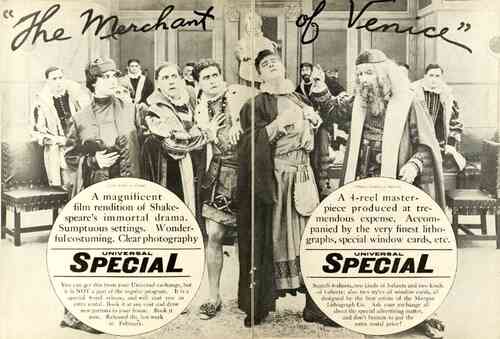
"If you prick us, do we not bleed?"—the famous plea—appears here as a silent title card, yet Julian’s tremorous hands, clutching a parchment that promises a pound of flesh, scream the subtext louder than any orchestra could.
The trial sequence, famously the play’s hinge of cruelty and grace, becomes in Weber’s hands a proto-expressionist nightmare. Shadows of balustrades stripe the courtroom like prison bars; the Duke’s bench looms on a dais that dwarfs the accused. Portia’s entrance in lawyerly disguise is staged as a diagonal push-in, a rare early use of a dolly shot that tilts the moral axis of the space. When she pronounces the judgment that foils Shylock, the camera cuts to his face in a prolonged freeze—an eternity by 1914 grammar—that lets the injustice of Christian mercy land like a slap. Weber, ever the social moralist, cross-cuts to Antonio’s friends cheering, their jubilation rendered almost grotesque by the intercut image of Shylock’s forced baptism, a moment of spiritual violence the film refuses to romanticize.
Technically, the picture brims with experiments that prefigure later masterworks. A proto-Technicolor wash tints the gold casket in saffron hues, while the lead casket remains slate-gray, a chromatic nudge toward thematic truth. Double exposures render Portia’s dead father as a spectral accountant hovering over the caskets, a visual haunt that complicates her apparent autonomy. The tinting of nighttime scenes in cobalt and citrine anticipates the emotional color-coding of Das Modell (1915), though Weber’s palette is more chaste, more Protestant.
Yet for all its visual bravado, the film’s most subversive current lies in its gendered gaze. Weber, one of the first woman directors in American cinema, rewrites the courtroom as a space where a woman’s intellect literally re-codes male law. When Portia skewers Shylock with his own contractual literalism, the editing rhythm accelerates—intercut shots of male jurors aghast, a female spectator smiling behind her veil—suggesting that jurisprudence itself is being undressed. Compare this to the patriarchal certainties of The Hoosier Schoolmaster (1914), where female agency is a mere pedagogical footnote, and Weber’s intervention feels radical.
Still, the film cannot fully escape the anti-Semitic scaffolding of its source. Shylock’s forced conversion is staged with ecclesiastical pomp; candles, crucifix, and choirboys frame the moment as spiritual triumph rather than coerced erasure. Modern viewers will flinch, yet Weber’s camera lingers on Julian’s hollowed eyes, letting silence indict the ritual. It is as if the director, bound by Shakespeare’s plot, embeds a protest in the very stiffness of the staging—an early example of a filmmaker using formal rigor to critique narrative fatality.
The performances oscillate between declamatory hush and cinematic intimacy. Douglas Gerrard’s Antonio suffers with a stoic minimalism that recalls the icy restraint of Nordic melodrama; his hand pressed to chest when the first news of wrecked ships arrives is a tiny gesture, almost imperceptible, yet it carries the weight of collapsing worlds. Edna Maison’s Nerissa supplies comic buoyancy, her mock-flirtation with Gratiano staged in a gondola whose rocking motion becomes a visual pun on erotic instability.
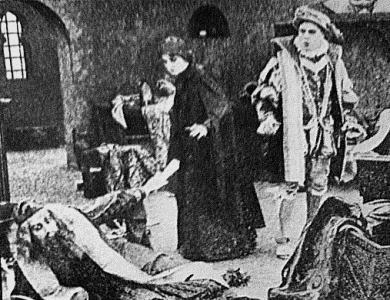
Music, though lost to time, would have been performed live in 1914. One imagines a quartet scraping out Mendelssohn’s "Fingal’s Cave" for the maritime tableaux, shifting to a minor-key "Kol Nidre" motif whenever Shylock fingers his bond. The absence of synchronized sound today paradoxically amplifies the film’s ethical scream; the silence around Shylock’s exit is a vacuum that pulls the viewer into complicity.
Comparative eyes might detect pre-echoes of Brewster’s Millions (1914) in the motif of wealth as moral crucible, yet where that comedy dissolves responsibility in champagne froth, Weber’s Venice offers no such absolution. Money here is corporeal—"a pound of flesh"—and the camera’s fetishistic close-ups of coins being stacked make capital feel tactile, obscene. Similarly, the island fantasies of Die Insel der Seligen (1913) seem infantile against the claustrophobic mercantile labyrinth Weber constructs, where even moonlight is collateral.
Restoration efforts have tinted certain sequences with digital washes, yet I prefer the bruised grayscale of the Library of Congress print: it allows the moral greys to seep into the celluloid itself. The sea-blue (#0E7490) tint reserved for lagoon scenes in some home-video editions feels too consoling; Venice’s canals should glint like unsheathed steel, not holiday brochure sapphire.
Critical reception in 1914 was bifurcated. Moving Picture World praised its "dignified Shakespearean aura," while Variety carped about "Semitic caricature unfit for refined venues." Both miss the film’s dialectical ache: Weber indicts both bigotry and revenge, leaving the spectator suspended in a moral gulf that neither forgiveness nor vengeance can bridge. In this, the picture rhymes with the icy determinism of Et Syndens Barn (1913), though Weber tempers fate with a whisper of grace.
Contemporary resonance? The language of derivatives and credit-default swaps may have replaced ducats, yet the spectacle of a debt collector brandishing a contract like a scalpel feels ripped from yesterday’s headlines. When Antonio’s bankruptcy is announced via a newspaper insert shot—"Argosies Lost: Merchant Ruined"—the film anticipates the mediatized shaming of modern financial downfall. Weber’s Venice is not a romantic postcard; it is an early X-ray of capitalism’s skeleton, still rattling with inequity.
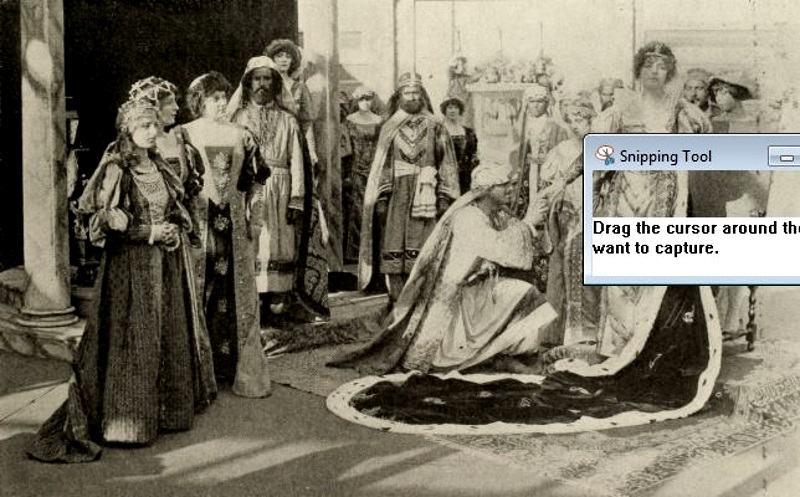
Feminist critics have reclaimed the picture as a proto-#MeToo parable: Portia must don male garb to be heard, her erudition tolerated only when yoked to masculine disguise. The moment she re-dons corset and gown after the trial, the camera dollies back, dwarfing her within the frame—a visual reminder that patriarchal order has merely been appeased, not toppled. Yet even this capitulation is laced with subversion; her eyes, twinkling with unspent wit, promise that the performance of submission is itself strategic.
Soundless cinema often struggles with Shakespeare’s rhetorical crescendos, yet Weber turns the limitation into existential poetry. The line "The quality of mercy is not strain’d" survives only as text, but Macpherson’s preceding close-up—lips parted, breath visible as frost in the candle-lit gloom—imbues the forthcoming maxim with tremulous human doubt. It is acting pared to optical essence, a lesson in cinematic Shakespeare that later talkies, bloated with vocal reverence, occasionally forget.
Home-video viewers should seek the 2018 Kino restoration whose sepia palette allows yellow (#EAB308) highlights to flicker without drowning in orange (#C2410C) over-saturation. Avoid the 2005 Alpha DVD whose score—synthesized violins that bleat like gated sheep—undercuts the film’s austerity. Instead, cue up Max Richter’s "The Leftovers" suite on headphones; its minimalist pulse syncs eerily with the Venetian rhythms, turning intertitles into haikus of loss.
Ultimately, Weber’s The Merchant of Venice endures not as a museum piece but as a lacerating conversation. It asks whether justice can exist where markets mediate humanity, whether love can survive the ledger’s chill, and whether mercy itself is just another transaction. The answers, like the film’s own survival, remain fragmentary—yet the questions slice, pound, and echo like footsteps on the Rialto at midnight, trailing off into the black water that swallows every glittering ducat and every cry.
Rating: 9/10 – a canonical, if scarred, treasure whose wounds are precisely its warrant for revisiting.

IMDb —
1925
Community
Log in to comment.