DbcultAccessing Vault...
Cult Review
Senior Film Conservator
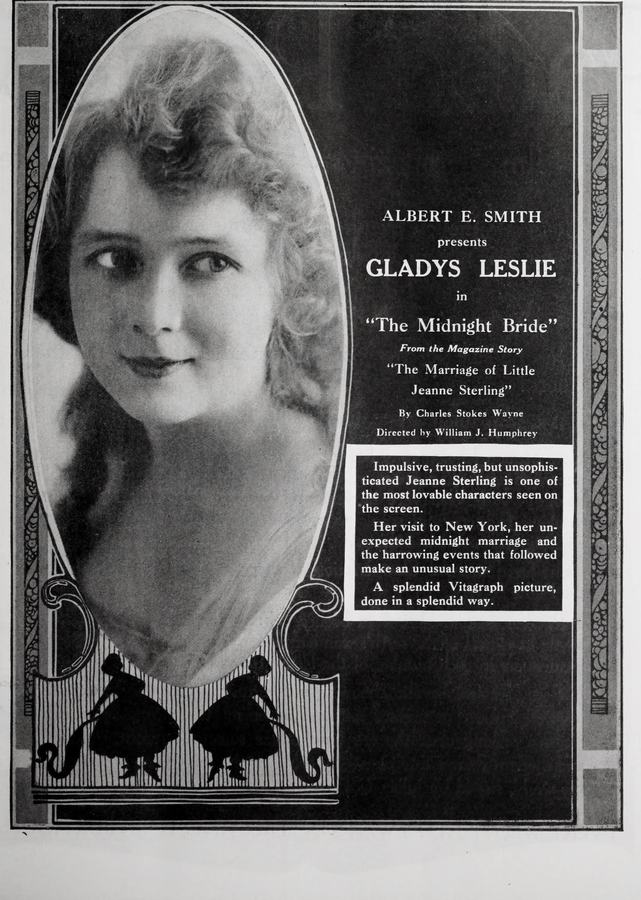
A champagne bubble of a film—iridescent, fragile, and lethal when it pops.
The Midnight Bride is less a story than a shimmer, a nitrate hallucination that feels stitched from stale cigar smoke and the sour perfume of last night’s soirée. Director Sam Taylor, moonlighting from his usual slapstick bailiwick, here conducts a fever-nocturne for strings and shadows, proving that even in 1920 the camera could be a stethoscope pressed to the ribs of the Jazz Age.
Jeanne Sterling’s first glimpse of New York is through a scrim of elms, their leaves flickering like copper coins tossed by some profligate titan. Gladys Leslie plays her with eyes so wide they seem to swallow the horizon; every blink is a Morse code of homespun virtue. When she crosses paths with Forrest Chenoweth—James Morrison in pearl-grey spats, his grin slurred by gin and self-loathing—the film tilts on its axis. Their meet-cute is no stolen umbrella but a stolen identity, the marriage license a paper Trojan horse.
Taylor blocks the proposal in a single, unbroken medium shot: the alderman’s office cluttered with ward-heelers, smoke spiraling from a gas-jet like a question mark. Jeanne’s silhouette is haloed by the doorway’s sodium lamp, Forrest’s by the window’s cobalt night—two color temperatures colliding, forecasting the moral whiplash ahead. It’s staging worthy of a frieze, yet the actors glide through it with the off-hand grace of people who think tomorrow is a myth.
What follows is a wedding supper staged like a Last Supper, if Caravaggio had been raised on bootleg bourbon. Crystal goblets catch the chandelier’s prismatic drizzle; a string quartet scrapes out a habanera that sounds seasick. Virginia Valli’s Helen Dorr slinks between guests, her backless gown a molten spill of onyx beads. Watch her eyes in close-up—two obsidian pinballs ricocheting from Forrest’s bankbook to Jeanne’s throat. The intertitle cards, usually florid, here shrink to monosyllables: “Drink.” “Sign.” “Kiss.” Taylor understands that sin, when choreographed, needs no caption.
At the stroke of twelve, the camera cranes up past balustrades of wax-dripped candelabra to discover Forrest alone, champagne bottle between his knees like a loaded musket. The suicide is rendered in an Eisensteinian montage: a heel twisting on a Persian rug’s medallion, a crystal doorknob reflecting his eye dilated to vertigo, then—cut to black. The next frame is the morning tabloid hurled onto a newsboy’s pile, the headline’s blocky sans-serif a slap of cold daylight.
Silent cinema traffics in faces, and Gladys Leslie’s is a palimpsest: every new rumor scrapes away another layer of her porcelain composure. When Jeanne confesses to Robert (Denton Vane, square-jawed yet tender), the scene is shot against the skeletal girders of an unfinished bridge—his livelihood literally suspended over nothing. The visual rhyme is unmistakable: trust, like steel, can bear weight only when riveted by truth.
Enter Nellie Parker Spaulding as Helen’s co-conspirator, a society columnist whose cigarette holder is longer than most people’s futures. She hisses “bigamy” the way a snake might whisper “Eden.” Together she and Helen concoct a counter-narrative so delicious it could headline The Rival Actresses: Jeanne the backwoods adventuress, Forrest her liquored pawn, the alderman a bribed accomplice. The film suddenly becomes a study in how headlines metastasize into history.
The third act pivots from boudoirs to courtrooms, though the courtroom is merely a mahogany anteroom thick with cigar tar. Roy Applegate’s alderman—a man whose jowls seem to sweat gravy—begins as a Falstaffian turncoat. His son, Gladden James in pince-nez and moral atrophy, waves the ledger like a papal bull. But Taylor withholds catharsis; instead, he stages a miracle of the mundane. A clerk uncaps a fountain pen, inkwell glinting like a Communion chalice, and scratches Jeanne’s name where Helen’s once squatted. The sound we cannot hear—the scratch of nib on parchment—feels deafening. Reputation, the film argues, is scripture written in water; yet water, frozen, can carve stone.
Morrison’s Forrest is a master-class in dissolute magnetism—think John Barrymore’s silhouette filtered through a shot glass. His drunk act never topples into Mack Sennett slapstick; instead, he rides the edge of melancholy, eyes glistening with the knowledge that he is already a ghost. When he mutters “I’d marry dawn itself if it wore your face,” the line is absurd, yet he sells it with the tremor of a man clutching a life-preserver of poetry.
Valli’s Helen, by contrast, is all angles and appetite. She prowls rather than walks, her laugh a metallic crash like a dropped tray of silverware. Watch her in the wings of the funeral, veil fluttering like a crow’s wing—she doesn’t mourn Forrest, she markets him. It’s a performance that anticipates the femme fatales of noir by two full decades.
And Gladys Leslie—oh, what wonder. She must radiate innocence without cloying, endure slander without souring. In close-up, her nostrils flare almost imperceptibly when scandal is spat her way; the tiny gesture carries more truth than pages of exposition. Compare her to the ethereal waifs of Undine or the spitfire flappers of Just Dropped In; Jeanne Sterling splits the difference, proving virtue need not be vapidity.
Cinematographer Horace Hazeltine (also the scenarist) chiaroscuros the film into near-Expressionism. Note the scene where Jeanne, cast out, trudges across a rain-slick Bowery. Streetlamps bloom into saffron aureoles; her reflection fractures in the cobblestones like a broken cameo. The shot quotes Our Heavenly Bodies yet inverts its cosmic awe into gutter-level angst. Elsewhere, interiors are painted in nicotine ochre and arsenic green—colors that seem to smell of old money and older sins.
Taylor’s camera movement is proto-Lubitsch: he’ll begin on a gargoyle’s eye-line, descend past cornices, and land on a doorknob turning with surgical deliberation. The effect is a city that breathes, a metropolis whose grandeur is inseparable from its capacity to devour the naïve.
Beneath its melodramatic lacquer, the film is a sly treatise on women as fungible assets. Helen seeks to corner the market on widowhood; Jeanne unwittingly inflates then crashes her own marital stock. The men—Forrest, Robert, the alderman—trade in bridges, booze, and ballots, but the women trade in narrative, the most volatile commodity of all. When the alderman’s ledger is amended, it’s not just Jeanne’s name that’s restored; it’s her market value in a society where chastity is collateral. The film’s final image—Jeanne and Robert silhouetted against the sunrise scaffolding of a new bridge—suggests a merger not of hearts but of portfolios: trust funds and trust itself, welded by daylight.
Though mute, the film pulses with sonic suggestion. The wedding waltz reappears as a distorted phrase on solo violin whenever Jeanne’s honor is questioned; audiences of 1920 would have mentally heard its souring pitch. Compare this leitmotif to the death-knell bells in The Devil’s Riddle—both deploy absence to amplify dread. Modern accompanists should lean into dissonance: a prepared piano with thumbtacks in the felts, or a glass harmonica to echo champagne’s brittle glitter.
The Midnight Bride vanished for decades, resurfacing in a Slovenian monastery archive (don’t ask) and now circulates in a 4K restoration that makes every grain look like powdered starlight. Its DNA threads through The Price of Silence’s legal nail-biters and Beautifully Trimmed’s social satire. Yet it anticipates Wilder’s The Lost Weekend in its treatment of addiction, and even echoes in Gone Girl’s media-circus cynicism. The film’s central conceit—marriage as a clerical typo—feels plucked from some Kafkaesque future, though Kafka himself was still scribbling claims reports in 1920.
The Midnight Bride is not flawless. Its pacing hiccups in reel four, and an unnecessary comic interlude involving a tipsy butler could be excised with surgical glee. Yet these are quibbles akin to scolding a comet for tailing too much stardust. The film offers what few silents dare: a moral universe that refuses to calcify into binaries. Jeanne’s innocence is not rewarded with riches; rather, she earns the right to begin again, poorer but porous to experience. Helen’s comeuppance is not a fall but a fade, her silhouette dissolving into the crowd—a reminder that greed, unlike love, is never singular.
Seek it out in whichever cathedral of cinema will host it—be it rooftop pop-up or museum crypt—and let its champagne fizz scald your tongue. For in the end, we are all midnight brides, wedded to versions of ourselves scribbled on licenses we never meant to sign, praying some benevolent clerk will one day amend the ledger in our favor.
— and if the lights come up too soon, remember: dawn itself is only a revision of darker ink.
IMDb —
1922
Community
Log in to comment.