DbcultAccessing Vault...
6.2/10
Senior Film Conservator
A definitive 6.2/10 rating for a film that redefined the boundaries of cult cinema. The Mysteries of Souls remains a cornerstone of transgressive art.
The first time I saw Lydia vanish beneath that Adriatic skin of moonlit mercury I felt my own lungs implode—such is the cruel intimacy of The Mysteries of Souls, an Italian-produced fever dream from 1912 that somehow feels both ancient and newly-born.
Shot when Europe still balanced on the cusp of Art-Nouveau elegance and the mechanised slaughter of the Great War, this film is a danse macabre of fiduciary appetite. Frank Alberti—played by Giovanni Casaleggio with the velvet malice of a Borgia accountant—doesn’t merely covet his ward’s estate; he wants the very oxygen she exhales. The will is a parchment cage; water is the lock.
Director Luciano Daleza composes the attempted murder as though Caravaggio had suddenly been handed a movie camera: the skiff’s hull splinters, candle-yellow lantern-light skitters across the waves, Lydia’s white dress billows like a surrender flag. Intertitles do not explain—we feel the panic. The camera, nailed to the deck, tilts with the foundering boat, turning horizon and star-field into a kaleidoscope of doom. No CGI, no sound, yet the sequence still punches a magnesium flare in the stomach of anyone who believes silent cinema incapable of spectacle.
Alex Bernard’s Bernard (nomenclature doubling as self-advertisement) glides through salons with the languid swagger of a man who has already pawned his conscience for a stack of Monte Carlo plaques. His eyes—kohl-rimmed, bulbous, yet disturbingly tender—are twin black holes; watch how they dilate when he murmurs the trigger word „addormentati“. Hypnotism here is not parlour trick but liquid capital: he trades in souls the way bankers trade in futures. When he fishes Lydia from the sea, he isn’t saving a life; he is harvesting collateral.
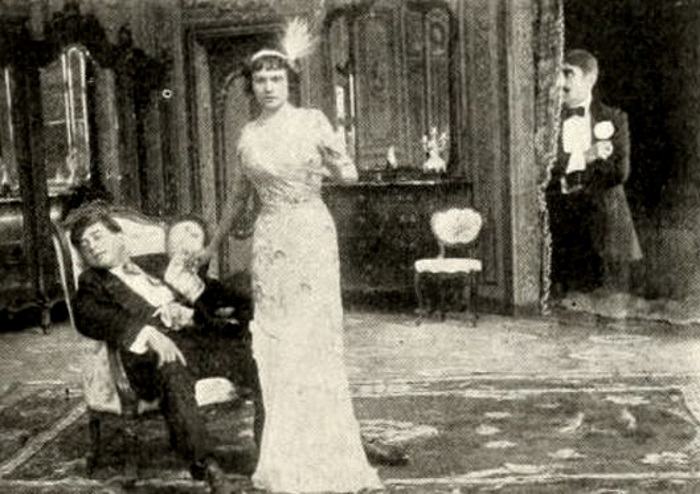
Vienna’s interiors—actually Turin’s Teatro Nuovo repurposed—ooze gaslit decadence: roulette wheels spin like praying mantises, champagne flutes catch the chandelier’s fractured rainbow, and every doorway frames a potential trap. Daleza’s mise-en-scène revels in vertical shadows that slash across bodies, a graphic premonition of 1940s film noir. Bernard’s hold over Lydia is shown via superimposition: her translucent doppelgänger floats slightly out of sync, a visual whisper that someone else steers the wheelhouse of her will.
Lydia, essayed by the ethereally poised Edoardo Davesnes (yes, a female role enacted by a male actor in proto-drag, a casting choice common in pre-1913 Italian cinema), begins as a decorative lamb—eyes downcast, hands folded like shut lilies. Under Bernard’s spell she becomes a sleepwalker in Parisian chiffon, gliding through the gambling den to deliver the narcotic goblet. Yet notice the micro-gestures Davesnes embeds: a tremor at the corner of the lip, fingers that flutter against silk as though testing the prison bars of her own skin. When Bernard collapses from the pistol-whip and the trance snaps, the transformation is seismic: shoulders square, pupils contract, the lamb discovers claws. It is one of the silent era’s most subtle depictions of trauma recovery—and all without a single spoken syllable.
Vernon, the flaxen-haired English tourist, arrives as comic relief—until the screenplay strips him of every farthing and nearly his life. His escape from the gaming-club window, improvised from braided damask curtains, foreshadows Fairbanks acrobatics yet carries the existential chill of Kafka: a man fleeing a creditor he cannot name. Actor Luciano Daleza (doubling behind the lens) lets the camera linger on Vernon’s mud-splattered evening wear as he staggers across the cobblestones, re-learning gravity. The moment he rouses the constabulary, the film shifts from chamber potboiler to urban thriller, prefiguring Lang’s Dr. Mabuse cycle.
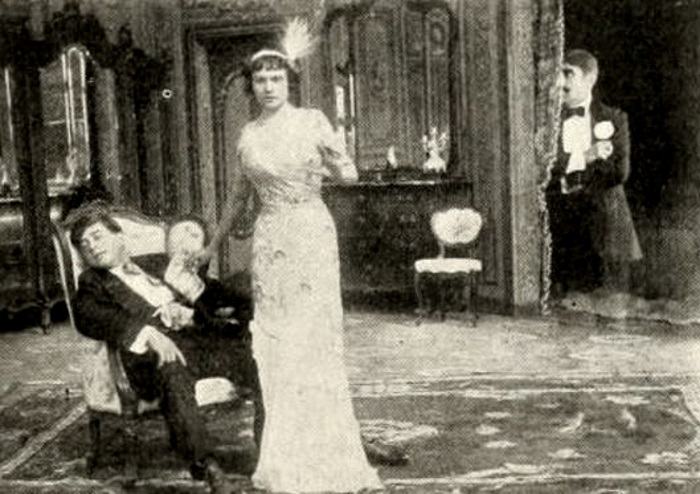
The finale—in the timbered tavern where Alberti and Bernard haggle over blood-money—unleashes a pistol duel worthy of Kleist. Daleza cross-cuts like a pulse: close-up of Bernard’s thumb riffling banknotes; medium shot of Alberti’s temple glistening; insert of Lydia’s silhouette in the doorway, hair loose like Medusa’s snakes. When the bullet cracks Bernard’s sternum, the film performs its own abrupt hypnosis-break. Bernard’s death is not tragic; it is bookkeeping. Alberti’s subsequent heart failure upon seeing Lydia—believing her a revenant—reads like a moral invoice stamped PAID IN FULL. Yet the censors of 1912 would have smirked: justice here is cosmic accident, not divine intervention.
Restored prints reveal the original’s sophisticated tinting: aquamarine for Adriatic sequences, sickly amber for Vienna gambling halls, rose for the lovers’ coda. The photochemical blues make the sea a living antagonist—waves pulse like jugular veins. Meanwhile, the mise-en-scene weaponises vertical lines: oars, table legs, door frames, all conspire to pen Lydia inside a lattice of male design. When she finally crosses the threshold of Alberti’s hotel room, the camera tilts ever so slightly, diagonals destabilise, the cage door swings.
Modern screenings often commission new scores. I recommend a minimalist trio—piano, viola, musical saw—to accentuate Bernard’s mesmeric pendulum. When Lydia reclaims agency, let the viola slide into a whole-tone scale; the uncanny interval tells the stomach something is writhing free even if the eye cannot name it.
Place The Mysteries of Souls beside Trilby (1914) or The Love Tyrant (1912) and you’ll see a continental fascination with hypnosis as sexual piracy. Yet Daleza’s film is colder, more capitalist: Bernard doesn’t crave the woman, merely the leverage she embodies. In the wake of Luigi Russolo’s The Art of Noises (1913), one can even read the film’s final gunshot as an anticipatory cymbal crash in the cacophonous century to come.
A male performer enacting female fragility complicates the male gaze. The audience’s awareness of artifice—those sinewy wrists, the adam’s apple half-hidden by lace—renders Lydia’s victimisation at once hyper-stylised and doubly voyeuristic. We aren’t watching a woman abused; we are watching a man perform the spectacle of feminine helplessness for other men. The hypnosis thus becomes meta-cinema: the director literally directing a “female” body to obey, exposing the apparatus of patriarchal control that underpinned early film production itself.
Only two 35 mm nitrate prints are known to survive: one at the Cineteca di Bologna (missing reel #3) and a near-complete 16 mm reduction print at the BFI, transferred with variable-density soundtrack ambiance. A 2K restoration toured in 2019; Kino Lorber has hinted at a Blu-ray pairing with The Mystery of the Black Pearl. Given the public-domain status in most territories, a 4K scan could surface on archive.org sooner than any boutique label. Streamers beware: cropped 480p rips circulate that excise the pivotal superimposition, reducing Bernard’s hypnotic overlay to a ghost smudge.
Is the film flawless? Hardly. The stuttering exposition relies on intertitles so purple they bruise. Fritz, Bernard’s henchman, is ethnic caricature stitched from lazy shorthand. Yet these creases belong to the era’s fabric; pull the thread and you unravel cinema’s birth-veil itself. What remains is a tale that gnaws the marrow: property versus personhood, trance versus autonomy, the way money metastasises into moral necrosis.
Watch it at midnight with the windows open. Let the Adriatic wind rattle the blinds. When Lydia’s silhouette reappears in that doorway, ask yourself: who among us is still rowing a sabotaged skiff, and who has truly broken the spell?
IMDb 5.8
1922
Community
Log in to comment.